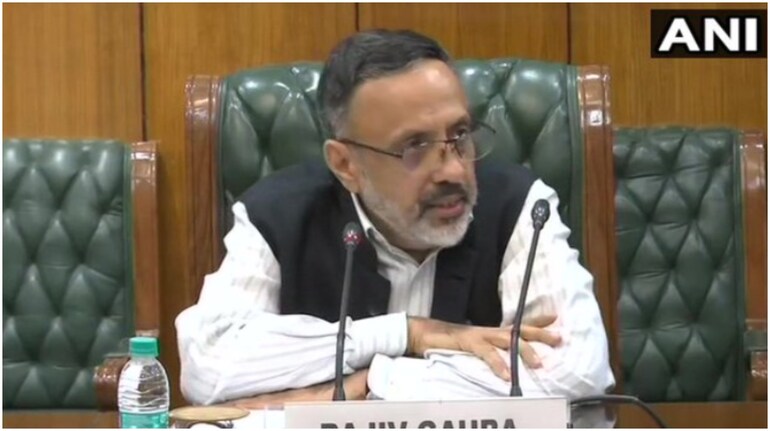
Pausing Quality Control Orders (QCOs) on raw materials and capital goods, relaxing registration and licensing norms of businesses, simplifying GST return filing, as well as maintaining policy stability, are the key recommendations of the NITI Aayog panel, headed by former Cabinet Secretary Rajiv Gauba, according to sources privy to the matter.
The panel headed by Gauba, currently a Member of NITI Aayog, was constituted in August. It has been tasked with reviewing non-financial regulatory reforms, with an objective of enhancing ease of doing business and cutting down the compliance burden of enterprises.
The Gauba-headed panel has finalised a report, which is yet to be released to the public. Government sources aware of the deliberations tell Moneycontrol that it has proposed a radical overhaul of several regulatory frameworks, and the report may be released to the public by the end of December. “As of now, the report has been shared with the ministries concerned,” one official said.
‘Reduce compliance, ease registration process’
According to sources, the report has suggested scrapping the mandatory CSR (Corporate Social Responsibility) requirement for MSMEs, simplifying GST return filing, and raising the threshold for a definition of a “small company” to more than Rs 100 crore.
The report has recommended reducing mandatory board meetings and audit burdens for smaller firms, cutting penal interest on delayed GST payments from 18% to 12%, and reducing documentation for new business registrations.
For agencies such as the Food Safety and Standards Authority of India (FSSAI) and the Bureau of Indian Standards (BIS), the report has recommended moving away from complex licence-and-inspection regimes to simpler two-tier standards systems.
Sources say MSMEs are burdened with compliance, as the report notes that several units have over 1,400 compliance issues per year and about 40 regulatory changes to monitor daily.
On licensing, the report states that licensing and compliance requirements shall be proportionate and graded by risk. Prior approvals in the form of license, permit, NoC, et cetera, shall be required only for reasons of national security, serious harm to public safety, human health, or environment or significant public interest, and only as provided under the statute.
The panel has further recommended that inspections of businesses should be based on computer-assisted randomised selection and risk assessment, and shall be conducted by accredited third parties, as a norm.
On policy changes, the panel says that there shall be a fixed calendar for regulatory updates, that is, changes/ amendments shall be introduced on a fixed date every year unless deemed necessary for compelling reasons.
On quality control orders, the panel has recommended deferring the implementation of upcoming QCOs and cross-sector technical standards (OTRs) for raw materials and capital goods, Moneycontrol had reported on November 14.
A QCO is a legal directive issued by a Ministry that makes compliance with a specific Indian Standard (IS), as established by the Bureau of Indian Standards (BIS), mandatory for certain products. Products covered under a QCO must obtain a BIS license and use the standard mark (like the ISI mark) to be legally manufactured, imported, distributed, or sold in India.
The report said that these measures should first be reviewed by the Inter-Ministerial Group (IMG), as their premature rollout could increase compliance burdens on manufacturers and MSMEs, as well as slow down investment in clusters dependent on imported intermediaries.
Many of these draft QCOs cover broad, generic industrial products, unlike similar international norms, and such wide mandates can potentially cause delays in approvals, making it harder for companies to access affordable capital goods, the report said.
The Centre has already begun taking steps in this direction. On November 13, 14 QCOs covering key sectors such as chemical, plastics and textiles were withdrawn. The pause will come with immediate effect from the date of Gazette publication, without any transition delay.
"While the fine print of the document is awaited, by moving towards a trust-based regulatory framework that eliminates redundant licences, permits and inspector-raj type compliance, India can possibly unlock significant ease-of-doing-business gains," said Rishi Shah, Partner and Economic Advisory Services Leader, Grant Thornton Bharat.
"If implemented in the right spirit, these reforms could materially lower compliance costs and friction, potentially providing the kind of ‘escape velocity’ in private sector growth needed to avoid the middle-income trap and sustain higher growth," he added.
Relax FDI restrictions
Meanwhile, besides these reforms, the Rajiv Gauba panel has discussed easing foreign direct investment (FDI) norms, including those imposed on China. According to sources, the panel recommended tweaking provisions of Press Note 3 (PN3) – which would relax government scrutiny of FDI inflows from China and other border countries.
The Central government had introduced PN3 in April 2020 to ward off any attempt at opportunistic takeover or acquisition of Indian companies. The circular states that an entity of a country sharing land border with India or where the beneficial owner of an investment in India is situated in, or is a citizen of any such country, can invest only through the government route.
Moneycontrol reported on November 24 that FDI from China into India’s electronics and consumer durables sector may soon become easier. According to sources, a draft Cabinet note has been finalized, and comments have been sought from all relevant ministries.
The draft note includes three key changes. First, if an Indian company receives up to 49% FDI, it will no longer undergo extensive security. Second, the proposed exemption applies only to the selected sectors — preferably electronics and capital goods sectors. This means that FDI up to 49% in companies operating in these sectors will not require deep scrutiny even if the investment comes from countries sharing a land border with India, including China.
And third, a significant proposed change relates to the definition of “beneficial ownership.” According to sources, the draft note suggests aligning the definition with the rules under the Prevention of Money Laundering Act (PMLA).
Discover the latest Business News, Sensex, and Nifty updates. Obtain Personal Finance insights, tax queries, and expert opinions on Moneycontrol or download the Moneycontrol App to stay updated!
Find the best of Al News in one place, specially curated for you every weekend.
Stay on top of the latest tech trends and biggest startup news.