




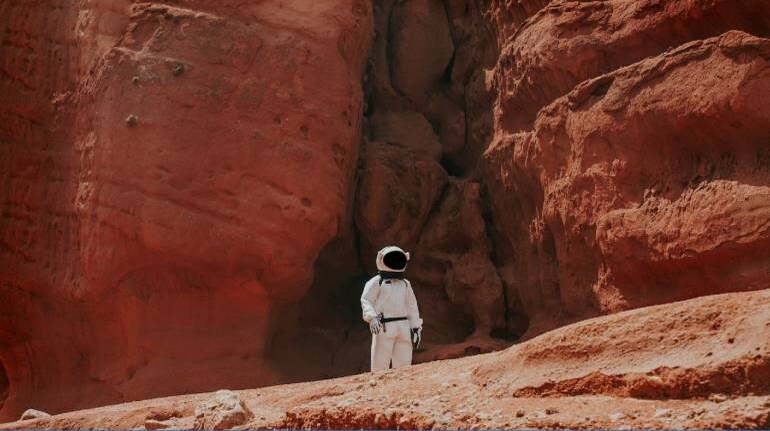
To make life on Earth better, we can perhaps learn from space.
A once-in-a-century health scare, in the form of COVIID-19, has redefined the hazards of living in the contemporary world, which has been further buffeted by the geopolitical crisis triggered by the Russia-Ukraine war.
If the pandemic had disrupted global supply chains and pushed up commodity prices, the continued tension between the two CIS (Commonwealth of Independent States) nations, where a quick victory has eluded Russian President Vladimir Putin, is threatening to harden interest rates on the back of hyperinflation and trigger a currency war.
It is during these hard times that Chris Hadfield’s An Astronaut’s Guide to Life on Earth can provide the right perspective to better understand and tackle such aberrations in life. The book draws from the experiences of an astronaut’s life, and its observations can better equip the human race to face myriad professional and personal challenges, including investment choices, during a crisis situation.
Here are a few interesting thoughts and ideas from the book.
Be prepared for unpredictable scenarios
The single-most striking thing about the book is the author’s emphasis on the state of preparedness. One should think of different scenarios and expect the unpredictable.
In certain activities, the margin of error is very low and, therefore, the state of preparedness is very crucial.
“In the ocean, things can go wrong in one breath, and the stakes are life or death. That’s why in order to get a scuba licence you have to do a bunch of practice dives and learn how to deal with a whole set of problems and emergencies so that you’re really ready, not just ready in calm seas,” writes Hadfield.
“For the same sort of reasons, trainers in the space program specialise in devising bad-news scenarios for us to act out, over and over again, in increasingly elaborate simulations.”
This is why training matters a lot for astronauts. They practise different adverse scenarios, such as an engine failure, a computer snag or an explosion. They are trained and forced to confront failures and difficulties, study them in details, dissect all the components, and learn how everything work and respond to different scenarios.
Likewise, the human race should always be prepared to face any sort of adversity.
Responding to situations
It is not just preparedness, but the attitude to deal with a problem that is equally important. Their training encompasses emotional balance and helps them build an attitude. Handling emotion and working on it to make prudent and logical decisions in situations that require precision are part of their training.
“Our training pushes us to develop a new set of instincts: instead of reacting to danger with a fight-or-flight adrenaline rush, we’re trained to respond unemotionally by immediately prioritising threats and methodically seeking to defuse them. We go from wanting to bolt for the exit to wanting to engage and understand what’s going wrong, then fix it,” the author writes.
Dealing with fear
While controlling emotions and responding rationally in times of dangers are parts of the survival story, the book underscores the value of knowledge and how it can help remove fear.
“In my experience, fear comes from not knowing what to expect and not feeling you have any control over what’s about to happen. Feeling helpless, you’re far more afraid than you would be if you knew the facts. If you’re not sure what to be alarmed about, everything is alarming.”
Knowledge can remove uncertainty
Knowledge can actually lift the veil of uncertainty and uncover many hidden independent variables that lead to fear.
“People tend to think astronauts have the courage of a superhero — or maybe the emotional range of a robot. But in order to stay calm in a high-stress, high-stakes situation, all you really need is knowledge. Sure, you might still feel a little nervous or stressed or hyper-alert. But what you won’t feel is terrified. Anticipating problems and figuring out how to solve them is actually the opposite of worrying: it’s productive.”
Hadfield’s words echo Warren Buffett’s thoughts, where the Oracle of Omaha says, “Risk comes from not knowing what you're doing.”
Taking criticism well
The bulk of an astronaut’s job is learning. One needs to be flexible and ready to listen to keep on learning and moving up the ladder. Criticism, feedbacks, and other modes of communications can be valuable in the learning process. These should not be ignored because of personal bias or any other reason.
“Our safety depends on many tens of thousands of people we’ll never meet, like the welders in Russia who assemble the Soyuz, and the North American textile workers who fabricate our spacesuits. And our employment depends entirely on millions of other people believing in the importance of space exploration and being willing to underwrite it with their tax dollars.”
“We work on behalf of everyone in our country, not just a select few, so we should behave the same way whether we’re meeting with a head of state or a seventh-grade science class. Frankly, this makes good sense even if you’re not an astronaut. You never really know who will have a say in where you wind up. It could be the CEO. But it might well be the receptionist.”
Visualising defeat to ensure victory
Unless you know how to encounter defeat, you will not be able to thwart it.
“My optimism and confidence come not from feeling I’m luckier than other mortals, and they sure don’t come from visualising victory. They’re the result of a lifetime spent visualising defeat and figuring out how to prevent it,” says Hadfield.
Are you ready?
There is emphasis on the preparedness of an astronaut. For them, being ready does not mean ticking a few check points. It means a lot more. They apply inverse thinking, an idea similar to what Charlie Munger has been suggesting in investing.
“Feeling ready to do something doesn’t mean feeling certain you’ll succeed, though of course that’s what you’re hoping to do. Truly being ready means understanding what could go wrong—and having a plan to deal with it.
It is painful to think what can go wrong but, if applied to any situation or profession, has its own merits in dealing with situations and being truly ready.
You can only improve your odds
Under no circumstance, you would like to meet a pessimist or be a pessimist yourself. But having a pessimistic view and constructing thoughts around it could help in enhancing knowledge and preparedness.
“It sounds strange, probably, but having a pessimistic view of my own prospects helped me love my job. I’d argue it even had a positive effect on my career: because I love learning new things, I volunteered for a lot of extra classes, which bulked up my qualifications, which in turn increased my opportunities at NASA. However, success, to me, never was and still isn’t about lifting off in a rocket (though that sure felt like a great achievement).”
“Success is feeling good about the work you do throughout the long, unheralded journey that may or may not wind up at the launchpad. You can’t view training solely as a stepping stone to something loftier. It’s got to be an end in itself”
So, being better prepared means the odds are in your favour.
One hopes An Astronaut's Guide to Life on Earth provides the launchpad for a successful lift-off in life,
For more research articles, visit our Moneycontrol Research Page.
Discover the latest Business News, Sensex, and Nifty updates. Obtain Personal Finance insights, tax queries, and expert opinions on Moneycontrol or download the Moneycontrol App to stay updated!
Find the best of Al News in one place, specially curated for you every weekend.
Stay on top of the latest tech trends and biggest startup news.