






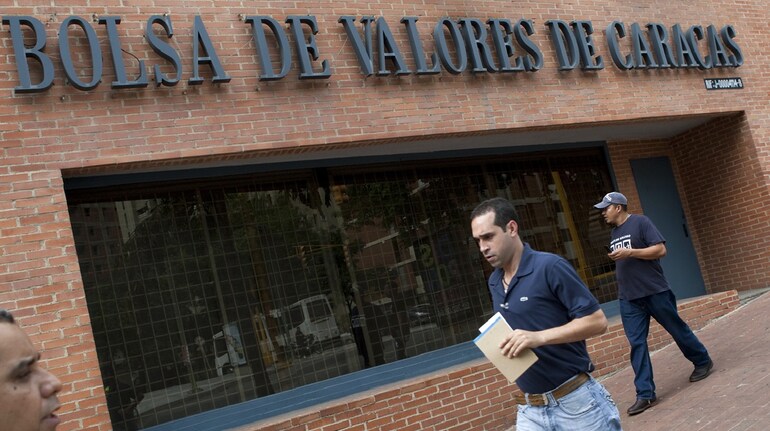

The Caracas Stock Exchange, in Venezuela, on January 5 closed with a nearly 17% increase, in reaction to the capture of President Nicolas Maduro by the United States.
The index rocketed 16.45% on January 5, closing at 2,597.7 (intraday high: 2,621.8), the biggest one-day gain in years.
The magnitude of the move suggests investors are interpreting recent developments as a potentially constructive shift for Venezuela’s political and economic outlook.
Bolsa de Valores de Caracas (BVC), founded in 1947, in reality, trading covers about 15 companies. This is the smallest stock exchange in South America.
Trading volumes did not exceed $1 million per day last year.
Venezuelan sovereign and state-run oil company PDVSA bonds have rallied on hopes of regime change and debt restructuring after Maduro’s capture.
Prices of defaulted Venezuelan sovereign bonds and notes issued by state oil firm PDVSA have already more than doubled in recent months, rising to about 23–33 cents on the dollar as US President Donald Trump intensified pressure on Maduro. Although still a distant possibility, investors said the chance of a future debt restructuring, a crucial step to attract fresh capital, could push recovery values higher, potentially into the 50–60 cent range, Reuters reported on January 5.
Trump said at a press conference on Saturday that the United States would oversee Venezuela until a leadership transition is arranged. He added that governance would be handled “by a group” largely made up of senior US officials, with a focus on restoring the country’s oil infrastructure.
Resolving Venezuela’s debt remains complex. The nation must address around $154 billion in defaulted bonds, loans and court rulings owed to a wide range of creditors, from Wall Street investors to Russia. Any restructuring, according to Gramercy’s Koenigsberger, is unlikely to happen until a permanent government is established.
Venezuela began defaulting on its obligations in 2017, two years before the US severed relations with Maduro’s administration and barred US investors from purchasing Venezuelan debt.
JPMorgan Chase & Co. reinstated the bonds in its major indices after secondary trading sanctions were lifted in 2023.
Since then, Venezuelan bonds have become one of the most lucrative trades among emerging markets, with returns accelerating last year amid rising investor appetite for risk. Other high-yield sovereign debt from countries that have implemented reforms or emerged from default, such as Lebanon and Ukraine, also posted strong gains in 2025.
Investors are closely watching the role of Venezuelan Vice President Delcy Rodriguez. Trump said Secretary of State Marco Rubio had been in contact with her and expressed confidence in her cooperation, which raised expectations of a smoother political transition.
However, just hours later, Rodriguez publicly called for Maduro’s return to power, describing the US actions as “barbaric.”
With inputs from ReutersDiscover the latest Business News, Sensex, and Nifty updates. Obtain Personal Finance insights, tax queries, and expert opinions on Moneycontrol or download the Moneycontrol App to stay updated!
Find the best of Al News in one place, specially curated for you every weekend.
Stay on top of the latest tech trends and biggest startup news.





