


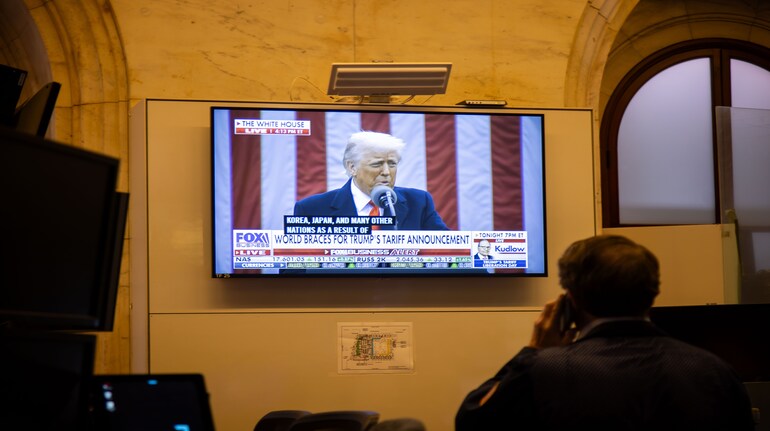
Roughly $1.7 trillion is set to be erased from the S&P 500 Index when trading opens Thursday amid worries that President Donald Trump’s sweeping new round of tariffs could plunge the economy into a recession.
The damage was heaviest in companies whose supply chains are most dependent on overseas manufacturing. Apple Inc., which makes the majority of its US-sold devices in China, is on track to open down 7.7%. Lululemon Athletica Inc. and Nike Inc., among companies with manufacturing ties to Vietnam, are down at least 9%. Walmart Inc. and Dollar Tree Inc., retailers whose stores are filled with products sourced outside of the US, are trading at least 4% lower.
Few stocks in the US were unscathed with the biggest ETF tracking the S&P 500 on pace for its biggest decline since 2022. More than 90% of companies in the S&P 500 were trading lower at 8 a.m. in New York, with over half of its 500 stocks down at least 2% in premarket trading.
“The market is realizing that there is pretty much no way to spin this as a positive,” said Steve Sosnick, chief strategist at Interactive Brokers. “Here we are with a substantial selloff on our hands abetted somewhat by traders whose commitment to buy every dip left them wrong-footed.”
The breadth and severity of the levies dwarfed those imposed by Trump during his first term, threatening to upend global supply chains, exacerbate an economic slowdown and boost inflation. It also left investors struggling to game out what levies would do to corporate profits.
The plan is equivalent to the largest tax increase since 1968, JPMorgan economist Michael Feroli wrote in a note. It could add as much as 1.5% to prices this year, using the Federal Reserve’s preferred inflation gauge, while weighing on personal incomes and consumer spending.
“This impact alone could take the economy perilously close to slipping into recession,” Feroli wrote. “And this is before accounting for the additional hits to gross exports and to investment spending.”
If Apple, for example, were to absorb the jump in costs as a result of tariffs on China, the iPhone maker’s gross margin could take a hit of as much as 9%, said Citigroup analysts led by Atif Malik.
US assets quickly emerged as the biggest losers after the announcement. Equity index futures tumbled more than 3.3%, and a gauge of the dollar slumped. The impact elsewhere was muted in comparison: A broad gauge of Asian stocks fell 0.6% and the Stoxx Europe 600 slid 2.4%, while the euro rose 2.3% against the dollar.
Semiconductor and industrial companies also came in for a beating. An exchange-traded fund tracking the Philadelphia Semiconductor Index sank 4.6% with Nvidia Corp., Broadcom Inc., and Micron Technology Inc. pacing declines. Caterpillar Inc. and Boeing Co., which get a big chunk of sales from China, dropped at least 4%.
Apple led declines among the Magnificent Seven stocks with a 7.7% drop. The group, which also includes the likes of Tesla, Microsoft, Nvidia, Alphabet, Amazon.com, and Meta Platforms, has been responsible for much of the US stock market’s gains over the last two years.
“We see 5,300 as the near-term target for the S&P 500, but if tariff uncertainty persists or negotiations with trading partners don’t go well, risks of downside through 5,000 become real,” UBS Group AG’s Bhanu Baweja wrote in a note to clients. “The probability of US stocks entering bear market is going higher.”
Discover the latest Business News, Sensex, and Nifty updates. Obtain Personal Finance insights, tax queries, and expert opinions on Moneycontrol or download the Moneycontrol App to stay updated!
Find the best of Al News in one place, specially curated for you every weekend.
Stay on top of the latest tech trends and biggest startup news.