

Over the last few months, India’s macro puzzle has steadily fallen into place. It began with the rationalisation of GST rates, quietly improving cost structures across consumption-heavy sectors. Then, after nearly two decades of negotiations, the India–EU Free Trade Agreement was finally concluded, linking India to one of the world’s largest and most stable trading blocs. Soon after, the Union Budget 2026 laid out a clear, manufacturing-first roadmap. And finally, after months of noise, uncertainty, and tariff anxiety, the India–US trade framework arrived.
Markets dislike uncertainty more than bad news. And for most of 2025, uncertainty was the dominant theme. This week, that cloud has lifted. The US tariff rate settling at 18% may not be ideal, but it is materially better than feared and, more importantly, it gives Indian exporters relative parity versus key Asian peers. The European Union (EU) deal diversifies India’s Western trade exposure. GST 2.0 improves demand elasticity. And the Budget reinforces a long-term manufacturing and capex cycle. Put together, this isn’t about one big bang announcement - it’s about multiple smaller tailwinds aligning at the same time.
That alignment explains why sentiment has turned decisively positive. But here’s the part seasoned investors must remember: markets usually move ahead of fundamentals. Policy clarity provides fuel, but earnings delivery decides how far the rally runs.
So, what should investors do now?
This is the phase where discipline matters more than optimism. With indices near all-time highs, much of the “good news” is already reflected in prices. Future returns will not come from rerating alone. They will come from earnings growth, margin expansion, fair valuation and capital efficiency.
After years of watching cycles, I have noticed one pattern repeats itself. When macro uncertainty fades, investors rush in. But only a subset of companies is actually able to convert policy tailwinds into profits. These are the firms with scale, execution capability, balance-sheet strength, and pricing power. That’s where capital should concentrate.
Think of this phase not as a frenzy, but as a filtration process. The easy money has been made by buying fear. The next leg up belongs to businesses that can show strong fundamentals.
Patience is the most underrated edge here. Time spent in the market, combined with selective positioning, beats aggressive churn. Expectations should remain realistic - this is a sentiment reset, not a guarantee of runaway returns.
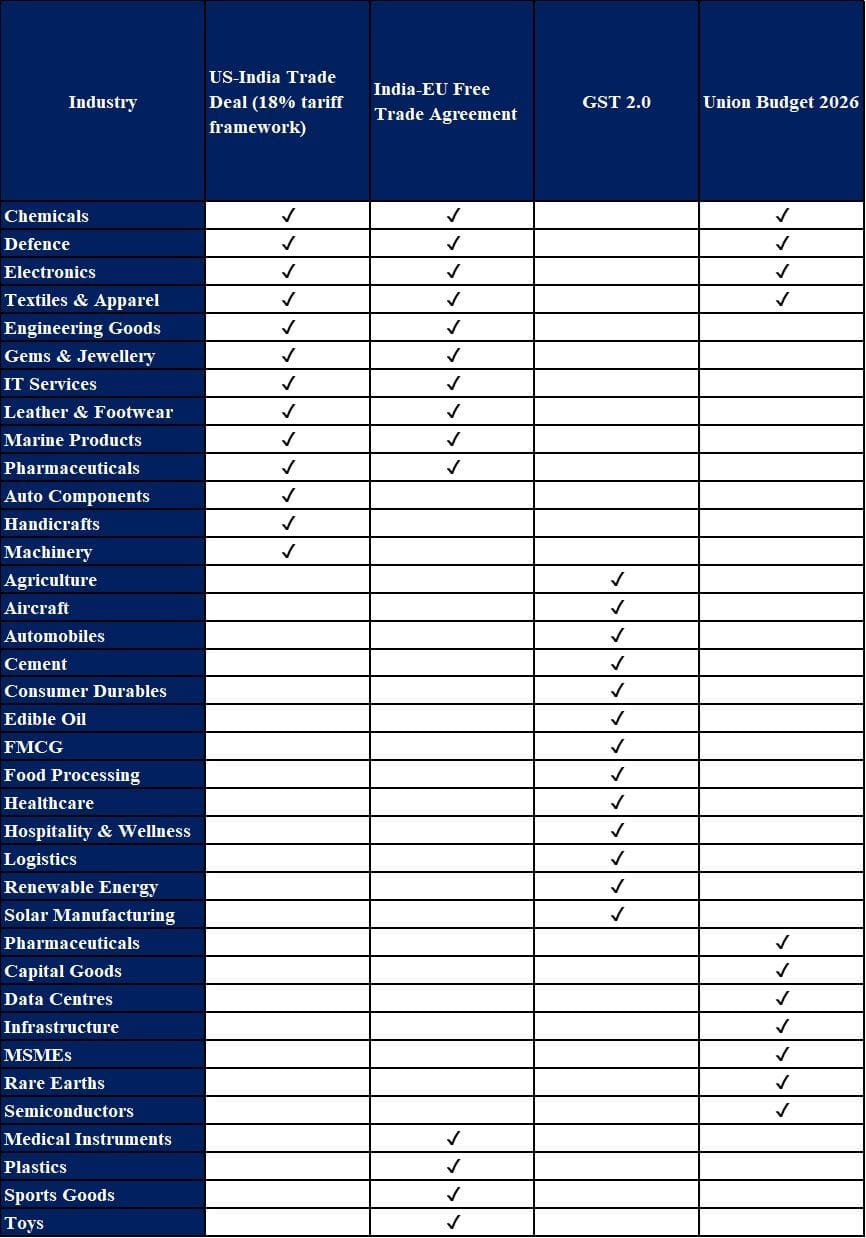
Most importantly, investors should align portfolios with sectors that are direct beneficiaries of the recent macro shifts. Below is a table to think about where the winds are blowing to be most favourable.
Here are Major Macro Events and Key Sector Beneficiaries
If January was the last meaningful dip, it wasn’t because markets suddenly became cheap. It was because India entered a phase where policy risk fell sharply, and execution took centre stage. The smart investor’s job now is not to predict headlines, but to back businesses that can quietly compound through this new cycle.
Where the Market Draws the Line
As macro visibility improves, the market’s tolerance for weak execution will narrow sharply. In periods of uncertainty, intent is often rewarded - expansion plans, policy alignment, long-duration narratives. In a stable macro environment, delivery (execution) replaces intent as the pricing mechanism.
The market will increasingly differentiate between growth and quality. It will reward businesses that deliver volume-led growth with pricing power, convert capex into higher returns on capital, and translate reported profits into real cash flows. At the same time, it will penalise revenue growth that erodes margins, expansion that fails to lift ROCE, and earnings that do not show up on the balance sheet.
Importantly, corrections from here are less likely to be macro-led. They will be company-specific, driven by execution slippage, margin disappointment, or poor capital allocation. Stability at the top-down level accelerates scrutiny at the bottom-up level.
In such an environment, competence compounds - and mediocrity gets repriced faster.
The story has shifted.
From uncertainty to execution.
From macro hope to micro results. And that’s usually when the real wealth gets built.
Disclaimer: The views and investment tips expressed by experts on Moneycontrol are their own and not those of the website or its management. Moneycontrol advises users to check with certified experts before taking any investment decisions.
Discover the latest Business News, Sensex, and Nifty updates. Obtain Personal Finance insights, tax queries, and expert opinions on Moneycontrol or download the Moneycontrol App to stay updated!
Find the best of Al News in one place, specially curated for you every weekend.
Stay on top of the latest tech trends and biggest startup news.