India’s equity cash market has recorded its steepest annual decline in turnover in three years, highlighting a slowdown in investor participation amid heightened volatility and weak market breadth. Derivatives volumes across both domestic exchanges also declined during the year.
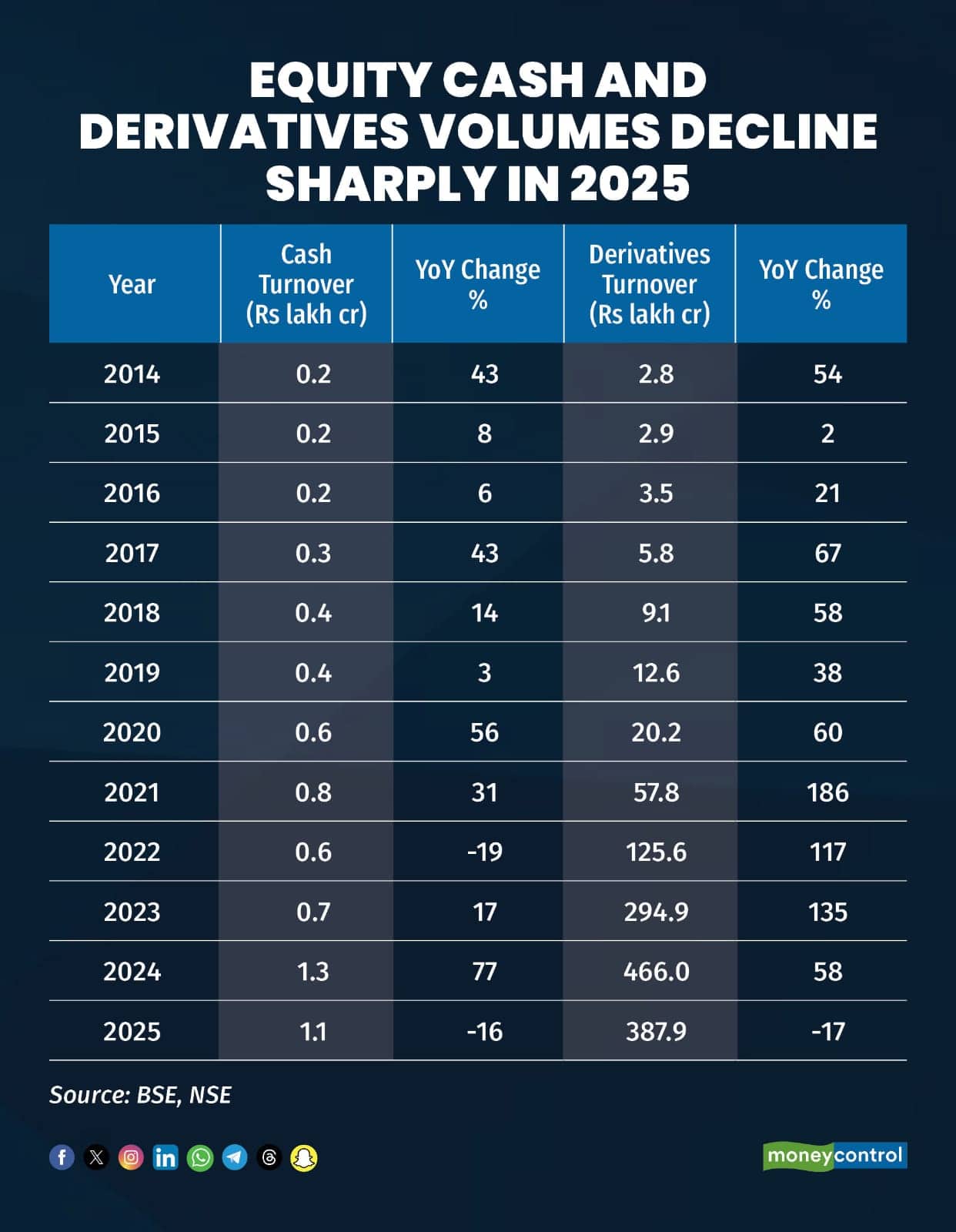
The combined average daily turnover of the NSE and BSE in the cash segment fell to Rs 1.08 lakh crore so far in 2025, a decline of 15.77 percent from Rs 1.28 lakh crore in 2024. This marks the sharpest annual contraction in cash market turnover since 2022, according to data released by the exchanges.
Derivatives trading also witnessed a sharp slowdown during the year. The combined derivatives volumes of the NSE and BSE declined for the first time since 2013, the earliest year for which comparable data is available. The 16.7% decline in trading volumes is attributed largely to tighter regulatory norms in the derivatives segment. Exchange data showed that the combined futures and options turnover fell 17.7% year-on-year so far in 2025 to Rs387.95 lakh crore from Rs465.96 lakh crore.
Market participants said that while activity in primary markets and block deals remained resilient, direct investor participation in the secondary market weakened amid muted returns over the past year. Persistent selling by foreign investors, stretched valuations and geopolitical uncertainties, including trade war concerns, weighed on market sentiment and trading appetite.
So far in 2025, benchmark indices Sensex and Nifty have gained about 10 percent each. However, broader markets showed divergent trends, with the BSE MidCap index rising 0.5 percent, while the BSE SmallCap index declined 9 percent, reflecting uneven investor interest beyond frontline stocks.
Participants also pointed to elevated securities transaction tax as a continuing drag on cash market activity, discouraging participation from ultra-high-net-worth individuals and institutions. Rising transaction charges and taxes further impacted trading returns, prompting some investors to shift activity toward primary market offerings.
The decline in volumes was attributed primarily to regulatory tightening by the Securities and Exchange Board of India aimed at curbing speculative and high-frequency options trading. Measures such as higher lot sizes, additional margin requirements, fewer weekly expiries and the removal of certain spread benefits reduced the viability of turnover-intensive intraday strategies. Market participants also cited the exit of major liquidity providers as a factor impacting sentiment.
Discover the latest Business News, Sensex, and Nifty updates. Obtain Personal Finance insights, tax queries, and expert opinions on Moneycontrol or download the Moneycontrol App to stay updated!
Find the best of Al News in one place, specially curated for you every weekend.
Stay on top of the latest tech trends and biggest startup news.