
The RBI Governor’s larger-than-expected rate cut of 50 bps along with a 100 bps cut in the Cash Reserve Ratio for banks - seen as a step to boost domestic demand – has triggered a sharp rally in rate-sensitive shares, taking key indices higher.
Historically, significant rate cuts have had varied effects on market performance over different timeframes in the past, but the trend has mostly been positive. For instance, in September 2015, a similar 50 bps rate cut led to a rally over the following month, with the Sensex and Nifty rising by 4.1 percent and 3.4 percent respectively, while the BSE Midcap and Smallcap indices rose 3.5 percent and 4.6 percent.
After the MPC meetings in March and May 2020, amid the COVID-19 crisis, RBI rate cuts of 50 and 40 basis points initially elicited a muted reaction, however, markets subsequently surged on both instances after the rate cuts. The Sensex and Nifty rose over 14 percent each after in May 2020 decision, while broader BSE Mid and Smallcap indices up more than 16 percent and 18 percent respectively within a month of the rate cut. A similar trend was seen after the March 2020 rate cut, with Nifty and Sensex higher by close to 8 percent a month after the cut.
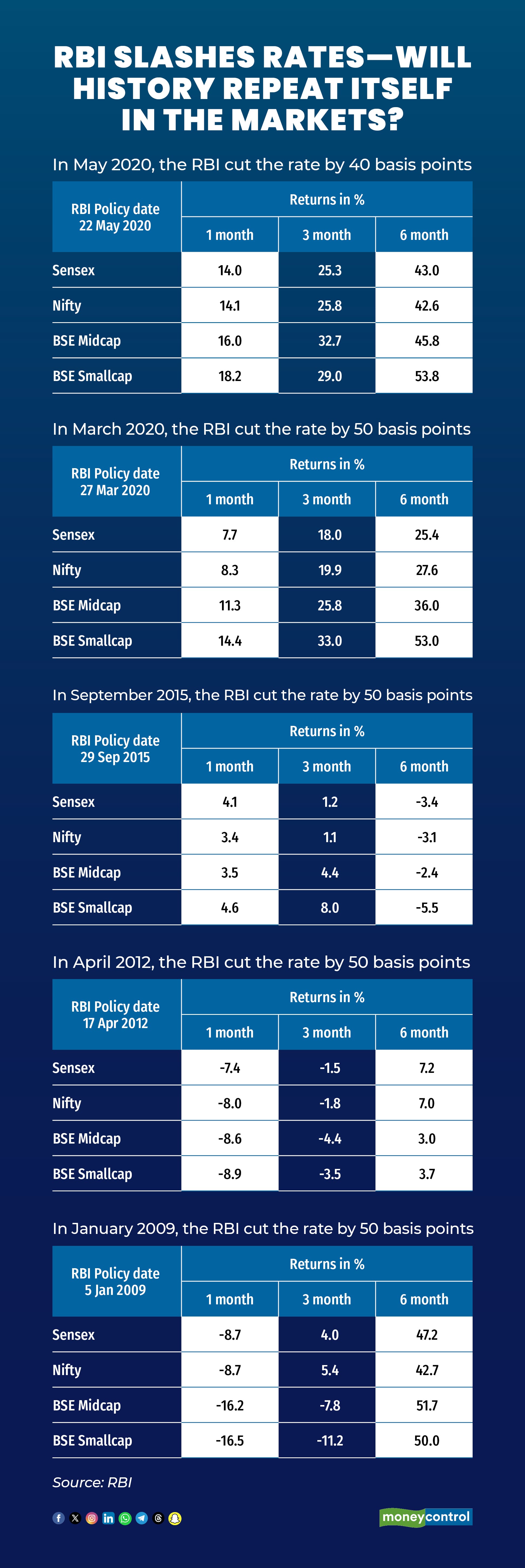
By contrast, the rate cuts in January 2009 and April 2012 - delivered amid slowing domestic growth and the global financial crisis - had triggered an initial downturn. A month after the 50 bps reductions, markets were down around 8 percent on both occasions. Infact, the BSE Mid and Smallcap indices fell by 16 percent after the January 2009 rate cut. Subsequently, a partial recovery followed within three months, and by the six-month mark, markets had fully rebounded and were trading higher on both instances.
RBI MPC meeting live: MPC has limited scope to boost growth, says governor Sanjay Malhotra
Market experts said that while rate cuts typically lower borrowing costs and stimulate both business investment and consumer spending - particularly in capital expenditure and consumer durables - the current environment is sending mixed signals.
Independent analyst Deepak Jasani said although a modest upside of 3 to 4 percent remains possible for the markets, elevated valuations and weak earnings could cap gains. He also cautioned that such an aggressive rate cut might reflect deeper concerns about slowing growth amid geopolitical tensions.
Still, analysts are seeing the RBI’s move as a constructive signal, particularly in the light of emerging signs of softer demand in the domestic sector, and the rate cut underscores the central bank’s confidence in the economy’s fundamentals and its commitment to support growth.
Disclaimer: The views and investment tips expressed by investment experts on Moneycontrol.com are their own and not those of the website or its management. Moneycontrol.com advises users to check with certified experts before taking any investment decisions.Discover the latest Business News, Sensex, and Nifty updates. Obtain Personal Finance insights, tax queries, and expert opinions on Moneycontrol or download the Moneycontrol App to stay updated!
Find the best of Al News in one place, specially curated for you every weekend.
Stay on top of the latest tech trends and biggest startup news.