






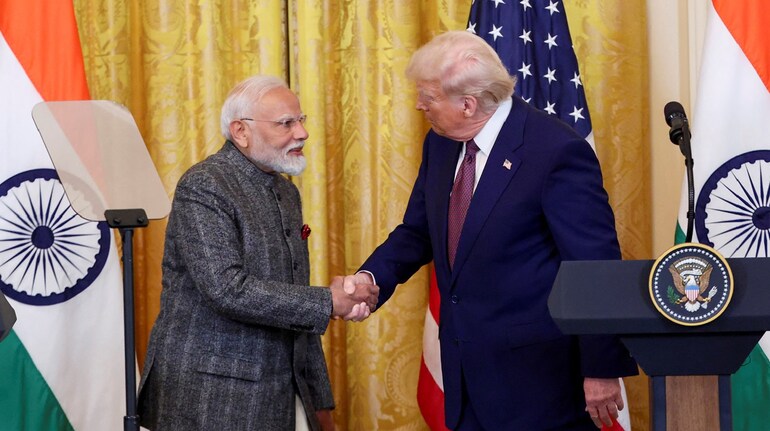

Indian markets are set for a strong start to the February 3 trading session after India and the United States announced a long-awaited trade deal that cuts reciprocal tariffs and eases a major source of uncertainty that has weighed on investor sentiment for months.
US President Donald Trump said late on February 2 that Washington had reached an agreement with New Delhi following a phone call with Prime Minister Narendra Modi. Under the deal, the US has reduced its reciprocal tariff on Indian goods to 18% from 25% with immediate effect, while India has committed to lowering tariffs on American products, removing non-tariff barriers and increasing purchases of US energy, technology, agricultural products and coal.
Early market signals point to a positive opening, with GIFT Nifty jumping 677 points in overnight trade, reflecting expectations of short covering and improved risk appetite. Traders and analysts said the deal could help reset sentiment after a bruising January marked by foreign outflows, currency pressure and concerns over rising transaction costs in derivatives markets.
Export-oriented sectors such as automobiles, textiles, pharmaceuticals and IT services are expected to be among the key beneficiaries, as lower trade friction improves competitiveness and order visibility. Market participants also expect the rupee to stabilise in the 88–90 range against the US dollar, supported by easing external pressure and renewed interest from foreign investors.
Prime Minister Modi said the agreement would support “Made in India” exports and strengthen economic ties between the two countries, underscoring the strategic importance of the pact beyond near-term market reactions.
While investors remain cautious about elevated valuations and a still-muted earnings backdrop, economists and fund managers said the tariff rollback meaningfully improves India’s relative positioning in global trade, even if it does not translate into an immediate earnings windfall.
Garima Kapoor of Elara Capital said the 18% tariff rate brings India closer to global peers and improves export competitiveness. She added that if penalties linked to India’s Russian oil purchases are eventually rolled back — something markets are beginning to price in — India’s effective tariff burden could decline further, creating a favourable differential for export-heavy sectors such as gems and jewellery, textiles, machinery and automobiles.
Currency and capital flows are likely to be the bigger transmission channels.
Vikas Gupta of Omniscience said the deal helps put a floor under the rupee after months of depreciation pressure. A stabilising currency, he said, could slow or even reverse foreign investor outflows, even though his firm’s sector preferences remain unchanged.
Portfolio managers also see positioning as a key driver of near-term market action. Vineet Gala of Xylem PMS expects aggressive short covering by foreign investors, noting that overseas inflows have been largely absent over the past five years, with more than $50 billion of net outflows over the past 18 months.
While he does not see a direct earnings windfall from the deal, Gala described it as a “much-needed booster shot” for equities after a prolonged phase of risk aversion.
From a longer-term perspective, the agreement strengthens India’s global investment narrative. Sachin Sawrikar of Artha Bharat Investment Managers IFSC LLP said the deal reduces policy uncertainty and improves market access, which should support capital inflows and supply-chain integration over time — a constructive development for export-led manufacturing and the rupee over the medium term.
Discover the latest Business News, Sensex, and Nifty updates. Obtain Personal Finance insights, tax queries, and expert opinions on Moneycontrol or download the Moneycontrol App to stay updated!
Find the best of Al News in one place, specially curated for you every weekend.
Stay on top of the latest tech trends and biggest startup news.





