






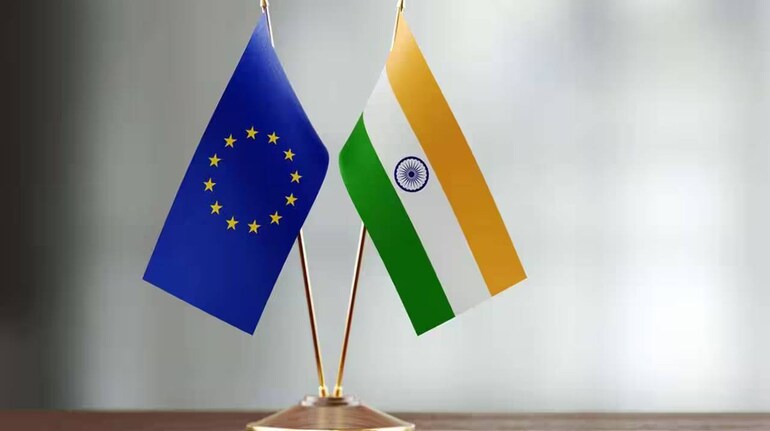

As India and the European Union move closer to implementing their landmark Free Trade Agreement, most market participants expect sectors such as automobiles, textiles, leather and gems and jewellery to emerge as the primary beneficiaries. However, analysts say the agreement has the potential to provide a boost to exports from India’s defence and capital goods sectors, even as certain domestic companies could face pressure.
Negotiations for the India–EU FTA concluded on January 27, with implementation expected in 2026, subject to legal vetting and approvals. The agreement provides for wide-ranging tariff reductions, harmonised standards and lower non-tariff barriers.
According to Amit Anwani, VP - Lead Analyst - Capital Goods, Industrials and Defence at PL Capital, the FTA is “a structural positive for India’s export and manufacturing ecosystem,” improving price competitiveness and export penetration in the EU. He said export-oriented defence and engineering companies with existing European exposure could benefit from better market access as Europe looks to diversify suppliers and deepen strategic partnerships with India.
Under the agreement, around 70.4% of tariff lines covering nearly 90.7% of India’s exports to the EU will receive immediate zero-duty access, benefiting labour-intensive sectors such as textiles, leather, footwear, tea, coffee, spices, sports goods, toys, gems and jewellery and select marine products. Another 20.3% of tariff lines, covering about 2.9% of exports, will see duties eliminated over three to five years, including processed foods, certain marine products and arms and ammunition.
Defence component-led opportunity
Anwani in a note said the FTA, coupled with the parallel India–EU Security and Defence Partnership, could strengthen defence cooperation at a time when Europe is actively diversifying its supplier base. He said export-focused defence companies with existing European exposure could see incremental opportunities as market access improves and regulatory barriers ease. Companies that could benefit include Bharat Electronics, Solar Industries, Mazagon Dock Shipbuilders, Cochin Shipyard, Garden Reach Shipbuilders & Engineers and Data Patterns.
Alongside the trade agreement, India and the European Union have signed their first Security and Defence Partnership framework covering maritime security, defence industry and technology, cyber threats, space security and counter-terrorism. The framework establishes an annual institutionalised India–EU Security and Defence Dialogue, negotiations on a Security of Information Agreement, exploration of India’s participation in European defence programmes and the creation of an India–EU Defence Industry Forum to promote co-development, co-production and industrial collaboration. Import tariffs on aircraft and spacecraft for European companies have been reduced from 11% to zero.
According to an ICICI Direct note, Europe plans to raise defence spending from about 1.9% of GDP to around 3.5% as it seeks to reduce reliance on United States and Chinese suppliers. The brokerage said Indian defence companies are “well positioned as cost competitive and reliable manufacturing and co-development partners.” Opportunity areas include aircraft programmes, aero structures, engines, missiles, electronics, radars, submarines and naval platforms. ICICI Direct added that existing linkages already exist with companies such as Hindustan Aeronautics, Bharat Electronics, Bharat Dynamics, Larsen & Toubro, Tata Advanced Systems, Mahindra Defence, Bharat Forge and Mazagon Dock Shipbuilders, and that the agreement supports a gradual shift from licensed production to co-development, engine manufacturing, platform integration and long-term participation in European defence supply chains.
Elara Securities’ Harshit Kapadia agreed on the strategic opportunity but added that near-term benefits are likely to be gradual and largely limited to components rather than full platforms. “The defence opportunity is likely to be gradual and largely limited to components rather than complete platforms,” he said. “The initial opportunity is in aerospace-related components for commercial aircraft, and in smaller systems such as radars, drones and counter-drone solutions,” he added, noting that defence exports to Europe currently form a small part of India’s overall shipments but had potential to grow.
Capital goods could see selective impact
On capital goods, Kapadia said the FTA’s impact will not be uniform. While some engineering exporters could benefit from improved access to European markets, domestic machinery manufacturers could face pressure as European equipment becomes cheaper to import. “In certain segments, lower duties could lead to higher imports of European machinery,” he said, adding that this could be negative for domestic players such as Jyoti CNC Automation, where customers may prefer imported machines over locally sourced equipment.
Anwani, however, is more optimistic on capital goods companies with established European exposure and believes they could still benefit in specific segments despite higher import competition. He highlighted Apar Industries, Elgi Equipments, TD Power Systems, Carborundum Universal, Thermax, Siemens Energy India, GE Vernova T&D India, Cummins India, Ingersoll Rand India, Triveni Turbines, CG Power and Hitachi Energy India as potential beneficiaries.
Stocks move on expectations
Defence stocks have risen in recent sessions, though Kapadia suggested that the move reflects multiple factors beyond the FTA alone. The Nifty Defence Index closed at 8,167.95 on January 28, up 6.95% on the day and about 5% higher over the past month. He said the gains appear driven by strong sector results, pre-Budget expectations and optimism around the India–EU FTA.
“At this stage, the deal itself does not materially change valuations. The real trigger will be collaboration announcements and eventual orders in the coming days,” he said.
Overall, the outlook for the defence sector remains constructive but selective. Defence stocks have already delivered strong returns, and valuations have corrected 15–20% from recent highs as execution assumptions have moderated.
Disclaimer: The views and investment tips expressed by investment experts on Moneycontrol.com are their own and not those of the website or its management. Moneycontrol.com advises users to check with certified experts before taking any investment decisions.Discover the latest Business News, Sensex, and Nifty updates. Obtain Personal Finance insights, tax queries, and expert opinions on Moneycontrol or download the Moneycontrol App to stay updated!
Find the best of Al News in one place, specially curated for you every weekend.
Stay on top of the latest tech trends and biggest startup news.





