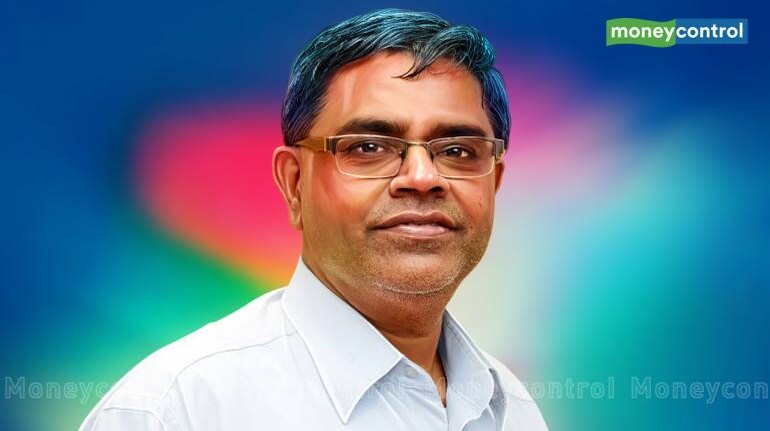
Clad in a plain, striped shirt and tailored trousers with a tilak on his forehead, it was easy to miss Satyanarayanan Chakravarthy as he sipped filter coffee at the canteen of IIT Madras Research Park in Chennai on a spring afternoon.
In a place where hundreds of entrepreneurs, researchers and scientists operate, this Indian Institute of Technology Madras professor blended right in while sitting in the canteen, fiddling on an un-smartphone reminiscent of the early 2000s.
However, little do people around him know that Chakravarthy is also a cofounder in at least six IIT Madras-incubated deep-tech startups – ePlane, an electric plane startup aiming to make air travel easier; space tech startups Agnikul Cosmos (which is gearing up to launch its first rocket) and GalaxEye; micro gas turbine maker Aerostrovilos Energy; TuTr Hyperloop, a deep-tech startup dedicated to creating hyperloop technologies, and X2Fuels, a company working on thermochemical technologies. He is also involved in the development of two more startups.
Also read: Inside IIT Madras: What makes the institute's ecosystem a deep tech haven
Chakravarthy, 54, is one of almost 100 faculty members of IIT Madras who is involved in entrepreneurship and startups. The involvement of faculty members can be traced decades back to IIT Madras’ decision to focus on translating research and development into commercial products, which has helped it in becoming a haven for deep-tech startups.
Plunge into entrepreneurshipHis journey with IIT Madras began in 1987 as a graduate student specialising in aerospace engineering. In 1991, he moved to the US to complete his PhD in the subject before returning to India in 1998. Since then, he has been a professor at the institute and took the plunge into entrepreneurship around 2016.
To be clear, his role in seven of the eight startups is more of an advisory one. What takes “99 percent” of his time, according to him, is ePlane – the startup concentrating on developing electric vertical take-off and landing (eVTOL) aircraft for passengers.
“I don’t think there are a number of faculty around the world who are into entrepreneurship at the level that I do. There are only a few people who will probably take a long leave of absence or not get paid,” Chakravarthy told Moneycontrol.
The professor stopped teaching in 2020 and has not taken on new research projects in a while.
“I have been kind of winding down my traditional academic line,” Chakravarthy said, adding that he is now concentrating on developing a two-seater eVTOL as part of ePlane, which last raised $5 million in seed funding in 2022.
How did the entrepreneurship bug bite him?Chakravarthy traces his entrepreneurship journey back to the pre-incubation days of Agnikul Cosmos.
“When we started Agnikul (in 2016), I had not really thought about entrepreneurship at all. I did not know much about thinking through a business case: Why are we doing this? Who will care? Who will be your customer? These are difficult questions that you're required to answer as an entrepreneur to start with, right? Those are all things that I had no idea about because I was still this professor,” Chakravarthy said.
By then, Chakravarthy had been teaching rocket propulsion and space technology to bachelor’s and masters students at the institute for more than a decade. And through his experience in the field, he realised that experimenting with rockets was very difficult.
So when Srinath Ravichandran, CEO of Agnikul, presented him with the idea of 3D printing in rocket manufacturing, he was sold. “It was crazy. I just jumped at the opportunity,” he said.
Unlike other rocket engines, Agnikul Cosmos’ Agnilet is built in a single step, eliminating the thousands of parts that are typically assembled in a conventional rocket engine. It recently obtained a patent for the engine. The engine is for its customisable rocket Agnibaan, which is slated to be launched soon.
Advisory roleWhile most of his time is spent on ePlane, Chakravarthy says he spends a few hours every week on the other startups he is involved with. His decades of experience in aerospace makes him a treasured addition, not just in terms of knowledge, but also in terms of contacts in the industry.
When Agnikul was formed, Chakravarthy brought in experts he knew from the Indian Space Research Organisation to sit in with them.
Also read: Inside IIT Madras: Big industry prefers Chinese chips over Indian
“I spent a lot of time looking at their propulsion, configuration; supporting them on igniter/injector development using facilities at the institute,” he said.
However, his role in these startups is not limited to advising on their current aims – he also helps in “configuring their goals for the future.”
“In the 2017-2019 time frame, we (Ravichandran and Chakravarthy) have actually sat and dreamt because we had nothing else to do. We literally sat in the middle of the night, at 2 am-3 am, texting each other on what we wanted to do. Space tourism? Where do you want to take our tourists? Could it be the moon? Could it be somewhere in between? How many days can people spend? Yeah, we thought through all this,” he said.
Easing air mobilityWith ePlane, which is building a flying electric taxi “for 10x faster commute,” according to its website, Chakravarthy wants to disrupt aviation by getting more people to fly in more places and more often, he told Moneycontrol.
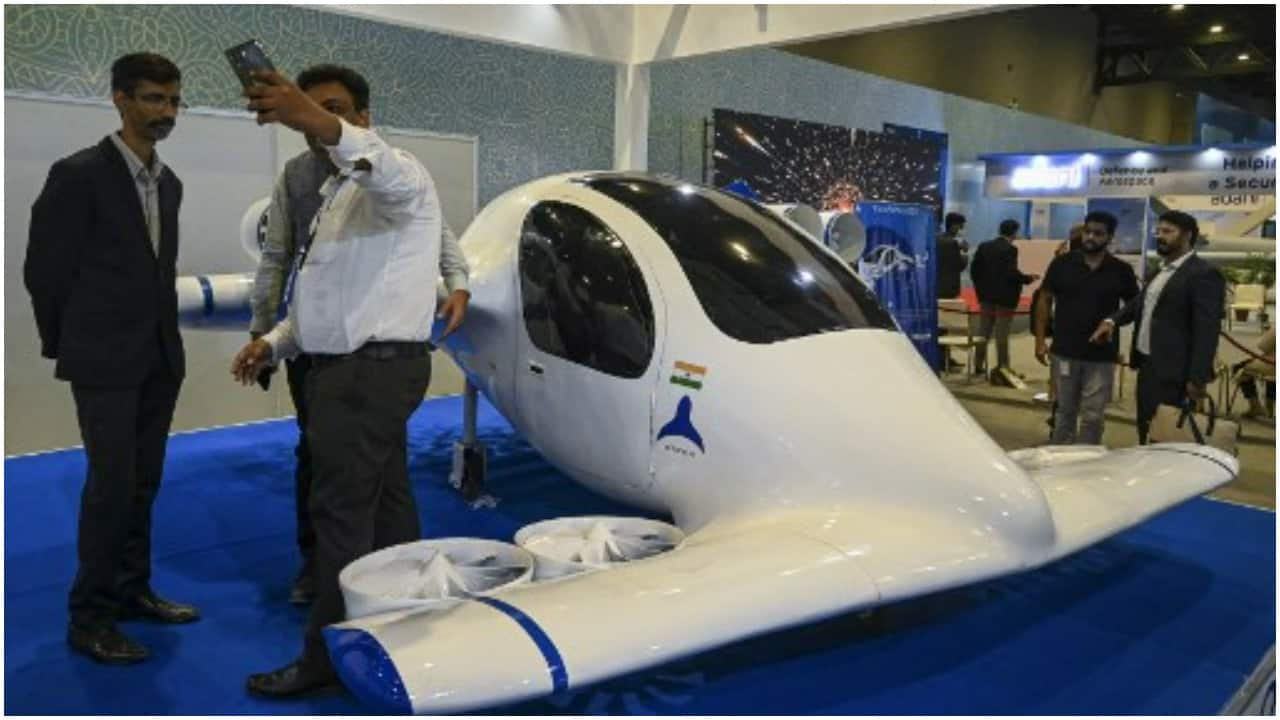 People take selfie next to India's first flying electric taxi "ePlane e200" at the Bharat Drone Mahotsav 2022, a two-day drone festival in New Delhi (Image credit: AFP)
“We don't really care about whether we are trying to make new planes. It's about how to get people to move from place to place faster, more economically and more ecologically,” he said.
Also read: Inside IIT Madras: Institute may work on regional alternative to ChatGPT, says director V KamakotiAs of now, the six-year-old startup has developed a subscale version of the two-seater eVTOL. “We will be developing that for transporting cargo and we are currently testing it,” he said.
Simultaneously, the startup has finished the design of the full-scale two-seater. “We will start fabrication of that sometime in May or June,” he said, adding that the startup is currently in the market to raise Series A funding.
The futureePlane’s concept of electric air taxis is not new and rocket manufacturer Agnikul Cosmos has strong competition worldwide. However, Chakravarthy is convinced that these two startups will thrive and grow.
“I actually don't have any doubts that both Agnikul and ePlane will actually be legacy companies. Right, that's what I believe will happen. They are actually companies that are meant to last longer, and grow bigger,” he said.
Chakravarthy explained that in the eVTOL sector, there are companies that started off 10 years ago as “pioneers’ in the sector but still have not entered the market despite raising huge amounts of funding.
The IIT Madras professor attributed the delay to technological requirements, sensitising certification agencies on how to deal with this new class of aircraft, and developing standards for this.
However, as a fairly new entrant in the sector, ePlane has an advantage.
“We have a hindsight advantage in regard to what all has been done before and what is the market gap,” he said. “What is the technology required for fulfilling this market gap? Can I quickly get there to develop that technology at a sustained level so that we can implement it in full scale?”
And for the crowded space launch services market that Agnikul is aiming to compete in, the idea is to reduce costs for the customer.
“Basically, the question is what is the value for money? So, is it possible for us to actually get a very low price point for the customer? This is the fundamental principle and how elastic the product can be to serve a very wide customer base,” the IIT Madras professor said.
“So Agnikul has a modular concept and also a mobile launcher approach, can be very agile, and we can move the launchpad to different areas as required. Basically, we can launch anywhere, anytime, anywhere.”
According to a Polaris Market Research report, the global space launch services market is expected to generate revenue of $42.9 billion by 2030.
Note to readers: Moneycontrol takes you to IIT Madras and the IIT Madras Research Park in Chennai, both of which have been responsible for the incubation and development of hundreds of deep tech start-ups, earning themselves the moniker of being India's deep tech haven. The 'Inside IIT Madras' series explores the kind of influence these two institutions have had on budding entrepreneurs and equally on those who have been in the ecosystem for years. A Moneycontrol specialDiscover the latest Business News, Sensex, and Nifty updates. Obtain Personal Finance insights, tax queries, and expert opinions on Moneycontrol or download the Moneycontrol App to stay updated!
Find the best of Al News in one place, specially curated for you every weekend.
Stay on top of the latest tech trends and biggest startup news.