




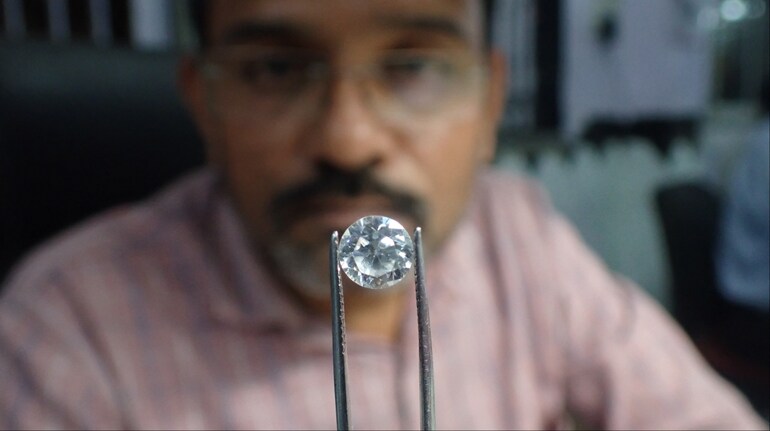
With US tariffs on Indian gems and jewellery doubling to 50 percent, exporters face the urgent task of finding alternative markets for one of the country’s most valuable exports.
“We stand with the Prime Minster; we will back him up no matter what. But we need to ensure the industry survives this storm,” says Praveenshankar Pandya, Founding Chairman of Diamond India Ltd.
The stakes are high. India sold nearly $10 billion worth of gems and jewellery to the US in FY25, with diamonds alone accounting for $7–8 billion. That concentration leaves the industry vulnerable, making diversification critical as the tariff wall rises.
“The industry was already struggling when 10 percent tariffs kicked in, and then at 25 percent orders almost came to a standstill, and now with 50 percent, it will stop. More than 50 percent of our exports in gems and jewellery is consumed in the US,” says Vipul Shah, Past Chairman of the Gem and Jewellery Export Promotion Council (GJEPC).
Exports to the US make up 40 percent of India’s outbound shipments in this sector. The effective tariff rate will surge to 52.1 percent, impacting major hubs in Surat, Mumbai, and Jaipur, where the industry employs millions in cutting, polishing, and manufacturing. Gems and Jewellery is India’s fifth-largest export item, with goods worth nearly $30 billion shipped to key markets in FY25.
“A 50 percent tariff is simply not feasible and will inevitably have a profound impact, particularly when over 90 percent of the world’s diamonds are cut and polished here. India is already at a disadvantage to competitors operating at far lower tariff levels like Thailand at 19 percent, the UAE at 10 percent, or Italy at 15 percent,” said Ankur Daga, Founder and CEO of Angara, a leading US-based fine jewellery brand specialising in coloured gemstones, with a strong presence in India.
Jobs in jeopardy
Over 2 million workers employed in the gems and jewellery sector remain on edge amid concerns around temporary factory closures.
According to industry estimates, in established factories, workers employed in the gems and jewellery sectors receive a monthly pay of Rs 20,000 to Rs 22,000 on average, but it could go up to Rs 1 lakh depending on the person's expertise.
“We will also struggle to maintain employment; people will be moving into industry where there is a better opportunity to work with the US,” Shah said.
Global Trade Research Initiative (GTRI) points out that Surat’s diamond polishing hub, employing 1.2 million workers, faces shrinking margins and halted orders, while Mumbai’s SEEPZ SEZ (special economic zone) where 85 percent of jewellery exports are shipped to the US, risks 50,000 jobs.
Jaipur’s coloured-stone SEZ faces the same crisis.
But Sabyasachi Ray, Executive Director, GJEPC, allays such fears.
“Our industry has built up skills over more than a decade, and it isn’t easily replaceable. Our artisans put 52 assets on one two-hundredth of a carat, so you can imagine their level of skill. So, we do not see any immediate job losses at least for the next four to six months,” Ray said.
The sector has also bought time by frontloading shipments before August 27, when steeper duties kicked in.
“While it is a big jolt to the industry with almost one-third of the market being a no-go, for the next one-and-one-and-a-half months, shipments have been sent to American inventories. But if this continues it is a big setback to the industry. For 50 years, the American market has captured 35-40 percent of our goods, and no other market will readily capture these goods,” Pandya told Moneycontrol.
Ray adds that lifting of orders has stopped once the 50 percent tariff was formalised and will only pick up if buyers have certainty on where the tariff rate finally settles, as well as on the exact regulations of transhipment.
Government's support
Exporters and associations now look towards the government for support even as they scout alternate destinations for their goods.
GTRI says that firms are seeking ways to maintain access to the US or find new markets. A few large jewellery makers are exploring manufacturing in the UAE to benefit from lower tariffs, while others are considering Mexico’s 25 per cent tariff advantage. They are also testing markets in Dubai, Riyadh, and Singapore, though these cannot immediately replace the demand from America, which accounts for 60 percent of India’s exports in this sector.
India already exports cut and polished diamonds to different markets like Europe, China, South Korea and Taiwan, but at best they could see shipments growing by 10 percent, which won’t be enough to compensate for the losses due to steeper duties imposed by the US, Pandya, who is on the board of the Gem & Jewellery National Relief Foundation (GJNRF), said.
Therefore, the industry is looking for disaster relief style measures starting from an interest moratorium from the government since exporters will require more time to sell goods to alternate markets that were originally heading to the US.
Ray says that since SEEPZ, the SEZ in Andheri, and the Sitapura SEZ in Jaipur are primarily involved in the manufacturing of studded jewellery, with most of it bound for the US, the government should allow these units to sell their goods in the domestic market.
Presently, SEZ units can only export and not sell in Indian market.
Colin Shah, MD, Kama Jewelry calls for strategic trade deals with China, Brazil, South Africa, as well as expediting the agreement with the European Union to ensure predictable rules of origin, reduced non-tariff barriers, and safeguards for high-value segments such as certified diamonds and branded jewellery.
“Key sectors like diamond cutting, gold jewellery, synthetic gemstones, and parts need to be facilitated by finance access, traceability standards, and compliance with international trade regulations. This would stabilise orders and promote investment,” Shah says.
Festive cushion?
India’s festive season that is currently underway from Ganesh Chaturthi leading into Diwali in October could ease the blow of Trump’s tariffs, exporters and associations say, but not by a lot.
“The festive season will provide a temporary cushion, particularly for jewellery, if export zones are allowed to access domestic markets but it cannot fully offset the scale of US trade. The real solution lies in how quickly exporters can pivot to alternate markets and how effectively policy support is mobilised to ease the transition. India’s own growth story, however, gives us strong reason for optimism,” Angara’s Daga said.
GJPEC’s Ray agreed that the festivals could help in sales of diamond jewellery, banking on more purchases in India. However, diamond isn’t the top choice for Indians in the festive season.
According to Pandya, India’s festival season has limited capacity to absorb and sees sales going up by only 3-4 percent in diamond jewellery. “But it will also hurt the American jewellery industry, there are over 100,000 mom and pop stores in the US that buy diamonds from India. No other country can process diamonds so quickly,” he added.
Risks mount as US buyers are turning to Israel and Belgium for natural diamonds, China for lab-grown stones and Italy, Thailand, Vietnam, Türkiye, UAE, and Mexico for finished jewellery, GTRI points out.
Pandya reiterated that support from the government is key. “We have not asked for any subsidy in the last 50 years, but now is the time for them to come forward and help the gems and jewellery industry through this unprecedented crisis.”
Discover the latest Business News, Sensex, and Nifty updates. Obtain Personal Finance insights, tax queries, and expert opinions on Moneycontrol or download the Moneycontrol App to stay updated!
Find the best of Al News in one place, specially curated for you every weekend.
Stay on top of the latest tech trends and biggest startup news.