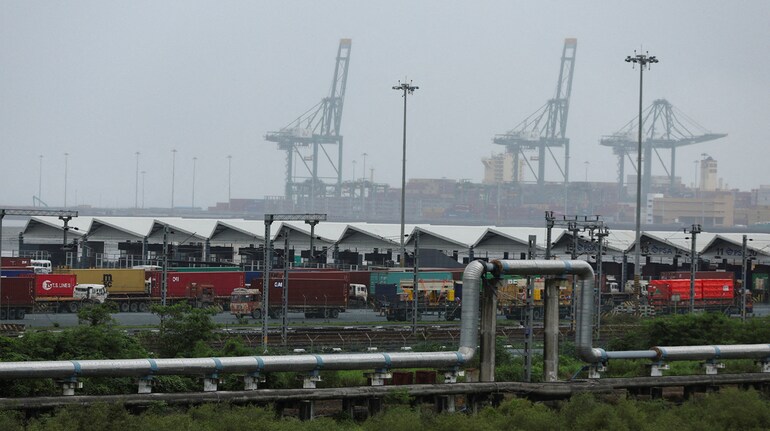

The Centre’s decision to move ahead with a deep-water dry bulk transhipment port at Atlanta Bay in North Andaman marks a significant expansion of India’s commercial and maritime footprint in the Bay of Bengal at a time when regional competition is intensifying, defence and strategic affairs experts have said.
The project, announced in October, and is undergoing a techno-commercial feasibility study. Andaman and Nicobar Islands lieutenant governor Admiral DK Joshi, a former naval chief, is supervising the port, highlighting the importance government attaches to it.
Prime Minister Narendra Modi is expected to visit the Andaman and Nicobar Islands later this month, during which he is also likely to review the Atlanta Bay and Galathea Bay port projects along with key strategic defence assets on the archipelago, the sources said.
The Atlanta Bay port is designed to handle some of the world’s largest dry-bulk vessels, including Capesize ships, and will have what is expected to be the longest continuous berth in the country.
While the government has positioned it primarily as a commercial facility, defence analysts say a deep-water port of this scale can also support naval and coast-guard operations by allowing large warships to refuel, resupply and operate closer to key shipping routes.
Strategic maritime geography
Commodore (Retd) Uday Bhaskar, Director of the Society for Policy Studies and a former navy officer, said the Andaman and Nicobar Islands had for decades been underdeveloped despite their strategic location.
“For a long time, India lacked both the resources and the vision to develop these islands, even though they sit next to some of the world’s most important sea routes linking the Malacca Strait and the Bay of Bengal,” he said.
North Andaman lies close to the shipping lanes that carry a large share of global trade and most of East Asia’s oil and gas imports. Any country with a strong presence here gains a clear view of what moves through these waters, giving it both commercial and security advantages.
The islands already host India’s only tri-service military command, along with airfields, naval bases, and surveillance systems.
A large port at Atlanta Bay would strengthen this setup by making it easier to move troops, equipment, and supplies in and out of the region and to keep ships deployed for longer periods.
Bhaskar said the scale of the Atlanta Bay project shows how much India’s thinking has changed.
“The port is being designed to handle 200,000-tonne ships, which only a handful of ports in the world can manage. India does not have anything like this today. If the country wants to become a $5-trillion economy, it needs a strong ocean-based trade system, and these islands will be central to that,” he said.
Chinese footprint
China’s growing footprint across Bangladesh’s port network has added urgency to India’s plans.
Beijing has invested heavily in Chattogram, Bangladesh’s largest port, and Chinese naval ships visited the facility in 2025. China has also committed about $400 million to modernise Mongla, Bangladesh’s second-largest port, which analysts say has clear dual-use potential.
Pakistan has also been given access to Mongla, a development that has drawn attention in New Delhi.
Atlanta Bay is being developed alongside the much larger container transhipment port at Galathea Bay in Great Nicobar. While Galathea Bay is aimed at attracting global container traffic currently routed through hubs such as Singapore and Colombo, Atlanta Bay will focus on dry-bulk cargo such as coal, minerals and industrial raw materials. Together, the two ports would give India major maritime infrastructure at both ends of the Andaman and Nicobar chain.
According to experts, for New Delhi, the stakes go well beyond trade alone. Economically, the two ports are expected to reduce India’s dependence on foreign transhipment hubs and improve its control over key supply routes.
Discover the latest Business News, Sensex, and Nifty updates. Obtain Personal Finance insights, tax queries, and expert opinions on Moneycontrol or download the Moneycontrol App to stay updated!
Find the best of Al News in one place, specially curated for you every weekend.
Stay on top of the latest tech trends and biggest startup news.