






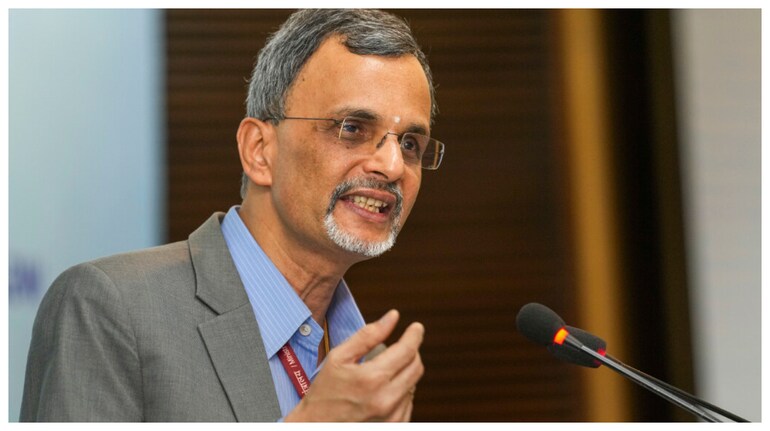
India is at a "demographic and economic inflection point" and higher education will play a decisive role, as millions of youngsters get ready to enter the workforce over the next two decades, chief economic adviser V Anantha Nageswaran said on December 17.
"Whether this demographic dividend becomes a growth accelerator or a social strain will depend in large measure on the quality, relevance and adaptability of our higher education system," he said, calling on states to lead the change.
"The groundwork for the policy has already been laid… the NEP (National Education Policy) has opened the doors," the CEA said, as he hailed the role being played by technology in dismantling traditional barriers to higher and better education.
"We have to migrate to a model of lifelong learning and lifelong earning," Nageswaran said at the 15th Confederation of Indian Industry (CII) Global Higher Education Summit in New Delhi.
The global higher education landscape is being reshaped as traditional academic hubs face demographic decline, fiscal pressures and tightening political curbs on international students.
"At the same time, Asia is emerging as a centre of gravity for learning, research and innovation. India has a rare opportunity to move from being primarily a centre of students to becoming a destination for global learners and scholars," he said.
Technology has broken old barriers. Digital platforms, hybrid delivery models, and modular credentials have made it possible to scale quality in ways that were simply not possible a decade ago.
“Regulatory thinking is evolving. What is now required is execution, institutional courage and cooperative federalism,” he said of NEP.
“In other words, this is not a call for disruption without preparation. It is a call to build on the momentum that already exists at this stage (and) is important to acknowledge what has already been achieved.”
He also highlighted how NEP has done away with rigid course structures and streams. "Academic flexibility…through multiple entry and exit options, credit, portability and interdisciplinary pathways, recognises a basic reality--careers are no longer linear, and learning cannot be either," the CEA said, as he referred to the new education policy.
‘States should lead’
Many states have transitioned to the 5+3+3+4 school structure and universities too are switching to new course designs but some states continue to oppose the change.
Nageswaran said higher education in India is largely delivered by state governments or regulated by them. "Most universities, colleges, faculty appointments and administrative decisions sit at the state level. Therefore, the success of national reform depends critically on state-level action," he said.
He pointed to five areas where "state governments can make a decisive difference, to higher education... governments should make the shift from control to stewardship”.
First, allow independent and professionally governed university boards, with merit-based leadership appointments, coupled with academic and administrative autonomy and accountability,
Second, address the teacher shortage urgently, as no reform is more urgent than addressing India's faculty shortage and faculty quality challenge, he said.
Third, he suggested moving beyond input-based regulation, which served well when inputs were missing. “Today, they run the risk of becoming anachronistic. What truly matters now is learning outcomes, research quality, graduate employability and social impact," the CEA said.
Number four is the entrepreneurial state, which call for a mindset shift. "Reforms also require a shift in the administrative culture, (to enable) the idea of the entrepreneurial state," Nageswaran said.
Five, states should increasingly fund institutions based on roles and outcomes, not uniform templates.
"Not every institution must be a research university. Some should focus on teaching excellence, some on applied research and some on regional development. Differentiation is not hierarchy. It is efficiency with purpose. A stronger role for industry. Industry's role as well must move beyond episodic engagement," he said.
What is NEP?
Launched in 2020, NEP replaces the traditional 10+2 system (10 years of school plus two years of high school) with a new pedagogical structure (5+3+3+4 years).
“The Foundational Stage” (5 years) applies to students aged 3–8. This includes three years of preschool (anganwadi) and Grades 1–2, with a focus on play-based learning.
“The Preparatory Stage” (3 years), for ages 8–11, focuses on light textbooks and interactive classroom learning.
“Middle State” (3 years), for ages 11-14, introduces vocational education and internships. The four-year “secondary stage”, for ages 14–18, offers multidisciplinary study with no rigid separation between arts, commerce and science.
For higher education, NEP introduces multiple entry and exit points. Students can leave a degree programme early with a certificate (after a year), a diploma (after two years), or a Bachelor's degree (after three or four years).
It also establishes a digital storehouse — called the Academic Bank of Credits — that keeps track of the "credits" a student earns, which allows them to resume their education even after a break.
NEP also aims to replace various bodies, such as the UGC and AICTE, with a single overarching body called the Higher Education Commission of India (HECI).
According to the education ministry, NEP provides for careful planning, joint monitoring and collaborative implementation by the Centre and states for execution of this policy.
Discover the latest Business News, Sensex, and Nifty updates. Obtain Personal Finance insights, tax queries, and expert opinions on Moneycontrol or download the Moneycontrol App to stay updated!
Find the best of Al News in one place, specially curated for you every weekend.
Stay on top of the latest tech trends and biggest startup news.




