






The Sustainable Harnessing and Advancement of Nuclear Energy for Transforming India (SHANTI) Bill lays down a new legal framework for regulating nuclear safety, safeguards and liability as private companies will now be allowed to enter nuclear power generation.
Beyond permitting new operators, the law sets out how nuclear materials will be controlled and accounted for, how safety oversight will function, and how compensation will be handled in the event of a nuclear incident. Provisions on security and safeguards are embedded across licensing conditions, regulatory oversight and the Central Government’s powers, rather than contained in a standalone chapter.
How does the Bill open up the nuclear power sector?
For the first time, the Central government will allow private Indian companies and joint ventures to directly build, own, operate and decommission nuclear power plants, ending the earlier framework where nuclear generation was effectively limited to state-run entities.
The law also enables new project models, including public–private partnerships and captive nuclear power for industrial users, subject to licensing and government approval.
However, foreign companies remain barred from direct participation and must route investments through Indian-incorporated entities, while fuel supply, pricing mechanisms and tariffs are left to be determined through subsequent rules and notifications.
How does the Bill deal with safety and liability?
The SHANTI Bill addresses safety through a licensing and regulatory framework that requires any entity seeking to build, operate or decommission a nuclear power plant to obtain approval from the Central Government along with safety authorisation from the Atomic Energy Regulatory Board (AERB). The law gives statutory backing to the AERB and strengthens its powers to set safety standards, conduct inspections, enforce compliance and issue binding directions.
According to the Bill, licences can be modified, suspended or cancelled if operations pose risks to public safety or security. Besides, the Central government shall retains the authority to step in and take control of a facility in exceptional circumstances.
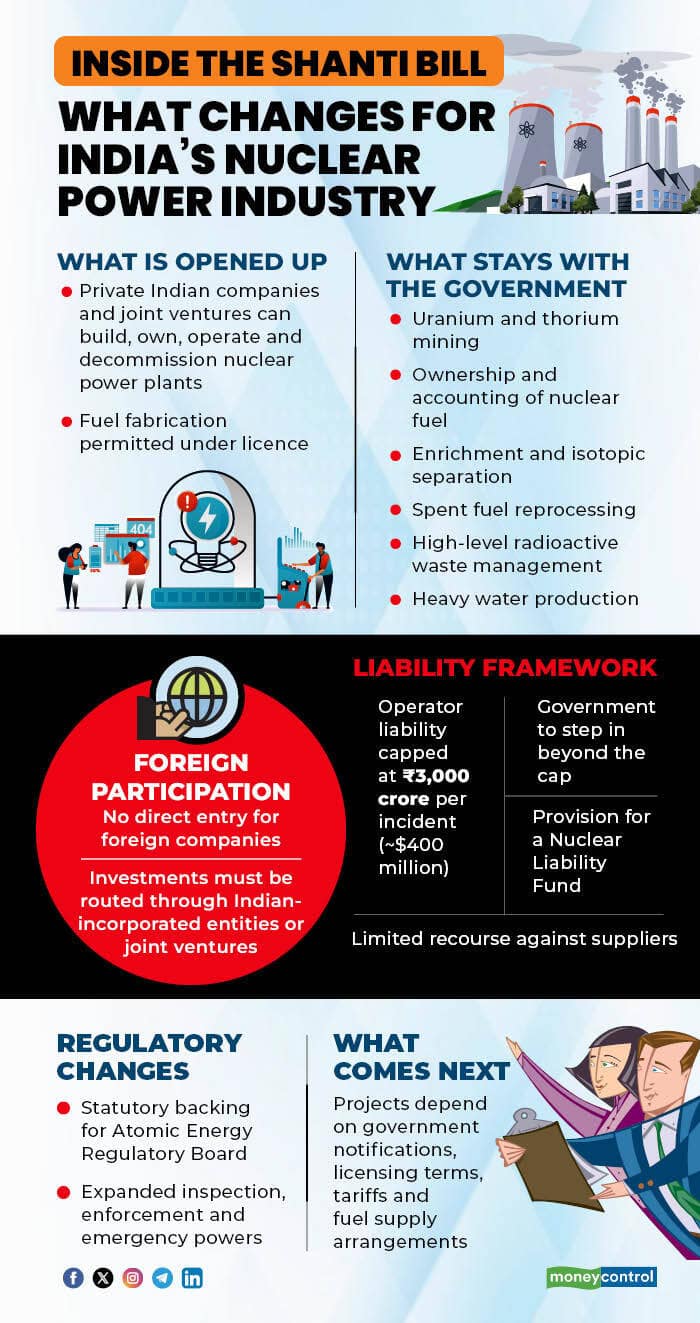
Liability for nuclear damage is dealt with separately through a graded compensation framework. The Bill links an operator’s maximum liability to the thermal capacity of the installation rather than the extent of damage suffered. Operators of large plants with thermal capacity above 3,600 MW face a liability cap of about Rs 3,000 crore per incident, mid-sized plants in the 1,500–3,600 MW range face a cap of Rs 1,500 crore, and smaller installations of around 150 MW have a cap of Rs 100 crore, with the Central Government stepping in to meet compensation claims beyond these limits.
The law also allows for the creation of a Nuclear Liability Fund and limits the operator’s right of recourse against suppliers to contractually agreed cases or instances of wilful misconduct, narrowing supplier exposure that had earlier deterred participation.
How does the Bill retain control over nuclear security?
The SHANTI Bill makes explicit that all source and fissile material—including uranium, thorium and plutonium—remain under the surveillance and accounting control of the Central government, irrespective of who operates a nuclear installation. Private operators are not permitted to own nuclear fuel or exercise independent control over sensitive materials.
Strategic activities such as enrichment, isotopic separation, reprocessing of spent fuel, high-level radioactive waste management and heavy water production remain exclusively with the government or government-owned entities, with the Centre retaining powers to impose special regulatory arrangements in the interest of national defence or security.
While fuel fabrication is permitted under licence to private Indian companies and joint ventures, ownership and accounting of nuclear fuel remain with the government, and all spent fuel must be returned to the state after cooling, ensuring continued control over the nuclear fuel cycle, the Bill states.
What penalties does the Bill prescribe for violations?
Separate from civil liability for nuclear damage, the SHANTI Bill contains a dedicated chapter on offences and penalties dealing with criminal and regulatory violations. The law provides for punishment in cases of unauthorised handling of nuclear or radioactive material, breaches of licence conditions, non-compliance with safety authorisations, concealment or false reporting of information, and obstruction of inspections.
Penalties can include imprisonment, fines or both, and apply not only to companies but also to individuals responsible for the conduct of business. Unlike the liability provisions, the penalties chapter does not specify fixed monetary amounts in rupees, leaving the quantum of punishment to be determined based on the nature of the offence. Prosecution requires prior sanction of the Central Government, keeping enforcement under sovereign oversight.
Separately, the SHANTI Bill caps administrative penalties for violations of the Act or licence conditions at Rs 1 crore, even in cases classified as a “severe breach”, a limit that applies to regulatory enforcement and not to accident compensation or criminal offences.
Concerns over liability caps and disaster preparedness
During the Lok Sabha debate, Congress MP Shashi Tharoor questioned the adequacy of the liability caps proposed under the SHANTI Bill, arguing that they fall far short of the costs involved in a major nuclear disaster.
“In a catastrophe like Chernobyl, the costs ran into hundreds of billions of dollars. Against that, a liability cap of a few thousand crore rupees (Rs 3,000 crore) is meagre and simply not credible in the event of a serious nuclear accident,” Tharoor said, while warning that capping liability at just Rs 3,000 crore could leave victims and the state bearing the real cost of a catastrophic failure.
Sujjain Talwar, Partner, Economic Laws Practice said the dilution of supplier accountability, limited to intentional acts via contractual clauses, may undercompensate victims in defect-driven incidents. “It doesn’t seem to end Bhopal gas tragedy’s shadow, inviting litigation over intent thresholds. Further, unchanged liability caps under CLNDA Section 6 remain burdensome for smaller entrants. AERB's newfound independence is promising, but historical overlaps with the Department of Atomic Energy raise regulatory capture concerns.”
Discover the latest Business News, Sensex, and Nifty updates. Obtain Personal Finance insights, tax queries, and expert opinions on Moneycontrol or download the Moneycontrol App to stay updated!
Find the best of Al News in one place, specially curated for you every weekend.
Stay on top of the latest tech trends and biggest startup news.




