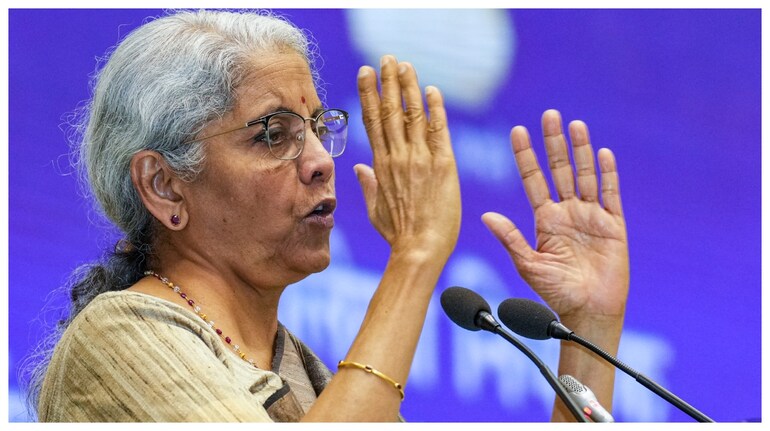
Finance Minister Nirmala Sitharaman’s ninth Budget for the financial year 2026–27 unveiled a series of measures aimed at easing pressure on labour-intensive sectors such as marine products, leather and textiles, which have been among the most exposed to the United States’ steeper tariffs of 50 percent imposed from mid-2025.
The textile sector, among the most affected by tariff actions in the US, will see an integrated programme comprising a National Fibre Scheme, a Textile Expansion and Employment Scheme for modernising clusters, as well as a National Handloom and Handicraft programme, and a sustainability-focused Tex-Eco Initiative.
The Budget also announced Samarth 2.0 to upgrade textile skilling, the setting up of Mega Textile Parks in challenge mode, and the launch of the Mahatma Gandhi Gram Swaraj initiative to strengthen khadi, handloom and handicrafts through training, branding and global market linkages.
To support marine exports, the Budget proposed raising the limit for duty-free imports of specified inputs used in seafood processing to 3 percent from 1 percent of the free-on-board (FOB) value of the previous year’s export turnover.
The move is expected to help exporters offset cost pressures arising from tariff barriers in major markets such as the US.
In the leather and footwear sector, the government announced that duty-free import benefits for specified inputs, currently available for leather or synthetic footwear, will be extended to exports of shoe uppers.
In addition, exporters of leather and textile garments, leather or synthetic footwear and other leather products will be given more time to meet export obligations, with the permissible period extended from six months to one year.
The Budget also announced measures to create new export avenues for marine products.
Fish catch by Indian fishing vessels in the Exclusive Economic Zone (EEZ) and on the high seas will be made duty-free, while landing of such catch at foreign ports will be treated as exports.
Safeguards will be put in place to prevent misuse during fishing, transit and transshipment.
And, to help small businesses, artisans and start-ups diversify markets amid global trade uncertainties, the government announced the complete removal of the Rs 10 lakh per-consignment value cap on courier exports.
The handling of rejected and returned consignments will also be improved through technology-based identification systems.
A dedicated initiative for sports goods manufacturing, focusing on research, innovation and material sciences, was also announced.
Taken together, the measures signal a shift towards reducing export costs, easing compliance burdens and diversifying markets as India seeks to cushion its exporters from the fallout of tariff actions in the US and other major economies.
India’s exports to the United States in December 2025 stood at $6.88 billion, declining 1.8 percent year-on-year.
Discover the latest Business News, Sensex, and Nifty updates. Obtain Personal Finance insights, tax queries, and expert opinions on Moneycontrol or download the Moneycontrol App to stay updated!
Find the best of Al News in one place, specially curated for you every weekend.
Stay on top of the latest tech trends and biggest startup news.