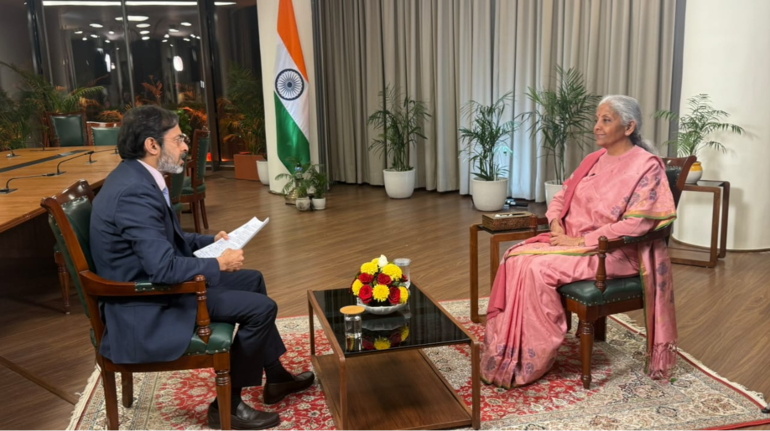

Finance Minister Nirmala Sitharaman on February 2 said the Union Budget 2026 was designed to promote stability and growth in the economy. In an interview with Rahul Joshi, Network 18 Editor-in-Chief, Sitharaman said the Budget was a measured approach to managing the economy.
"We had to keep in mind the uncertainty in the world and plan for this year and the next five years," Sitharaman said. "The stability of the Indian economy is what I want to underline."
The finance minister's comments come at a time when the global economy is facing significant challenges, including the ongoing trade tensions between the US and China, and the slowdown in global growth. Despite these challenges, Sitharaman said she was confident that India would continue to be one of the fastest-growing major economies in the world.
Sitharaman said the government's focus was on promoting ease of doing business and extending the "red carpet" for investors while removing "red tape" that can hinder growth. "We have to extend the red carpet and remove the red tape at the same time for ease of doing business," Sitharaman said. “Those who are saying that the Budget lacks vision have not understood the Budget. Budget or aside the budget, reforms will continue,” she said.
Sitharaman presented her ninth Budget that blended immediate concerns with long-term structural goals by focusing on the new economy sectors, mainstreaming artificial intelligence (AI), hi-tech, rare earths and data centres while staying firm on the fiscal consolidation path.
She laid out a new rural welfare framework —anchored by the VB-GRAM G programme with an allocation of Rs 95,600 crore, which replaced the 22-year-old MGNREGA that had a budgetary allocation of Rs 88,000 crore in 2025-26.
The Budget raised the securities transaction tax (STT) and kept long-term capital gains tax (LTCG) unchanged.
The STT on futures has been raised to 0.05 percent from present 0.02 percent. STT on options premium and exercise of options are both proposed to be raised to 0.15 percent from the present rate of 0.1 percent and 0.125 percent, respectively.
“It (higher STTs) is not for revenue considerations. It is not on all STTs. It is only on F&O. It is only for speculators,” she said.
The Budget also proposed a tax holiday till 2047 to any foreign company that provides cloud services to customers globally by using data centre services from India, and the finance minister told Network 18 in the interview that even Indian global companies can also benefit from this.
The finance minister also proposed to provide a safe harbour of 15 per cent on cost in case the company providing data centre services from India is a related entity.
In another move, intended to benefit the IT sector, and especially global capability centres (GCCs), the government has raised the threshold for availing safe harbour for IT services to Rs 2,000 crore from Rs 300 crore.
The finance minister also clubbed software development services, IT-enabled services, knowledge process outsourcing services, and contract research and development services into “information technology services”, with a common safe harbour margin of 15.5 per cent for all.
The finance minister also highlighted the government's efforts to rationalise capital gains taxes for all asset classes, saying it was not done for revenue considerations but to provide a stable approach to tax rates.
"The stable approach to tax rates has always guided us."
On the issue of private sector capital expenditure, Sitharaman said she saw "green shoots" of improvement and believed that private capex was growing. "I see some green shoots. I see the situation is improving. I see the reason to believe that private capex is growing," Sitharaman said.
The finance minister also discussed the government's plans to promote artificial intelligence (AI) and its potential benefits for MSMEs and the economy. "We are interested in increasing productivity, and AI can help us achieve that," Sitharaman said. "MSMEs will benefit from AI, and we are also using AI in agriculture, healthcare, and other areas."
Sitharaman also responded to criticism from opposition leaders, including Rahul Gandhi, saying that he often speaks without basis and that India deserves a better opposition. "He is the leader of the opposition. But most often, I think he shoots from his hip. He doesn’t use good foundational data to make his points," Sitharaman said. "That one comment on the dead economy made in haste -- that itself pushed the carpet under his feet. He speaks without any basis. He speaks out of thin air. India deserves a better opposition."
The finance minister also dismissed concerns about the Budget's impact on certain states, including Tamil Nadu, saying that the state was benefiting from various initiatives and allocations. "It is a sad commentary. Super-fast trains, high-speed trains, is that not happening?" Sitharaman said.
"Kerala and Tamil Nadu are election-bound states. Coconut farmers will benefit from budget measures. Rare earth corridors will benefit both Tamil Nadu and Kerala. Look at the allocation of VB G Ram G Act. Rs 95,000 crore has been given. The MNREGA component has received Rs 30,000 crore. The total allocation is Rs 125,000 crore. Does it not benefit Tamil Nadu and Kerala?"
Discover the latest Business News, Sensex, and Nifty updates. Obtain Personal Finance insights, tax queries, and expert opinions on Moneycontrol or download the Moneycontrol App to stay updated!
Find the best of Al News in one place, specially curated for you every weekend.
Stay on top of the latest tech trends and biggest startup news.