








The Reserve Bank of India (RBI) has followed a pattern of delivering rate cuts in February every other year over the past four years, even as its inflation projections have taken a far less predictable path.
The Reserve Bank had delivered a 25-bps cut last year in February bringing the policy rate down to 6.25 percent. The central bank has since delivered an additional 100 bps cut. A Moneycontrol poll of 19 economists found that the RBI is unlikely to move on the rate front on Friday.
A review of past Monetary Policy Committee (MPC) projections indicates that the central bank frequently revises both inflation and growth forecasts within months of the initial February outlook, underscoring the uncertainty surrounding macroeconomic conditions.
February policy meetings typically carry heightened importance as they help set the tone for the coming fiscal year. Yet inflation projections released at that stage have often required quick recalibration. CPI forecasts, for instance, have historically been revised upward in the April policy review in several years, reflecting shifts in food prices, global commodity trends and domestic demand conditions. While February projections provide an early policy anchor, they have rarely proved final.
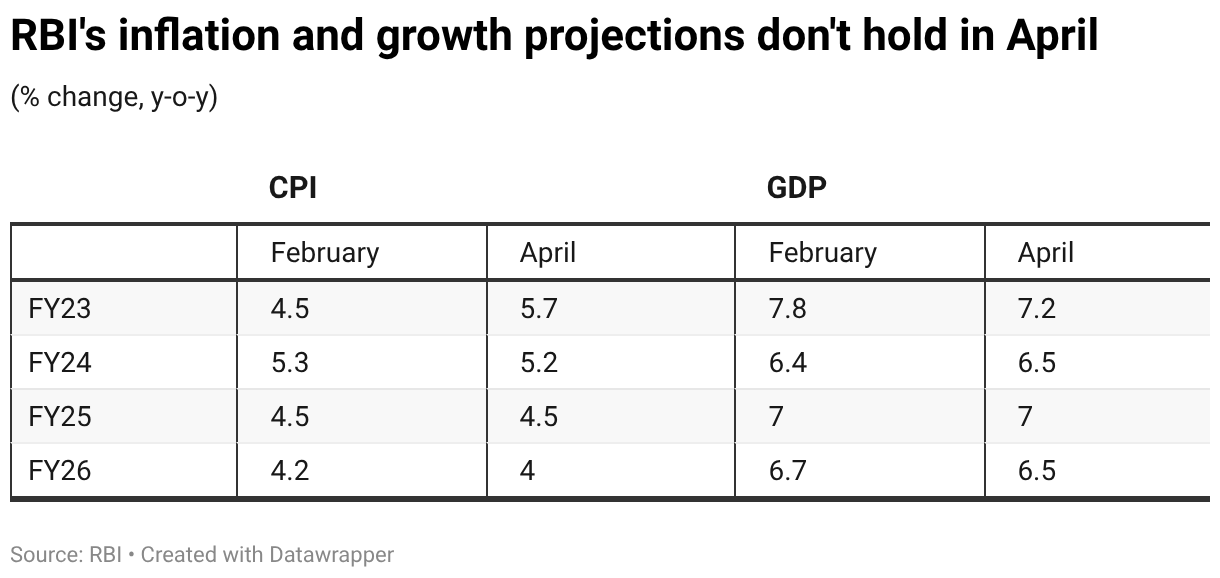
Growth projections display a similar pattern. GDP estimates issued in February have often been adjusted in subsequent meetings as fresh high-frequency data becomes available. In FY24, growth forecasts were gradually revised upward through the year before settling above initial estimates, supported by resilient domestic demand and services activity. By contrast, in FY20, projections saw sequential downward revisions as economic momentum weakened.
The February MPC meeting will therefore be closely watched not only for the interest rate decision but also for the inflation and GDP outlook for the next fiscal year.
Current assessments suggest inflation may remain broadly contained, while growth prospects are drawing increased attention. RBI policy deliberations come shortly after India and the US announced a trade agreement reducing US tariffs on Indian goods to 18 percent from 50 percent earlier. With the US accounting for over a fifth of India’s exports, the deal—placing India at a tariff advantage relative to many South and Southeast Asian peers—is expected to support growth.
Moneycontrol had earlier reported that the agreement could add roughly 20–30 basis points to growth, with some economists projecting expansion above 7 percent. The Economic Survey has placed FY27 growth expectations in the 6.8–7.2 percent range.
Against this backdrop, economists expect that even if the RBI presents a stable inflation trajectory in February, revisions in April cannot be ruled out—particularly if growth momentum strengthens or inflationary pressures re-emerge. Recent experience suggests early fiscal-year projections often remain provisional, with the central bank retaining flexibility to respond to evolving economic conditions.
Discover the latest Business News, Sensex, and Nifty updates. Obtain Personal Finance insights, tax queries, and expert opinions on Moneycontrol or download the Moneycontrol App to stay updated!
Find the best of Al News in one place, specially curated for you every weekend.
Stay on top of the latest tech trends and biggest startup news.





