
India faces lower tariff rates than most of its South and Southeast Asian peers after India-US announced a trade deal on February 2, giving its exporters a relative cost advantage in key global markets even as several competing economies grapple with steeper trade barriers.
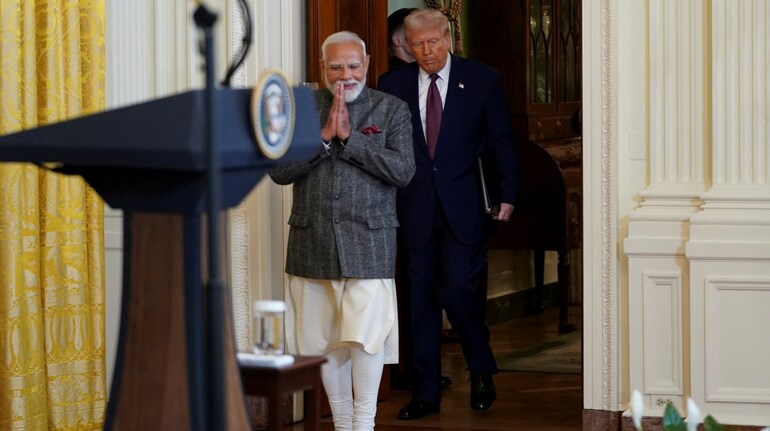
“Delighted that Made in India products will now have a reduced tariff of 18%. Big thanks to President Trump on behalf of the 1.4 billion people of India for this wonderful announcement,” Prime Minister Narendra Modi had said on social media platform X.
India is subject to an 18 percent tariff rate after a trade deal, which is lower than or equal to most economies in South Asia and ASEAN. By comparison, Bangladesh, Sri Lanka, Taiwan and Vietnam face tariffs of 20 percent, while Pakistan, Indonesia, Malaysia, Thailand and the Philippines are levied 19 percent. Cambodia also faces a higher tariff burden at 19 percent.

India was one of the highest tariffed economies until now, facing 50 percent tariff along with Brazil. The 50 percent tariff included a 25 percent reciprocal duty and an additional 25 percent levy US had imposed for purchase of Russian oil.
"It was an Honor to speak with Prime Minister Modi… He agreed to stop buying Russian Oil, and to buy much more from the United States and, potentially, Venezuela. Out of friendship and respect for Prime Minister Modi and, as per his request, effective immediately, we agreed to a Trade Deal between the United States and India, whereby the United States will charge a reduced Reciprocal Tariff, lowering it from 25% to 18%. They will likewise move forward to reduce their Tariffs and Non Tariff Barriers against the United States, to ZERO,” US President Donald Trump had said on his social media platform Truth Social.
Among South Asian economies, India’s tariff rate is lower than Bangladesh and Sri Lanka, and only marginally higher than Afghanistan, which faces a 15 percent tariff but has a far smaller export base and limited manufacturing depth. Pakistan, India’s closest regional competitor in textiles and select manufacturing categories, faces a 19 percent tariff, placing it at a slight disadvantage relative to Indian exporters.
The gap becomes starker when compared with Southeast Asia’s export-heavy economies. Vietnam, a major rival in electronics, garments and footwear, faces a 20 percent tariff, while Indonesia, Malaysia and Thailand are all at 19 percent.
Globally, India’s tariff positioning also compares favourably against several large exporters. Brazil faces a 50 percent tariff, Myanmar and Laos 40 percent, South Africa 30 percent, and Mexico 25 percent. Even developed economies such as Canada (35 percent) and Switzerland (39 percent) face significantly higher tariffs than India.
Only a limited set of major economies enjoy lower tariffs than India. These include the United Kingdom, which faces a 10 percent tariff, and a broad set of countries — including Japan, South Korea, the European Union and its member states — that face a 15 percent tariff having signed trade deals with the US earlier.
Discover the latest Business News, Sensex, and Nifty updates. Obtain Personal Finance insights, tax queries, and expert opinions on Moneycontrol or download the Moneycontrol App to stay updated!
Find the best of Al News in one place, specially curated for you every weekend.
Stay on top of the latest tech trends and biggest startup news.