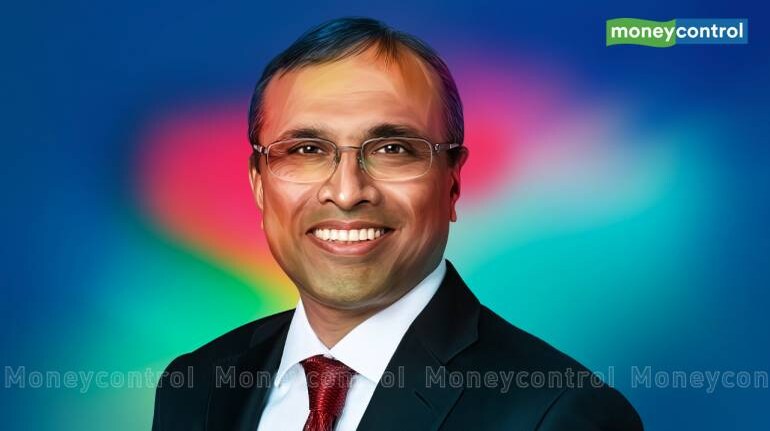
Hindalco Industries is well positioned to invest even during a commodity cycle downturn; the company may not need to revise its capex after slashing it by almost half to $4.4 billion in April, Managing Director Satish Pai told Moneycontrol in an exclusive interview on December 7.
Pai expects India demand for aluminium and copper to remain strong despite lingering concerns over global macroeconomic factors. The US arm of the Aditya Birla Group’s aluminium and copper flagship, Novelis, may see financial results improving progressively with every quarter, he added.
Halfway through the pivotal UN Climate Change Conference, better known as COP28, the aluminium industry has committed to greenhouse gas reduction. Pai, who is also the Chair, International Aluminium Institute, spoke exclusively to Moneycontrol on decarbonisation, his company, and his first visit to COP.
Edited excerpts follow:
The aluminium industry has committed to back a new initiative to reduce greenhouse gas emissions. How will this work?Aluminium plays a big part in electrification. The reason why the aluminium industry has come out so strongly and launched this initiative is because it is also an electricity-intensive industry. We want to make sure that the aluminium that we produce has low carbon (emissions). So that it is very clean and transparent, the International Aluminium Institute has come out with a methodology and a way to track and report what each member company commits to and what they actually do.
The group wants to declare a long-term greenhouse gas emission reduction target by 31 December 2024—preferably net-zero by 2050. How much investment would this require?The investment profile is different, depending on the region you are in. If you are in Europe, you have access to hydropower and you have less of an investment to make. But I think what we should focus on is what they call the Global South…the majority of our power is from coal. To decarbonise our electricity profile and the grid, this is where the majority of the investment will have to go.
If you look at India, where the majority of our power comes from coal, to decarbonise our electricity profile and the grid will require major investments.
The Carbon Border Adjustment Mechanism, or CBAM, which will force foreign importers to cover the cost of their carbon emissions, kicked in on October 1. How prepared are Indian metal manufacturers for it?
It is a given that there will be some sort of a carbon tax in most countries in the long term. Europe is normally ahead of the pack and has announced it. The Indian government is in active discussions with the industry and other stakeholders to put some sort of a carbon trading mechanism. Most companies are quite well aware that there’ll be some sort of a carbon tax coming in most countries; they aim to be world players and are preparing for this.
There are some serious challenges the aluminium industry faces in turning green. By its very nature, it needs uninterrupted round-the-clock (RTC) power, and while India has developed renewable energy capacity significantly, RTC is still at an early stage. What is Hindalco doing in this respect?Yes, just renewables on its own is not going to solve industry’s problem for baseload power. Hindalco’s RTC power contract Greenko, where we are using pumped hydro, actually got selected in COP28 — it was one of the projects that got an award. The concept is that we will be using a combination of solar, wind and pumped hydro to give us an 85 percent load factor. We are actually going to start using this in our Aditya smelter from the third quarter next year. If we can make this work, then this gives us a line of sight to decarbonise the aluminium smelting chain, which is the most difficult one. We are actually quite eager to get this contract started. Just to be clear, Hindalco has a target that 30 percent of its aluminium production will be low carbon by 2030. And the pumped hydro contract is actually one of the kingpins of our strategy to make that happen.
After the second quarter results, you had said that ahead of the Union Election, you expect strong aluminium and copper demand in domestic markets, driven by higher project execution. What’s your demand and price outlook for the third and fourth quarter?The Indian market demand is very good and is growing at more than 10 percent year-on-year. This is going to be driven by auto, electrification projects, building and construction sectors. I had said at the end of Q2 that LME prices will be between $2,100 and $2,300 (per tonne) and I will stay with that guidance. It is around $2,175 today; the weakness is still because of global macroeconomic triggers.
Hindalco has plans to incur a capex of $4.4 billion over the next five years in India and the US. This is lower than the $8 billion announced some time back. Do you foresee any challenges that may force you to revisit this number again? And how's the capex going right now?We revisited the plan to keep the capex in line with our cash flows. When LME prices came down and there was a little bit of softness in demand internationally, we decided to go slow on the capex. I am happy to say that we see no further need to change any of our capex plans. We are going ahead with all the big projects that we announced. Just to recap, the big $2.7 billion Bay Minette project of Novelis is progressing very well. Our Aditya smelter expansion of Rs 3,500 crore in India is progressing very well. And we also announced a big Rs 1 billion greenfield alumina refinery in Odisha. So, I think that the strength of Hindalco’ balance sheet allows us to stick with our capex plans, even during these slightly softer times.
Give us some perspective on what you expect from Novelis and the demand globally.The worst is over from a can market destocking for Novelis, so we are now seeing can volumes pick up. Auto demand has always been very strong—aerospace is very strong. I think for Novelis the worst is over and we are going to see progressively better results every quarter.
A big concern in the industry is on the energy side, which includes both energy security and the price of energy. What is Hindalco’s strategy? Are you looking at any merger and acquisition opportunities to secure energy for your company?Not really, you see, internationally, we buy it from the grid. The only place we were worried about for Novelis is Europe, but I think this year, the prices are still at reasonable levels. So, I don't think we have much concern there. In India, power demand is extremely strong. It is fair to say that the auction prices of coal have been trending a little bit higher. But I also think that the production profile from Coal India and all has been extremely robust. I am quite confident that energy availability and coal availability to do power this winter will not be a concern in India.
There are concerns that your industry has raised over dumping by China in the past. And there is also a potential opportunity for India from the ‘China plus one’ strategy that countries are looking at. How is the China factor playing out in the industry?I think you actually said it very well. On the one hand, there is a great opportunity with ‘China plus one’. So, a lot of people are coming into India, setting up capacity and we are looking to provide aluminium and copper for that opportunity. But as the Chinese economy has weakened, their aluminium industry is looking for new markets. India, the Middle East and Africa are big targets. If you look at the level of imports coming into India from China, especially foil, it has risen sharply and it's coming in at what I call lower prices than the cost of production in China. That is a concern and through the appropriate industry bodies, we have filed petitions for anti-dumping again.
Metal manufacturers are vulnerable to commodity cycles and yet they have to move ahead with decarbonisation. There are factors affecting margins and then there is also significant debt on the books of most companies. How do these companies, especially Hindalco, plan to finance decarbonisation projects given this background?
Our strategy at Hindalco, which we started to execute about 6-7 years ago, was that we would deleverage the company, pay off our debts, and make the balance sheet clean. This is helping us during these times, because now, interest rates have gone up. Any metal company borrowing money now is going to pay very high interest rates. The advantage of Hindalco is that our net-debt to EBITDA ratio in India is close to zero. We are generating pretty robust cash flows. Novelis is a converter with robust cashflow. So, we have the ability to invest in a downcycle, which is going on right now. And I think that’s what differentiates Hindalco versus other metal companies.
We are almost midway through COP28. What is the best outcome that you are hopeful of from COP28 before it wraps up later this month?What differentiates COP28 from the other COPs is that most of the hard-to-abate sectors like oil and gas, steel, cement, aluminium, and all others are represented here by their CEOs, not just lobbyists. Let me be clear there’s no lobbyists from Hindalco here, I am here. If you want to make real action happen on climate, then it's industries and corporates like us who have to take the steps. The other bodies, the NGOs, the governments, they can make the declaration, but the action starts from companies like us. I am very hopeful because every industry that I have seen here has come in with firm commitments with projects that they’re working on. This is a transition phase so it will take some more time; but the commitment is there from all industries. It’s a practical COP, not just a COP of declarations.

Discover the latest Business News, Sensex, and Nifty updates. Obtain Personal Finance insights, tax queries, and expert opinions on Moneycontrol or download the Moneycontrol App to stay updated!
Find the best of Al News in one place, specially curated for you every weekend.
Stay on top of the latest tech trends and biggest startup news.