India’s free trade agreement (FTA) with Oman could unlock close to $1 billion in incremental trade, largely by allowing Indian exporters to undercut rivals such as China, the European Union, Malaysia, Singapore, Pakistan and the United States, a Moneycontrol analysis shows.
India exported goods worth $3.95 billion to Oman in 2024, making it Oman’s second-largest export partner, after China. Yet a large share of Oman’s import basket is still dominated by competitors that enjoy a tariff-driven cost advantage.
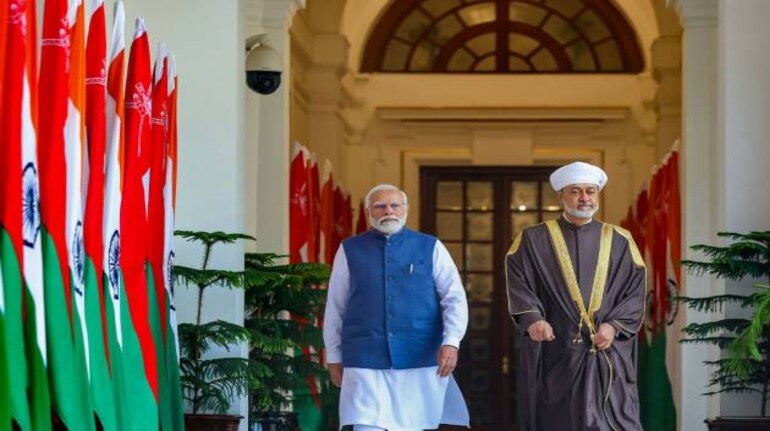
The FTA—signed by Prime Minister Narendra Modi on December 18 as part of a comprehensive partnership agreement—has the potential to materially shift market share in India’s favour across multiple product categories.
At present, most Indian goods entering Oman attract a 5 percent customs duty, while some categories face much steeper tariffs—100 percent on alcohol, 52 percent on chocolates and canned fruits, and 29 percent on animal fats and vegetable oils. Even the removal of the baseline 5 percent duty could significantly improve India’s price competitiveness in categories where it already trails rivals by narrow margins.
Big 3 face limited exposure
In absolute terms, China, the EU and the US stand to lose the largest value of exports, though the proportional impact remains modest. The analysis suggests India could become competitive in $81.5 million of Chinese exports, $151 million of EU shipments and $77.2 million of US exports to Oman, if tariffs are equalised.

For China—Oman’s largest trading partner with $5.8 billion in exports—only about 1.4 percent of shipments are at risk. The EU and the US could see 4–5 percent of their Oman exports face fresh competition from India, largely in segments where price differentials are small.
Pakistan, Southeast Asia face stronger pressure
The most pronounced impact is likely to be felt by Pakistan, Malaysia and Singapore, as Indian exporters could threaten nearly half of their existing exports to Oman.
Pakistan emerges as the most vulnerable. Of its $215 million exports to Oman in 2024, more than $105 million—or 49 percent— could face direct competition from India. Much of this exposure is concentrated in agricultural products such as guavas and mangoes, where Pakistan’s exports were already around 15 percent lower than India’s last year.
Malaysia and Singapore also face significant exposure. India could potentially challenge 42 percent of Malaysia’s exports and 44 percent of Singapore’s shipments to Oman. For Malaysia, the risk is concentrated in soft-drink concentrates and food preparations. For Singapore, products such as industrial pumps and parts—whose export values were within 1 percent of India’s—are particularly exposed.
Broader Asian impact
Among other Asian exporters, Indonesia could see nearly $80 million, or 19 percent, of its exports to Oman challenged by India. Thailand and South Korea face smaller but still meaningful risks in select manufactured and intermediate goods.
The analysis focuses on product lines where Oman’s global imports exceed $100,000, India’s market share is below 40 percent, and Indian exports are either within 5 percent of competitors’ levels or already higher, signalling strong underlying competitiveness.
While the estimated $900 million–$1 billion opportunity is modest, relative to Oman’s total imports of nearly $26 billion, it could help India consolidate its presence in food products, chemicals, light engineering goods and consumer items.
Discover the latest Business News, Sensex, and Nifty updates. Obtain Personal Finance insights, tax queries, and expert opinions on Moneycontrol or download the Moneycontrol App to stay updated!
Find the best of Al News in one place, specially curated for you every weekend.
Stay on top of the latest tech trends and biggest startup news.