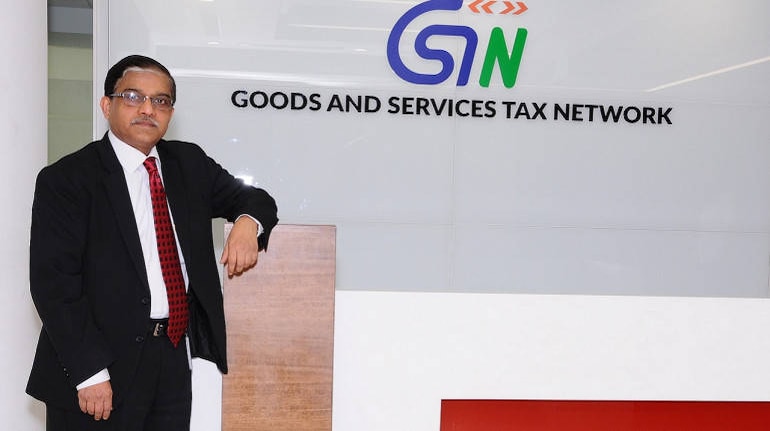
Goods and Services Tax Network (GSTN), a special purpose vehicle (SPV), is ready with a robust IT backbone and portal to enable real-time taxpayer registration, filing returns, handle invoices, and connect states for two-way data flow.
GSTN CEO, Prakash Kumar told Moneycontrol in an exclusive interview that the network is equipped to handle 2.6 billion transactions every month from an estimated 8 million GST tax payers.
It can scale up to handle double the volume (5.2 billion transactions a month) and up to 13 million tax payers, without any change.
GST, which promises to stitch a common national market by subsuming a web of local and central taxes into a single levy, is expected to be rolled out from July 1, 2017
GSTN trial runs will begin from May 1. The soft-launch or the dipstick study will be carried out through identified 3,000 tax payers who have migrated and enrolled into the new system, who will test the system by uploading invoice data, filing returns, and paying taxes.
The system is highly secure to prevent any data leakage. That said, Kumar is of the view that there is an urgent need for a privacy law in India
Excerpts:How prepared is GSTN for a roll-out from July 1?We first rolled out our portal on November 8. That’s the day we started the enrollment of taxpayers. By now, 58.5 lakh taxpayers have already come on board, which is about 71 percent of 81 lakh assessees.
There are three modules for which we are responsible under the GST portal: registration, return filing, and creation of challans for making payments through banks.
Payment does not take place at our portal. The taxpayer will create the challan and then he will choose a bank where he goes and makes a payment. He will be brought back to our portal, with a confirmation from the bank.
The government has added credit card and debit card as modes of payment, which, so far, a few states like Rajasthan have allowed.
They are also going to allow RTGS and NEFT payments from any bank. Suppose I am a taxpayer and I want to make a payment through a specific bank, I can do it directly through RTGS.
They will come to the portal, create the challan, go to the bank, and make the payment. The banks will compile that and send it to the RBI. RBI will also get data from us. These two, the RBI’s and our data, will go to the accounting authority for reconciliation.
How long will the entire process take on a real-time basis?The way you make any payment. Like an income tax payment or the way you make credit card payment, bill payment. Once the payment happens, you come back again (to the portal). It is basically a handshake between our portal and the bank portal and back to our portal.
How will GSTN authenticate data integrity?We are starting a process called server-to-server authentication. This is just to double-check that what is coming back from the bank is authentic. This will be done in the backend. The taxpayer will not see it. This is required so that this is full proof.
There is another check that happens when bank checks the scroll in the night. It is a multiple reconciliation process.
On any given day, how many billion transactions will take place through the GSTN portal?There are nine states where they already take invoice-level data. Our estimations are based on the number of invoices which these nine states are currently getting. We expect the portal to get 2.6 to 3 billion invoices every month in the portal once GST comes into force.
What is the level the system is equipped to scale up to?What we have designed is for 80 lakh taxpayers to start with. It can go up to 1.3 crore taxpayers, without any change in anything. The volume of transaction can double the amount (from 2.6-3 billion invoices to 5.2-6 billion invoices a month).
What is the statistical probability of a system crashing?I don’t know. I don’t want to hazard a guess.
But you have done a simulation exercise?That work is going on, with testing and other things with full load. It is being done in Bangalore now. GSTN trial runs will begin from May 1. The soft-launch or the dipstick study will be carried out through identified 3,000 tax payers who have migrated and enrolled into the new system, who will test the system by uploading invoice data, filing returns, and paying taxes.
We trained 1,924 master trainers in February in different batches. They in turn are now training around 65,000 tax officers from both the Centre and states.
What happens when portal goes through a downtime?No one in the world can say with 100 percent certainty that when a system will be up 100 percent. We have two data-centres—one each in Delhi and Bangalore—working in “active-active” mode. That’s the business continuity plan. If one of them goes down due to certain reasons, this one takes over the full load. The response time may go down as it will be a little degraded mode. Time for getting this up is half an hour. We have also gone for Tier 3 data-centres. Even if power supply fails or some natural calamity happens, there will be some data centres that will remain operational throughout the period.
We also have two small "near" data-centres. These are almost like proxies.
Also read: Two rates for services under GST? Council may examine proposalWhat about storage?Storage is not a problem. Why does a system crash? Because, it has limited capacity to handle volumes. Our system is designed on the basis of half of the people coming on the last day for filing returns in the last four hours. This is based on data from VAT departments and the Central Board of Excise and Customs (CBEC).
What is the scope of data leakage?We have two kinds of data. One is tax data, which is an indicator of the financial health of an entity that is registered with us. We also have personally identifiable data such as the PAN details. In our system, data gets immediately encrypted using the highest encryption algorithms available in the world today. Storage is also done like that.
There are two ways it can be misused: external and internal. To plug internal misuse we have ensured that one database administration does not have access to the full record. Any record that comes in is shared in different parts and allocated to different places.
On the external side on only two people can see the data: the taxpayer and the tax assessing officer.
What are your views on the recent reported Aadhar data leakage in Jharkhand?The fault lies with the user agency, which has the data. It is also lack of awareness. Attitude change is required and the country needs a privacy law. We should have it as early as possible.
Watch: Decoding: What does GST mean for you?What if someone is giving misleading data? What if there are instances of under-invoicing?The system has no capability to detect that. The tax department will look into it. There will, however, be a compliance rating. Metric for the compliance rating will not be disclosed. It will show how regular you are in paying taxes.
There has been criticism about GSTN’s corporate structure as a private company. What are your views?The government has created it after lots of deliberation. We are audited by CAG. We are a private company, with the strategic control of the government. The structure has been made in this way so that we have flexibility to recruit people, technical people from market.
How will the system work?Any taxpayer is both a supplier and a buyer. Even if you are manufacturer, you buy some raw material, buy some services, you upload the receipts data. Whatever you have sold, all the invoice data you will upload. This is only business-to-business. Only the incremental value addition that happens, like the manufacturer adds some value to raw material and the services and he makes something, is taxed. He is entitled to input tax on all raw materials.
You have the option of uploading the data one by one. We are also releasing an offline Java-based excel-compatible tool. If you maintain your accounts in excel, you can straight away pull that and upload. You can upload 19,000 invoices in one attempt.
What happens to a neighbourhood shop? There is a worry that most people are not accustomed to this exercise. Can they do it on their own?They can either do it on their own or engage a GST professional. There are three categories of GST professionals. The first includes chartered accountant s (CA), company secretaries (CS) and cost accountants. The second category includes law graduates. The third are sales tax practitioners. They are retired tax officers above a certain level.
Neighbourhood shops are not selling it to another business. They are selling it to people like us. There will be no business-to-business invoice. Their tax is very simple.
Ignorance can be a major challenge. In every township above one lakh population, there will be town hall kind of a thing to explain people how to file returns using the GSTN portal.
How often does one need to file returns?Every month. Expect few people, those whose turnover is below 50 lakhs and they want to opt for composition scheme. If you opt for composition, then you don’t get any input tax credit.
Discover the latest Business News, Sensex, and Nifty updates. Obtain Personal Finance insights, tax queries, and expert opinions on Moneycontrol or download the Moneycontrol App to stay updated!
Find the best of Al News in one place, specially curated for you every weekend.
Stay on top of the latest tech trends and biggest startup news.