Mere enrolment in a welfare scheme does not sufficiently determine whether beneficiaries are protected by a social protection safety net. For example, even after successful enrolment in a cash transfer scheme the safety net can be compromised when credit failures occur.
As in the case of Sunita, an MGNREGA labourer from Uttar Pradesh, many others are experiencing back-end issues with respect to their Direct Benefit Transfer (DBT) payments. Beneficiaries are often entirely unaware of the status of their payments and the follow-up required.
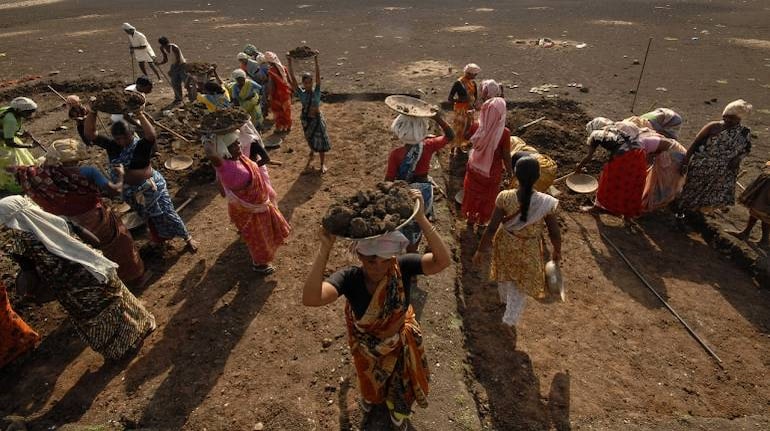
Sunita is a daily wage labourer in the Jalalabad district of Uttar Pradesh. She sometimes supplements her precarious income by claiming employment under the Mahatma Gandhi National Rural Employment Guarantee Act (MGNREGA). This is common practice in her village, and permits residents to earn Rs. 204 for a day’s work.
In May 2020, Sunita was allotted 13 days of work digging a pond site in a village in Jalalabad. In the following weeks, she waited for her wages (amounting to approximately Rs. 2,600) to no avail. As per scheme rules, she is entitled to receive her wage within a fortnight of completing any work. This protocol was not followed for reasons unclear.
Sunita was not the sole aggrieved – most MGNREGA workers from her village had not received their wages. Enquiries with the Block Development Officer (BDO) revealed that failure to link workers’ Aadhaar cards with their job cards, and spelling errors in workers’ names, were among the reasons for the payment failures.
This demonstrates a commonly occurring problem in processing DBT payments – the failure of payments due to bank account-related and Aadhaar-related documentation.
Results from the three-state Dvara-Haqdarshak survey of 1,500 DBT beneficiaries reveal that 18 percent of the payment issues reported were bank account and Aadhaar-related. Among Aadhaar-related issues, errors in the beneficiary’s Aadhaar details (36 percent) and pending KYC forms (32 percent) were the most common.
We validated these findings through interactions with stakeholders (such as district and block officers) and interviews with civil society volunteers. They confirmed that issues with Aadhaar details in the National Payments Corporation of India (NPCI) `mapper’ (which facilitates DBT payments), and closing / freezing of bank accounts are persistent issues which cause DBTs to fail. Issues with a beneficiary’s Aadhaar details, such as wrongly spelt names, lead to rejections by the DBT back-end.
Some beneficiaries even find that their accounts are restricted from receiving incoming DBTs as they are flagged as inactive by banks, sometimes wrongly.
Some of these issues continue to occur in spite of notifications by the ministry of finance instructing banks to eliminate some types of failures.
Indeed, analysis of official administrative data published on the publicly-available PM Kisan dashboard reveals that 51 percent of payment failures may be attributed to Aadhaar-related problems.
This implies that beneficiaries’ Aadhaar details may not be captured in the NPCI mapper, or that the submitted Aadhaar number already exists in the mapper, but for a different citizen.
A district agricultural officer in Raipur, Chhattisgarh, has confirmed that issues in PM-Kisan data often arise due to incorrect / incomplete seeding of citizens’ Aadhaar numbers with their bank account details.
We make the following policy recommendations to make payment processing more inclusive. We advocate the overall reduction of payment errors while equipping citizens with the requisite tools to rectify them, should they occur.
1. Publication of DBT transaction failure data:
At present, there is limited information in the public domain regarding the outcomes of DBT payments. The NPCI publishes annual data on the volume and value of successful DBT transactions under the Aadhaar Payments Bridge System (ABPS).
Beyond this source, there is no regular publication of data about failures in DBT payments – even though the ‘DBT file’ created during disbursement captures the reason for transaction failures.
Publishing such data could improve transparency in the DBT system and foster a better understanding of why welfare payment failures occur.
Such reports may also provide details at some level of disaggregation – say, the number of transactions failed (with root causes) by location type (urban / rural), welfare scheme, gender and so on.
Over time, the regular publication of such transaction failure data would prompt improvements in the system. A similar protocol may be applied to grievance data for complaints about payment processing.
2. Improve channels of communication with the citizen:Our field interactions indicate that DBT beneficiaries often rely on banks to provide updates on the payment status of DBT transfers. Most citizens approach the local bank / banking agent to enquire whether a welfare payment has been made into their accounts. If the bank / banking agent cannot provide a satisfactory update, beneficiaries are unlikely to be able to diagnose potential issues.
We propose that crucial details about the payment status of a DBT must be communicated to citizens by a designated governmental entity within the DBT architecture. Government-to-citizen services (G2C) communication must be transparently allocated to a public authority rather than be left to banks.
The communication must be designed to apprise citizens of all updates to their payment status – from the generation of the Fund Transfer Order (FTO) until successful credit.
In case of failure, the specific reason for credit failure must be mentioned, along with information on the steps required to resolve the issue. These details should be regularly updated on the beneficiary’s online record and communicated through an SMS notification / IVR call in the local language.
Aishwarya Narayan is a Research Associate at the Social Protection Initiative at Dvara Research.
Discover the latest Business News, Sensex, and Nifty updates. Obtain Personal Finance insights, tax queries, and expert opinions on Moneycontrol or download the Moneycontrol App to stay updated!
Find the best of Al News in one place, specially curated for you every weekend.
Stay on top of the latest tech trends and biggest startup news.