






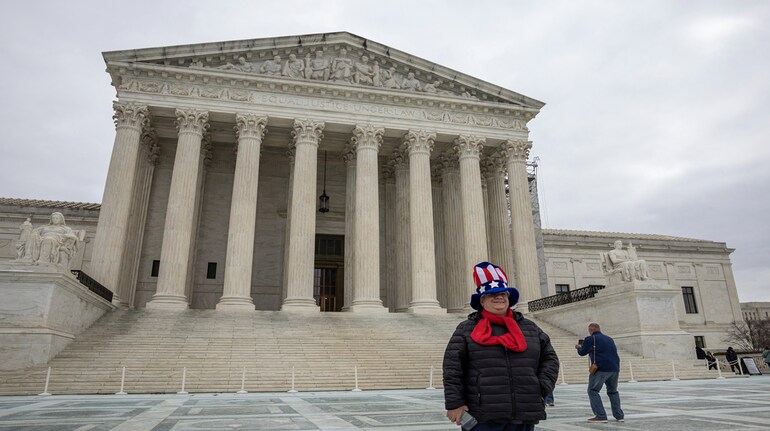

A ruling by the US Supreme Court on the legality of former president Donald Trump’s global tariff regime could sharply alter the scale of India’s trade exposure to the United States but it will not eliminate it altogether. For New Delhi, the difference between a favourable and an unfavourable verdict is stark: tariffs on roughly $8 billion of exports at one end, or more than $50 billion at the other.
If the court upholds the use of emergency powers under the International Emergency Economic Powers Act to impose sweeping tariffs, India’s exports worth over $50 billion could continue to face elevated duties of over 50 percent. The burden in such a scenario would fall disproportionately on labour-intensive sectors such as textiles and gems and jewellery, where India is deeply embedded in US consumption supply chains and has limited ability to redirect volumes quickly.
India exported about $80 billion worth of goods to the US in 2024. While pharmaceuticals and mobile electronics form a large part of this basket, categories such as shrimps, carpets and textiles are areas where Indian exporters are especially dependent on US demand.
In nearly $10 billion of these products, the US accounts for a dominant share of India’s total global exports.
Recent data already hints at growing stress. In hair products used for wigs, India’s share of US imports slipped to about 51 percent in September, down sharply from roughly 76 percent over the first seven months of the year. A similar erosion is visible in worked synthetic or reconstructed diamonds, where India’s share fell to around 69 percent in September compared with about 93 percent earlier in the year.
In some large-ticket categories, the decline has been even steeper: India’s share in diamond imports dropped to roughly 22 percent in September from 51 percent in the preceding months, while granite fell to just 9 percent from nearly 48 percent. Certain stone categories saw shares plunge to 31 percent from highs of 88 percent.
What if tariffs go?
Even if the Supreme Court strikes down Trump’s emergency tariffs, India will not emerge entirely unscathed.
Duties imposed under Section 232 of the Trade Expansion Act of 1962—which are justified on national security grounds—would remain intact.
These measures cover strategically sensitive products such as steel, aluminium, automobiles, timber, copper and select machinery, and they are based on investigations rather than presidential emergency powers.
According to UN COMTRADE data, India exported about $8.3 billion worth of goods covered under Section 232 to the US in 2024. This represents 10.4 percent of India’s total exports to the American market, meaning that even in the best-case legal outcome, roughly one in every ten export dollars would still face tariff exposure.
The vulnerability is concentrated. Automobiles form the largest block, with exports worth about $3.9 billion falling under the national security lens. Steel shipments totalled roughly $2.5 billion, while aluminium exports were close to $800 million. Timber, copper and industrial vehicles have a significant exposure.
In proportional terms, the dependence is more pronounced. The US absorbed nearly 39 percent of India’s global timber exports in 2024, about 37 percent of aluminium exports and roughly 34 percent of steel exports.
Discover the latest Business News, Sensex, and Nifty updates. Obtain Personal Finance insights, tax queries, and expert opinions on Moneycontrol or download the Moneycontrol App to stay updated!
Find the best of Al News in one place, specially curated for you every weekend.
Stay on top of the latest tech trends and biggest startup news.





