
co-presented by
ASSOCIATE SPONSORS
co-presented by


ASSOCIATE SPONSORS





There have been 124 crypto hacks between January 2020 and October 2022, resulting in losses amounting to $5.18 billion, according to DeFi TVL aggregator DeFiLlama.
While there are many different modes in which crypto hacks have taken place since the start of this decade, their impact on the affected token’s price does draw surprising results.
While rug-pulls constitute less than 10% of all these hacks, vulnerabilities in blockchain protocol architecture continue to be a soft target for attackers, followed by exploits on the network’s infrastructure or its ecosystem.
Rug pulls happen when fraudulent developers create a new crypto token, pump up the price and then pull as much value out of them as possible before abandoning them as their price drops to zero.
In terms of the modus operandi employed, nearly a third of all the evaluated crypto hacks are contributed by compromises in the private keys of investors and reemphasize the importance of storing them securely.
While these hacked projects have seen their native token’s price plummet by ~50% on average, some tokens have lost as much as 99% of their value in the aftermath.
Surprisingly though, a crypto hack does not necessarily lead to the total collapse of the project, and in some cases, the underlying token has even gone on to bounce back to price levels higher than prior to the attack.
With this background, let us delve deeper into the insights offered by DeFiLlama’s analysis and understand what investors should expect in the scenario of a crypto hack.
Crypto hack categories and methods
DefiLlama characterized the hack in their dataset according to whether it targeted a flaw in the infrastructure (its technology), the smart contract language (digital contracts stored on a blockchain), the protocol logic (rules that government a blockchain network), or the interaction between various protocols (interaction between different blockchains).
The chart that follows shows the outcomes.
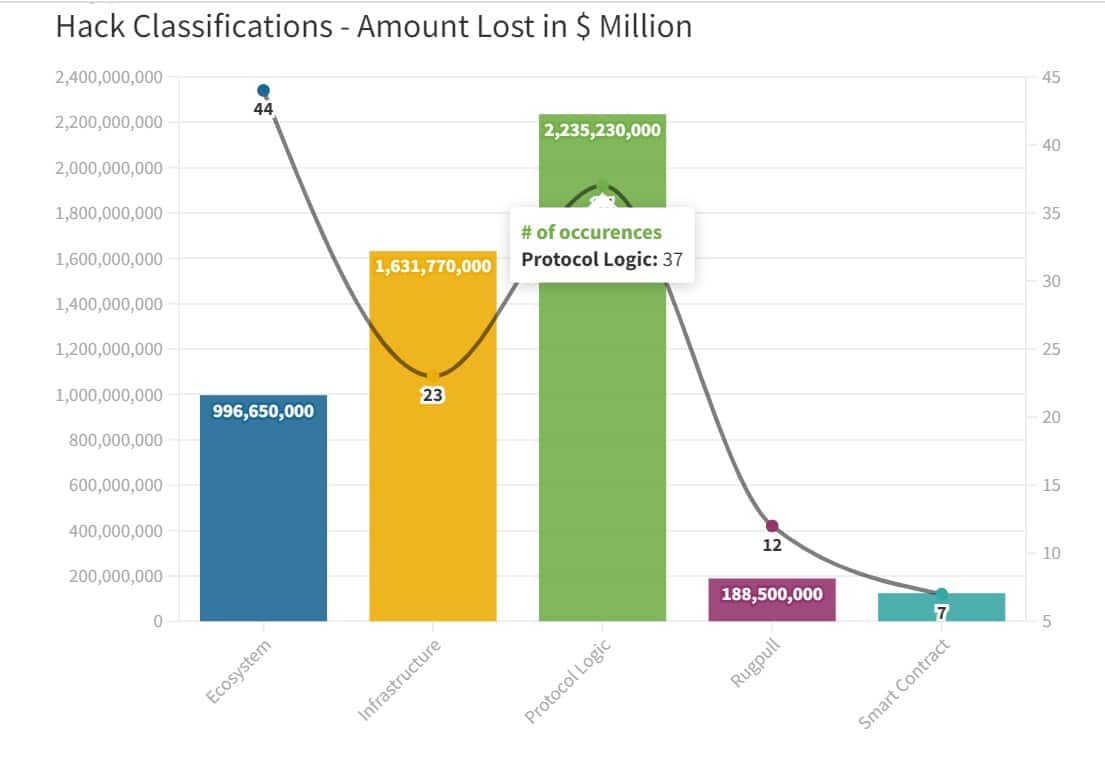
According to the research, the highest attack surface for potential attackers is provided by protocol logic hacks; 37 protocol logic hacks cost more than $2 billion in losses.
Similar to this, the ecosystem and infrastructure of crypto platforms frequently include gaps that hackers might exploit.
Rug pulls are rather uncommon.
The following graph displays a sample of the assault methods that were most frequently used and how much money was taken using them.
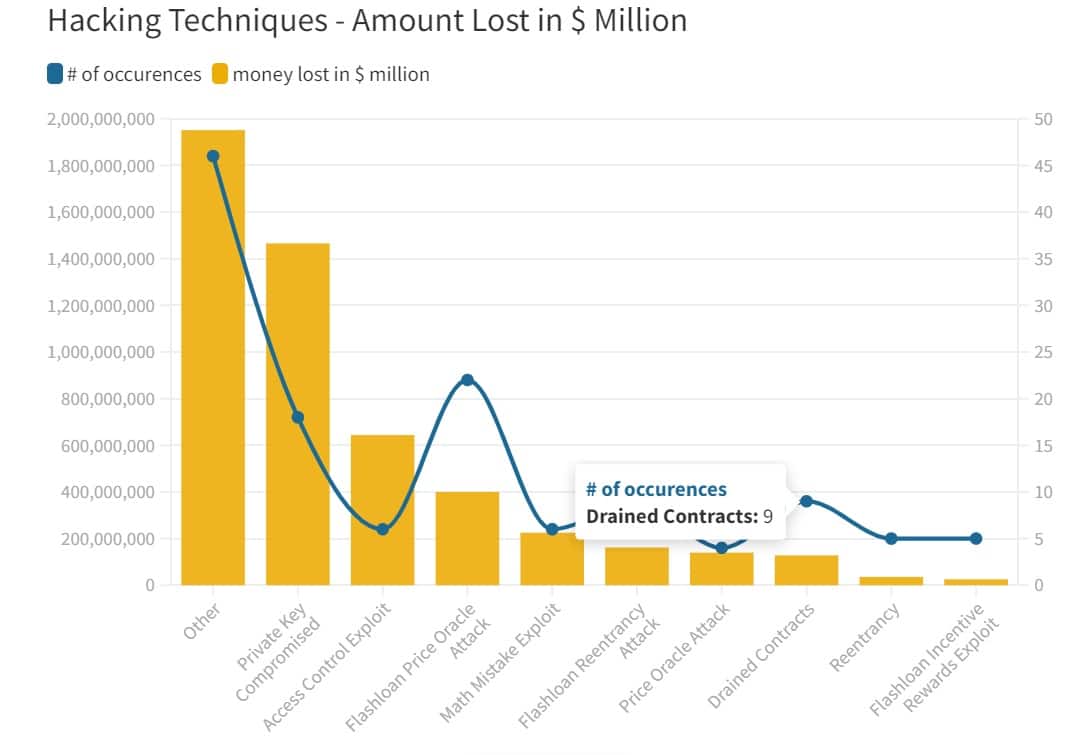
What is surprising is how frequently hackers were successful by stealing the private keys of investors and project participants.
Attackers were able to use access control vulnerabilities to gain access to features and carry out tasks they should not have been able to.
Price oracle manipulation refers to the ability of hackers to alter data that third parties supply to a smart contract in order to force the smart contract to take a particular action.
How Hacks Affect Cryptocurrency Prices
It comes as no surprise that the announcement of a hack has a cascading effect on the value of the impacted cryptocurrency.
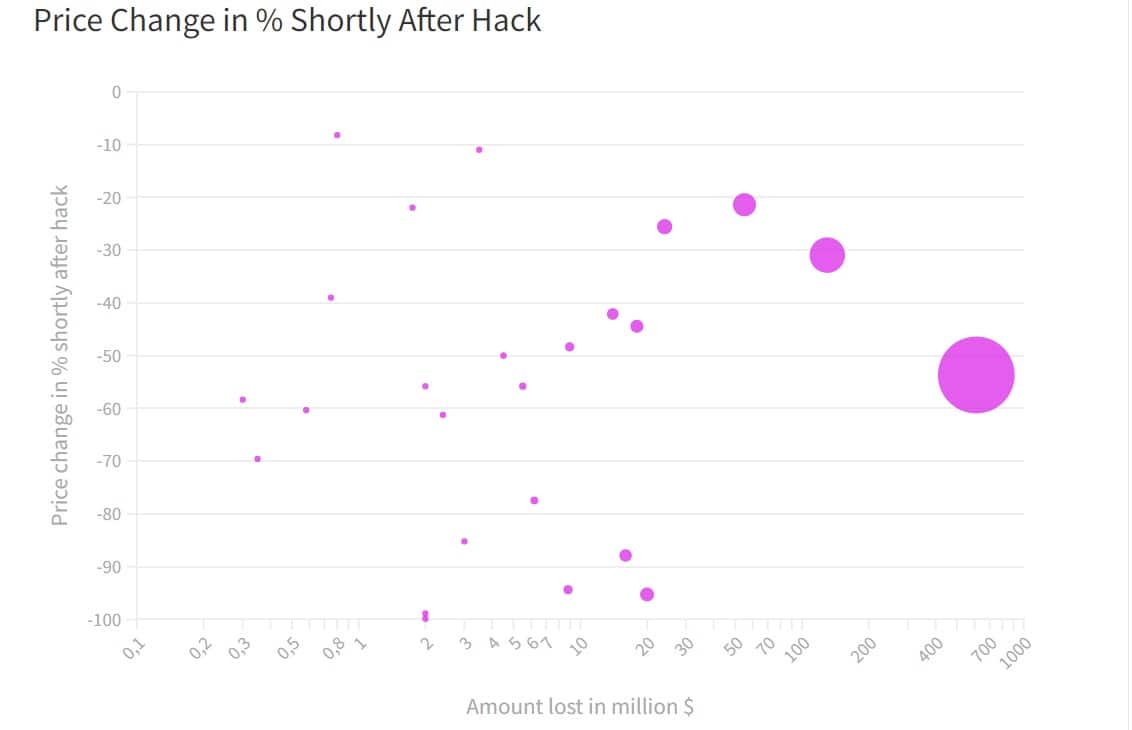
Hacked cryptocurrency projects typically lost 50% of their value during the first few days after the breach was made public.
Using a sample of comparable projects, the following chart illustrates when the prices achieved a local bottom a few days after the hacks.
The quantity of lost funds does not appear to be related to price reductions.
Let us now look at the timeline below to gain a better idea of how hacked cryptocurrency prices react over time.
It displays the value's percentage change over time at various time stamps.
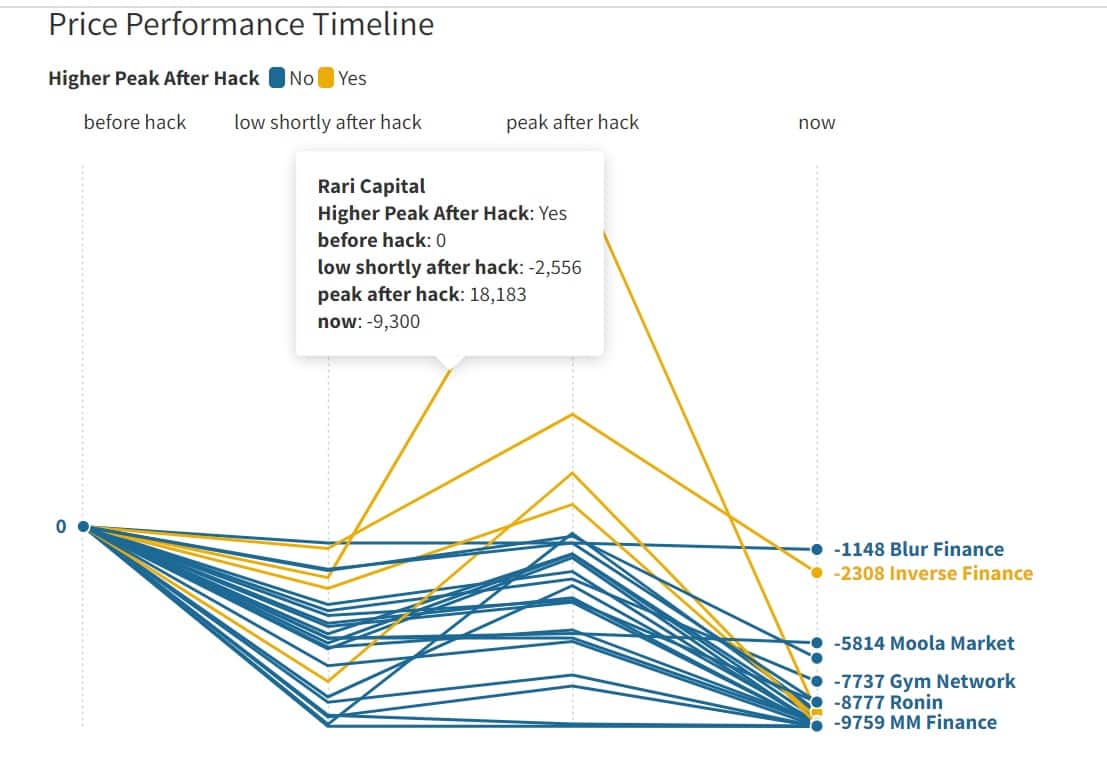
The affected cryptocurrencies suffered severe value losses in the initial days following the breach, as the previous graphic demonstrated.
Peak after hack
What is striking is that a hack does not always
result in an instant project total collapse.
A significant portion of the investigated cases had a relative price recovery after the attack, which is depicted in the above chart as "peak after hack."
The length of time needed to achieve the peak and the magnitude of these price rises cannot be generalized.
The well-known "dead cat bounce" played a role in certain instances, but the underlying bull market also appeared to play a significant role.
However, compared to the pricing before the hack, the vast majority of projects never attained the same or greater price level (blue-colored lines).
This implies that once the trust is lost, it typically never returns.
This occurred in the 2021 bull market for the select few cryptocurrencies (yellow lines) where a greater price was attained following the hack.
None of these endeavours could, however, generate profitability over the long haul.
Long-term projects that have been hacked drastically lose value; on average, they saw a loss of 80% from the price levels soon before the hack.
Conclusion For Investors
The major inference from this analysis is that
investors should sell any cryptocurrencies they own if they have been compromised.
The information on hacking categories and methods presented above demonstrates that many cryptographic projects have significant flaws.
It is challenging to review and assess crypto ventures in this regard as a retail investor, which emphasizes the value of audits conducted by trustworthy third parties.
Discover the latest Business News, Sensex, and Nifty updates. Obtain Personal Finance insights, tax queries, and expert opinions on Moneycontrol or download the Moneycontrol App to stay updated!

| 1W returns-13.36% |
| 1W returns-14.20% |
| 1W returns-14.21% |
| 1W returns-15.64% |
| 1W returns-16.59% |
| 1W returns-16.97% |
| 1W returns-20.98% |
Find the best of Al News in one place, specially curated for you every weekend.
Stay on top of the latest tech trends and biggest startup news.