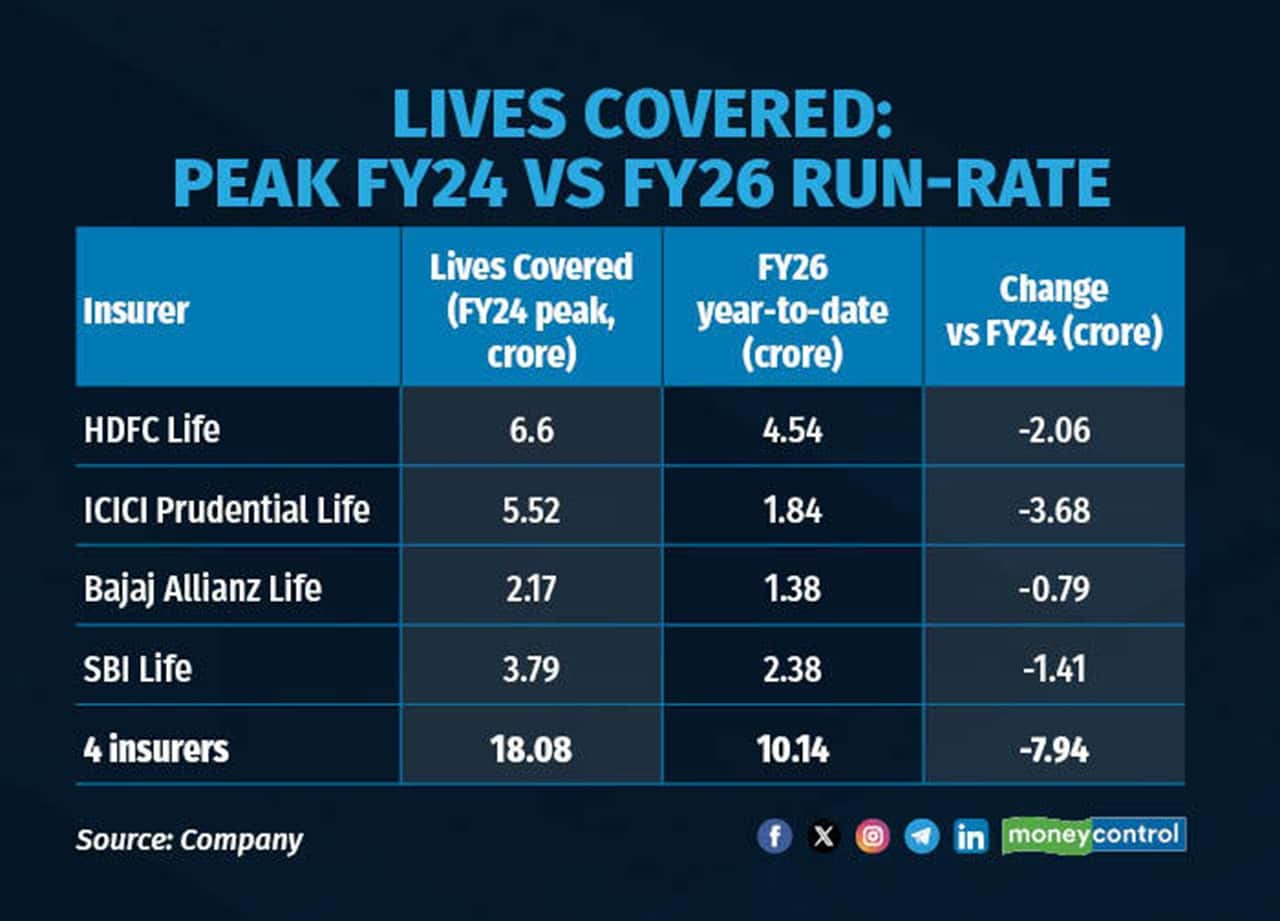
Over the roughly 18-month period from FY24 to the first half of FY26, the four large private life insurers including HDFC Life, ICICI Prudential Life, Bajaj Life and SBI Life have seen an erosion of nearly 8 crore lives.
A comparison of peak coverage in FY24 with the current FY26 run-rate illustrates the scale of the decline. In FY24, HDFC Life covered 6.6 crore lives, ICICI Prudential Life 5.52 crore, Bajaj Life 2.17 crore and SBI Life 3.79 crore, taking the combined total for these four insurers to about 18.08 crore people.
By the first half of FY26, the number of lives covered had fallen sharply across all four insurers with HDFC Life reporting 2.27 crore lives in H1 FY26, ICICI Prudential Life 92.49 lakh, Bajaj Life 69.22 lakh, and SBI Life around 1.19 crore lives.
When annualised to arrive at a comparable full-year run-rate, this translates to roughly 4.54 crore lives for HDFC Life, 1.84 crore for ICICI Prudential Life, 1.38 crore for Bajaj Life and 2.38 crore for SBI Life, or a combined run-rate of about 10.14 crore lives.
Industry executives and analysts say the data points to unintended consequences of the private sector’s aggressive pivot towards protection products in recent years, particularly group term and employer-linked covers.
While insurers had positioned protection as a more sustainable and customer-centric alternative to savings-linked policies, the sharp fall in lives covered combined with persistently high mortality claims suggests that the strategy may be under strain.
“Group protection delivers volumes quickly, but margins are thin and claims volatility is much higher,” said an analyst. “Once pricing turns adverse, insurers are forced to pull back sharply.”
A senior executive from a life insurance company added that the stress in group protection is prompting a reassessment of product mix across the industry. Several insurers are increasingly shifting focus back towards savings-oriented products, including monthly income schemes (MIS), which offer more predictable cash flows and lower claims volatility.
“From a risk-management perspective, savings products provide stability when mortality experience is uncertain,” said the executive. “What we are seeing now is not an abandonment of protection, but a recalibration after the experiment of scaling it too aggressively, especially on the group side.”
FY25 data confirms trend
The annual numbers mirror the same trend.
According to IRDAI and insurer annual report data, the number of lives covered by major private life insurers declined from 14.29 crore in FY24 to 10.82 crore in FY25.
Individually, HDFC Life’s lives covered fell to 4.97 crore in FY25 from 6.6 crore a year earlier, ICICI Prudential Life to 4.13 crore from 5.52 crore, and Bajaj Life to 1.72 crore from 2.17 crore.
SBI Life also saw a contraction in its coverage base. The insurer covered 2.55 crore lives in FY25, down from 3.79 crore lives in FY24, implying a reduction of over 1.2 crore lives year-on-year.
While SBI Life’s decline is less severe in percentage terms than some peers, the fall underscores that even insurers with a historically large and diversified group portfolio have not been immune to the broader industry slowdown.
...but claims remain high
What is particularly striking is that the contraction in coverage has coincided with persistently high mortality claims at several private insurers.
At ICICI Prudential Life, claims paid in FY25 stood at around 3.68 lakh, with FY26 estimates, annualised based on first-half data, placed in the range of 3.1-3.2 lakh. This remains significantly higher than the insurer’s peak Covid-year claims of about 2.5 lakh in FY22.
A similar pattern is visible at HDFC Life, where mortality claims continue to remain elevated despite the sharp fall in lives covered.
Analysts interpret this as evidence of adverse mortality experience within a smaller insured pool.
Bajaj Life has also reported elevated mortality claims relative to its reduced coverage base, particularly in the group segment, though absolute claim numbers remain below Covid-era peaks.
Analysts, choosing to remain anonymous, note that the decline in lives covered has not been matched by a proportional fall in claims, raising questions around pricing adequacy and underwriting discipline during the earlier phase of rapid protection-led growth.
However, in contrast, SBI Life’s mortality experience appears to have followed a more normalised post-pandemic trajectory, with claims trending down from Covid highs.
PSUs tells a different story
The divergence is most visible when compared with the PSUs like Life Insurance Corporation of India (LIC).
LIC’s number of lives covered rose 17 percent year-on-year in H1 FY26 to 4.25 crore, from 3.62 crore in the same period last year. On an annual basis, LIC covered 6.39 crore lives in FY25, up from 6.18 crore in FY24.
At the same time, LIC’s mortality claims have declined in line with post-pandemic normalisation.
After paying peak Covid-era claims of about 15.71 lakh, LIC’s claims fell to 10.13 lakh in FY25, with FY26 estimates expected to remain below 10 lakh.
An analyst explained, “LIC’s large, diversified policyholder base and lower dependence on group protection have helped smoothen its mortality experience.”
He further added, “Protection growth looked attractive on paper, but group business carries thinner margins and higher volatility. Once claims stay elevated, the economics can turn very quickly.”
He said, this stress may be prompting insurers to recalibrate their product strategies. There are signs of a renewed focus on savings-oriented products and monthly income schemes, which offer more predictable margins and lower claims volatility.
While such products have long been criticised for offering lower protection value, he argues they provide balance in a risk environment that remains uncertain even years after the pandemic.
Discover the latest Business News, Sensex, and Nifty updates. Obtain Personal Finance insights, tax queries, and expert opinions on Moneycontrol or download the Moneycontrol App to stay updated!
Find the best of Al News in one place, specially curated for you every weekend.
Stay on top of the latest tech trends and biggest startup news.