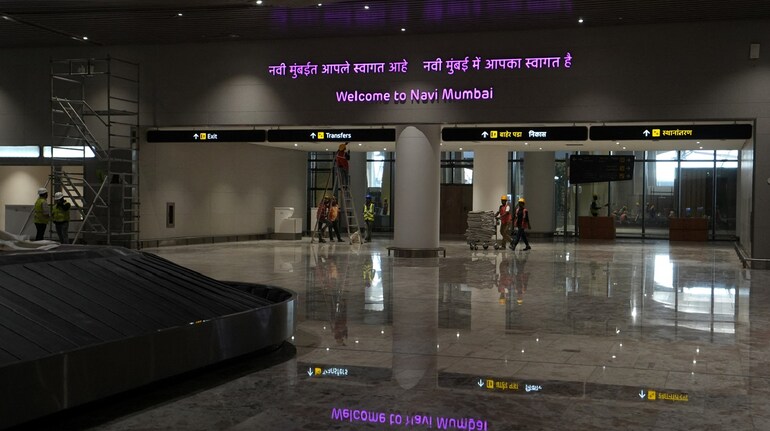
Airports Economic Regulatory Authority (AERA) of India is said to be formulating a methodology under which tariffs can be uniform for both Mumbai and Navi Mumbai airports which will make them a single unit rather than two separate airports from a tariff perspective.
The Navi Mumbai airport, which is set to open to the public from December 25, 2025, is perceived as an extension of the Mumbai airport. Both the airports, from a a tariff perspective, are under the control of Adani Airports Holdings (AAHL), India’s second largest private sector airport operator in terms of number of passengers handled.
The Navi Mumbai airport is partly owned by the City and Industrial Development Corporation (CIDCO) of Maharashtra.
Speaking to reporters, Jeet Adani, Director – Airports, AAHL, said: “Both CIDCO and AERA have agreed to, in principle, adopt the combined tariff formula, and AERA is working on the methodology on how it will work under the group of airports policy that they have. It is quite positively being worked upon by AERA.”
In June 2025, AERA declared that passengers at the Navi Mumbai airport will pay Rs 620 for flying domestic and Rs 1225 for international flights, as user development fee (UDF), which is among the steepest in the country.
UDFs are independently decided by AERA based on defined formulas which also has inputs from the airport operators. These rates go down with time. If the combined tariff plan results in a comparatively lower UDF, it would help increase traffic flow at Navi Mumbai, where AAHL has invested Rs 16,700 crore. On the other hand, if the tariff or UDF is high, it would make flying from Navi Mumbai costlier for passengers as airlines would pass on the high rates to its customers.
Since the last several years Mumbai airport has seen a total saturation in capacity at 55 million passengers. As there is no further space to grow organically, its operator AAHL will share the load with the Navi Mumbai airport where the eventual capacity after completion of the all the phases will be 90 million.
“We are talking about 12 million capacity in FY27 and a couple of million in this year (FY26) for the Navi Mumbai airport. By the year after that, 27-28, it should be a full 20 million capacity. But by then you will also see the combination of the tariff between Mumbai and NMIA, because it is quite positively being worked upon by AERA,” Adani added.
AAHL had earlier in 2025 argued for having a uniform tariff for Mumbai and Navi Mumbai airports. The company had referred to a 2021 amendment of the AERA Act that allows grouping of airports. The government had said that this will enable clubbing of profitable and non-profitable airports as a combination/package to bidders to make it a viable combination for investment under the public private partnership (PPP).
Navi Mumbai airport will commence operations with 30 flights, led by IndiGo. It will start with only daytime operations followed by night operations in January 2026. International operations are set to begin from March 2026, said senior executives of AAHL.

Discover the latest Business News, Sensex, and Nifty updates. Obtain Personal Finance insights, tax queries, and expert opinions on Moneycontrol or download the Moneycontrol App to stay updated!
Find the best of Al News in one place, specially curated for you every weekend.
Stay on top of the latest tech trends and biggest startup news.