






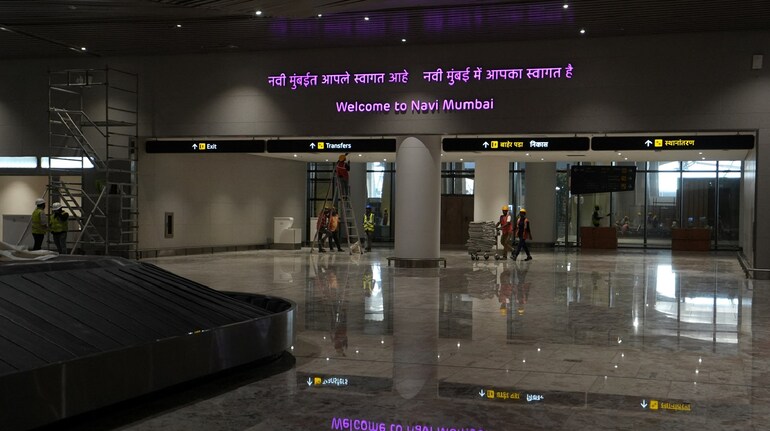

Private telecom operators have urged the Telecom Regulatory Authority of India (TRAI) to step in urgently, alleging a monopolistic choke point at the upcoming Navi Mumbai International Airport. They have also called for a cap on in-building mobile infrastructure charges at public facilities such as airports.
The appeal comes amid a standoff over mobile connectivity at the newly operational Navi Mumbai International Airport (NMIA), where passengers have flagged the absence of cellular services since commercial operations began on 25 December. Connectivity remains unavailable as telecom operators and the airport operator have failed to reach an agreement on commercial terms.
A similar dispute has also unfolded on Mumbai Metro’s Aqua Line, where commuters have endured patchy mobile connectivity for nearly three months after operators and authorities failed to reach consensus on commercial arrangements needed to roll out network services.
Through their representative body, the Cellular Operators Association of India (COAI), operators have alleged denial of Right of Way (RoW) permissions and the imposition of an exclusive in-building telecom infrastructure at the new airport being developed and operated by Navi Mumbai International Airport Limited (NMIAL).
In a January 13 letter to TRAI chairman Anil Kumar Lahoti, COAI said NMIAL has refused to allow licensed telecom service providers (TSPs) to deploy their own networks within the airport premises. Instead, the airport operator has allegedly mandated compulsory use of a single in-building solutions (IBS) network deployed by NMIAL or its affiliate, on terms and pricing that operators say are commercially unviable and not cost-based.
Moneycontrol has seen a copy of the letter.
“COAI’s member TSPs, namely Bharti Airtel Limited, Reliance Jio Infocomm Limited and Vodafone Idea Limited, had approached NMIAL seeking RoW permissions to deploy their telecom and IBS infrastructure for provision of 4G and 5G services within the airport premises. However, contrary to the express mandate of the Telecommunications Act, 2023 and the RoW Rules, NMIAL has declined to grant RoW permissions to licensed TSPs,” S P Kochhar, director general of COAI, said in the letter.
Instead, NMIAL has mandated that all TSPs must compulsorily utilise a network deployed by NMIAL or its affiliate, on terms unilaterally determined by it and at charges which are commercially not viable, Kochhar said.
COAI said the arrangement violates the Telecommunications Act, 2023 and the RoW Rules, which require public entities to grant RoW permissions in a non-discriminatory, transparent and time-bound manner. The association said it has been conveyed to its members that NMIAL is seeking payments of about Rs 92 lakh per month per operator—nearly Rs 44.16 crore annually for four mobile operators.
“These charges are grossly disproportionate, bear no rational nexus to the underlying cost of related infrastructure, and significantly exceeds the capital and operating expenditure ordinarily required for deployment of an independent IBS network. Such charges are also prima facie inconsistent with the RoW Rules, which permit recovery only of reasonable operational expenses and restoration costs,” Kochhar said.
By leveraging control over the airport premises, COAI said NMIAL has effectively positioned itself as the sole provider of in-building telecom infrastructure, while denying competing licensed operators the ability to deploy their own networks.
“This arrangement has resulted in a clear market failure. NMIAL/IBS Operator, though licensed only as a VNO, has assumed control over an essential facility, namely in-building access infrastructure within a public airport, thereby creating a monopolistic bottleneck. In the absence of competitive constraints and cost-based regulation, NMIAL/IBS Operator can impose excessive, non-transparent and noncost-oriented charges on all TSPs, who have no alternative but to accept such terms if they wish to serve consumers at the airport,” he said.
COAI has urged TRAI to examine NMIAL’s conduct, lay down and enforce a cost-based pricing framework with appropriate price ceilings for captive public locations, and issue directions to ensure non-discriminatory RoW permissions—or mandate shared infrastructure strictly on regulated, transparent and cost-oriented terms. It has also asked the regulator to take note of what it termed misleading public communications by NMIAL on network coverage and prevent attribution of fault to TSPs where RoW denial is the underlying cause.
Warning that the issue is systemic, COAI said similar exclusive IBS arrangements are emerging across airports, metro projects and other public infrastructure, enabling monopoly rents unrelated to actual costs. Timely regulatory intervention, it said, is critical to prevent replication of this model and to safeguard competition and consumer experience.

Discover the latest Business News, Sensex, and Nifty updates. Obtain Personal Finance insights, tax queries, and expert opinions on Moneycontrol or download the Moneycontrol App to stay updated!
Find the best of Al News in one place, specially curated for you every weekend.
Stay on top of the latest tech trends and biggest startup news.





