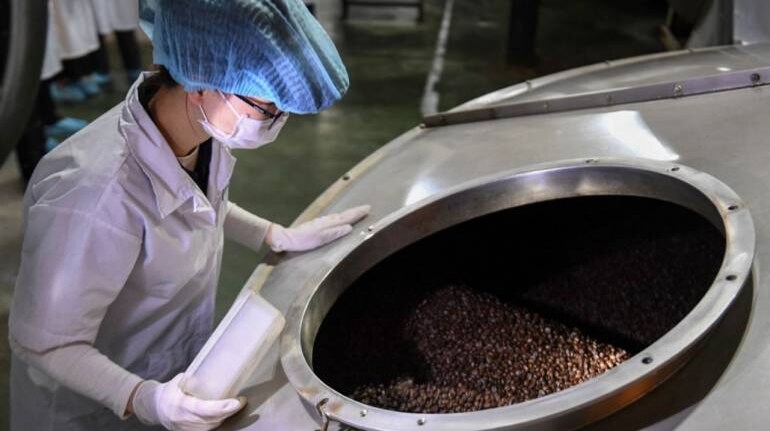
Surging prices and shortage of robusta beans have hit coffee exports from the country amid fears of the anticipated El Nino aggravating the situation this year.
Though coffee exports have shown a marginal drop of 2 percent for the six months ended June 30, 2023 at 2,18,192 tonnes, exporters reckon the slide will get worse in the coming months. Already the robusta cherry, the largest export, has seen a fall of 13 percent in the first half.
India exports around 70 percent of its coffee production and in 2022 the shipments came close to a record 4 lakh tonnes spurred by good output and demand.
Indian coffee production is 70 percent robusta beans and 30 percent arabica beans. Growers and traders claim the robusta crop is over 30 percent short of the Coffee Board’s estimate of 2,59,000 tonnes for 2022-23.
``Robusta is resistant to pest attacks but its growth is dependent on the monsoon. Erratic rainfall has led to lower production of the variety. Long dry spells followed by abnormally high rains have affected robusta production,’’ says M B Ganapathy, coffee grower and former chairman of the Karnataka Planters’ Association. Karnataka is the largest coffee producing state in India, followed by Kerala.
Given the insufficient rain in June and the long summer earlier, crop for the next year is likely to be affected as well, although a clear indication of the nature of the crop can be assessed only after September, he says.
Poor arrivals in the market and high prices have put exporters in a fix for two reasons. For one, it is hardly remunerative for them to buy at the current price. For another, there aren’t sufficient beans available to buy. Most of the exporters entered into contracts with the buyers towards the end of last year when the bean prices were lower. Indian robusta prices have seen a 30 to 40 percent jump since last year. Raw robusta coffee is hovering around Rs 6,000 per 50 kg, a slight drop from the previous month.
The global robusta prices too have surged this year on reports of anticipated shortage in Vietnam and Indonesia, the main producers of the variety. The global robusta futures prices reached a 15-year high of nearly $2,800 per tonne at the end of May before falling to the current level of about $ 2,500 per tonne.
``There is a slowdown in exports and profitability has also been affected. The current problem may reflect in the exports after a few months as usually the export contracts are entered into some time before execution,’’ says Ratnakar Mishra, CEO of the coffee division of food products supplier, Allanasons.
Europe is the biggest market for Indian green coffee and this year, a majority of the buyers have shifted to cheaper coffee from other suppliers. Though Indian robusta is much favoured in Europe for its superior quality, the buying trend has changed after the outbreak of the pandemic. Europe has become more price-sensitive.
``The buyers want us to sell coffee to them at a lower price. The coffee from other origins are around 10 percent cheaper,’’ says N Sathappan, director of SLN Coffee. Unlike the conventional coffee, export of instant coffee from India has not been hit. The cheaper instant coffee, which uses more robusta beans, is sold all over the globe with Asian countries being the principal destinations.
Mishra reckons that India may not lose its markets in Europe permanently. ``As the exports will be lower this year the better carryover stock may help us to sell at cheaper rates next year,’’ he points out.
But 2023 is going to be a difficult year for the Indian coffee industry as the robusta bean prices are likely to go up in the coming months because of inadequate availability. The next robusta harvest happens only by January next year. ``But usually the freshly harvested robusta is not good for roasting. It needs to be kept for two months for the quality to get better. So, more arrivals can be expected only by April next year,’’ said a coffee broker.
The United States Department of Agriculture (USDA) has forecast that the world coffee production for 2023/24 will go up by 4.3 million bags (60 kilograms) to 174.3 million with higher output in Brazil and Vietnam expected to offset reduced production in Indonesia. But with global consumption expected at a record 170.2 million bags, ending inventories are expected to remain tight at 31.8 million bags, it said. USDA predicts Indian coffee production to drop by 4 lakh bags to 5.8 million due to irregular weather.
Latest reports say El Nino (warming of the Pacific Ocean) may set in the second half of 2023, causing reduced rainfall that may lead to shrinkage of coffee crops in Vietnam (the largest robusta producer in the world), Indonesia and Brazil. Tight supplies are likely to put coffee prices under pressure.
Discover the latest Business News, Sensex, and Nifty updates. Obtain Personal Finance insights, tax queries, and expert opinions on Moneycontrol or download the Moneycontrol App to stay updated!
Find the best of Al News in one place, specially curated for you every weekend.
Stay on top of the latest tech trends and biggest startup news.