







Serious and ongoing deliberations are underway in New Delhi over the evolving Gaza peace process, with India weighing its options cautiously amid a fragile ceasefire and uncertain ground conditions. Government sources told CNN-News18 that India is intentionally avoiding haste, opting instead for a calibrated and realistic assessment of any potential role it may be asked to play.
Officials stressed that India’s position is anchored in long-standing principles rather than short-term optics. New Delhi has historically participated in peacekeeping or stabilisation missions only under a clear United Nations mandate, and that red line remains firmly in place when it comes to Gaza. Any departure from this framework, sources said, would require exceptional clarity on mandate, enforceability and broad international consensus.
A key concern within the government is the sequencing of the Gaza ceasefire plan. Sources cautioned against a rushed transition from Phase I to Phase II, warning that premature moves could destabilise an already fragile situation. The internal assessment is that unless the first phase is fully implemented and holds on the ground, advancing to subsequent stages could undo limited gains and trigger renewed violence.
Officials also pointed to past international interventions that collapsed due to weak mandates, unclear command structures and political contradictions. These precedents, they argue, reinforce India’s reluctance to endorse initiatives that prioritise symbolism over sustainability.
Despite this caution, New Delhi continues to support genuine diplomatic efforts to end the conflict. Sources emphasised that India remains committed to calling for an immediate ceasefire, sustained de-escalation and a political process that has credibility on the ground. In this context, Prime Minister Narendra Modi recently congratulated US President Donald Trump and Israeli Prime Minister Benjamin Netanyahu for efforts aimed at pushing the ceasefire forward, a gesture officials described as consistent with India’s support for diplomacy that reduces violence.
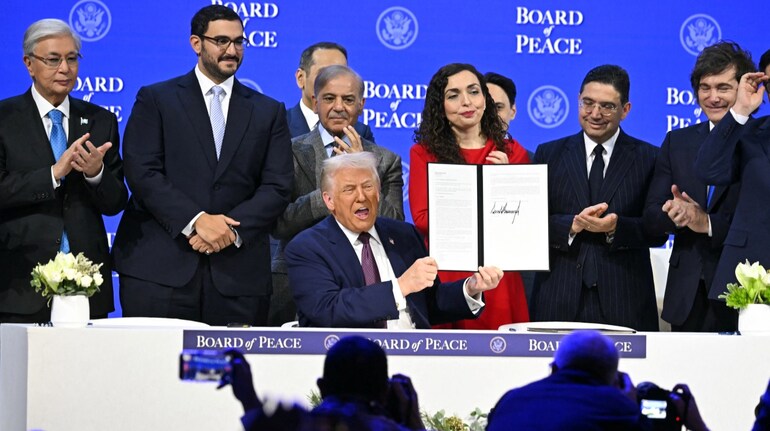
India’s approach stands in sharp contrast to Pakistan’s recent conduct. While New Delhi has deliberately stayed away from high-profile stagecraft, Islamabad rushed to align itself publicly with Trump’s Gaza “Board of Peace” initiative at Davos. Pakistan Prime Minister Shehbaz Sharif’s visible presence alongside Trump, sources note, appears driven more by the need to curry favour with Washington than by a coherent peace strategy.
Officials privately describe Pakistan’s posture as risky and politically fragile, especially given strong domestic opposition and the absence of a UN-backed framework. India, by contrast, is prioritising realism over headlines, and durability over diplomatic theatre.
For New Delhi, Gaza is not about quick fixes or visibility. It is about ensuring that any peace effort has the legitimacy, structure and staying power required to survive the realities of conflict on the ground.
Discover the latest Business News, Sensex, and Nifty updates. Obtain Personal Finance insights, tax queries, and expert opinions on Moneycontrol or download the Moneycontrol App to stay updated!
Find the best of Al News in one place, specially curated for you every weekend.
Stay on top of the latest tech trends and biggest startup news.





