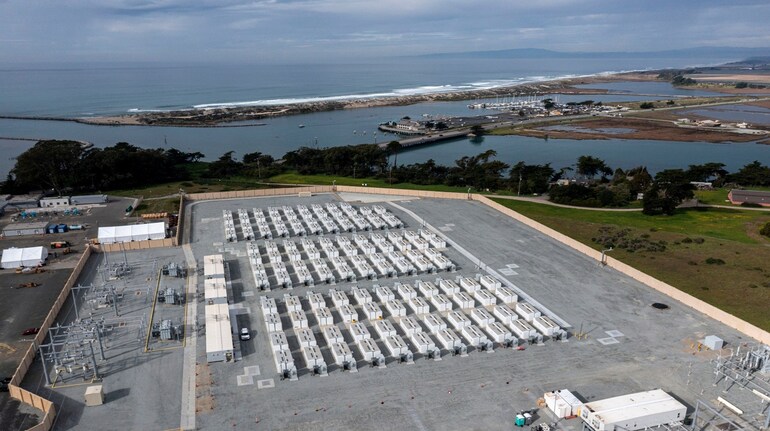
The cost of battery energy storage systems (BESS) in India has declined sharply, with tariffs discovered through competitive bidding falling to as low as Rs 2.1 per unit (kWh), the government said in Parliament on Monday, signalling a major improvement in the economics of renewable power integration.
In a written reply in the Rajya Sabha, the Ministry of Power said that earlier battery storage costs were around Rs 10.18 per unit, but recent bids show a steep decline. “Considering realistic usage of about 1.5 cycles per day, the effective cost works out to around Rs 2.8 per unit,” the ministry said.
The government said the reduction in storage costs is critical for managing the intermittency of solar and wind power and for meeting peak electricity demand. “Battery energy storage systems play a vital role in ensuring reliable and round-the-clock power supply with increasing renewable energy penetration,” read the reply.
To support faster deployment, the Centre said it has approved multiple financial and policy support measures. “A viability gap funding scheme of rs 3,760 crore has been approved for setting up 13,220 MWh of battery energy storage capacity,” the ministry said. In addition, another scheme under the Power System Development Fund has been approved to support around 30 GWh of storage capacity.
The government said interstate transmission system charges have been waived for up to 12 years for battery storage projects co-located with renewable energy plants, helping lower overall project costs. Battery projects are also eligible for incentives under the production-linked incentive (PLI) scheme for advanced chemistry cell manufacturing, aimed at promoting domestic manufacturing.
“The sharp decline in battery storage tariffs, supported by policy interventions, will help strengthen grid stability and facilitate large-scale integration of renewable energy,” the ministry said.
Global ties, reforms
In a separate reply, the ministry said India is stepping up international engagement in the power sector while rolling out multiple domestic reforms to strengthen grid reliability, renewable integration and distribution efficiency.
"India is working with global and regional platforms such as the G20, BRICS, Clean Energy Ministerial, International Solar Alliance, Shanghai Cooperation Organisation (SCO), Bay of Bengal Initiative for Multi-Sectoral Technical and Economic Cooperation (BIMSTEC), ASEAN and the One Sun One World One Grid initiative, and has signed bilateral cooperation agreements with countries including Denmark, Nepal, Bhutan, Bangladesh, Sri Lanka, the UAE and Saudi Arabia.
Power sector PSUs such as NTPC, NHPC and Power Grid have also entered into partnerships with foreign counterparts for cooperation in generation, transmission and renewable energy, the Ministry said.
On the domestic front, the government said under the Revamped Distribution Sector Scheme, projects worth about Rs 2.83 lakh crore have been sanctioned so far, with central support of Rs 1.21 lakh crore, covering infrastructure upgrades and smart metering.
Discover the latest Business News, Sensex, and Nifty updates. Obtain Personal Finance insights, tax queries, and expert opinions on Moneycontrol or download the Moneycontrol App to stay updated!
Find the best of Al News in one place, specially curated for you every weekend.
Stay on top of the latest tech trends and biggest startup news.