Last week's minutes of the August 6-8 Monetary Policy Committee meeting put up the image of a sharply divided house over the panel's approach to rate cuts and economic growth.
Two external members of the rate-setting panel - Jayanth Varma and Ashima Goyal - yet again made their case on why keeping the real rates high was a bad idea. "Real rate affects the real sector," Varma said, making a strong case for lowering the real interest rates and calling the MPC decision to keep the interest rates high as the "unacceptable growth sacrifice induced by a monetary policy that is excessively restrictive".
In an interview with Moneycontrol Pro, Varma later said high real interest rates depress private sector capital investment which is yet to see the much-anticipated revival. "High interest rates also suppress consumption demand as debt service takes away a bigger chunk of income."
Varma's opposition to the status quo in policy rates for the ninth time in a row found an echo in Goyal pointing out that it is the MPC, whose mandate covers all groups, that has to be concerned about "correct" real rates in order to balance interests and respond to pressing priorities and seize opportunities.
Goyal argued that India's economic growth was not up to its full potential. “Even if growth is high, it has to rise to its full potential. A falling trend and low core inflation indicates growth is below potential, implying real rates are above the neutral real policy rate and there is scope to reduce the repo rate and raise growth,” she said.
The six-member committee, however, went on to uphold the majority view.

RBI Governor Shaktikanta Das too strongly defended the majority decision in his statement, discarding the argument of the two external members for early adjustment of real interest rates.
“At this stage, when durable disinflation to the target is still a work-in-progress, the issue of equilibrium natural interest rate is premature. Policymaking in the real world cannot be based on an abstract, theoretical and model-specific construct which is unobservable and time varying. Hence, any justification for policy easing based on so called high real rates can be misleading,” Das said.
The term of this MPC is set to end with the term of the three external members — Jayanth Varma, Ashima Goyal and Shahanka Bhide — set to expire in early October. Even among the internal members, the term of RBI Governor Shaktikanta Das too will end in December and that of Deputy Governor Michael Patra in early January.
It's obvious that one would wonder which side of the rate-setting panel is right when it comes to the issue of real rates and actual growth potential of the economy.
In fact, both sides have valid arguments.
Can't overlook inflation worriesIt is but obvious that persistently high retail inflation is a key concern for a nation where the highest spending area for majority of households covers food and essentials. For them, high food and vegetable prices are the biggest worries. The MPC cannot ignore this by lowering the guard on inflation early.
But, remember, the MPC has been on a pause mode for nine consecutive review meetings keeping the interest rates at the higher end.
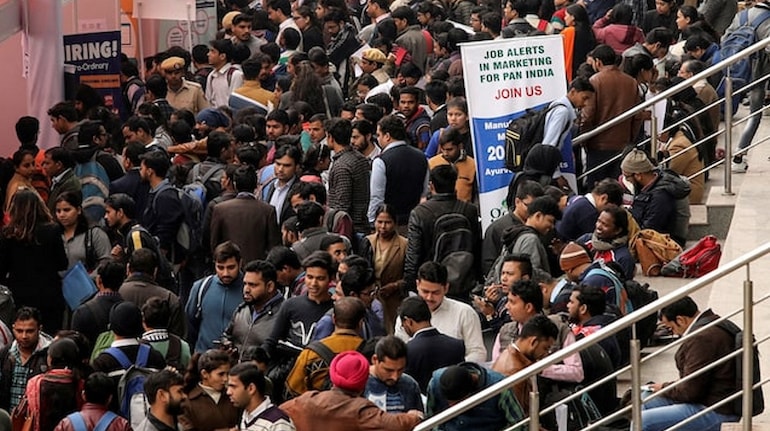
Managing rising unemploymentAlthough India continued to grow at the fastest rate among its peer economies, there are certain pockets of deep worry. One of the foremost is the issue of rising unemployment. Joblessness scaled an eight-month high of 9.2 percent in June, showed CMIE data. This was a steep surge from 7 percent recorded in the previous month. More worryingly, unemployment among women in rural areas is also on the rise.
An analysis of the latest quarterly Periodic Labour Force Survey (PLFS) showed that the jobless rate for women in urban areas worsened during the April-June quarter of this financial year. The data shows the women unemployment rate increased in urban areas to 9 percent in April-June from 8.5 percent in the preceding quarter.
Every year, millions of young graduates queue up to enter the job market and creating opportunities for them is a key challenge for the government. There could be more possibilities for this workforce if the economy could accelerate at full throttle. In the obsession to attain the inflation target, sacrificing the potential economic growth rate could be a mistake with the backlog spiralling out of proportion.
In May, former chief economic advisor Kaushik Basu had warned that the country’ youth unemployment rate is among the highest in the world. He urged the government to take corrective measures to deal with the unemployment problem.
The short point is that while the MPC is making growth assumptions based on the headline GDP growth projections for policy preparations, it also needs to look at the quality of growth. The rate-setting panel must weigh on the rising unemployment problem without any further delay.
It is, therefore, going to be a tough task for the Monetary Policy Committee next year to strike the right balance between its two fronts - inflation and economic growth.
Banking Central is a weekly column that keeps a close watch and connects the dots about the sector's most important events for readers.
Discover the latest Business News, Sensex, and Nifty updates. Obtain Personal Finance insights, tax queries, and expert opinions on Moneycontrol or download the Moneycontrol App to stay updated!
Find the best of Al News in one place, specially curated for you every weekend.
Stay on top of the latest tech trends and biggest startup news.