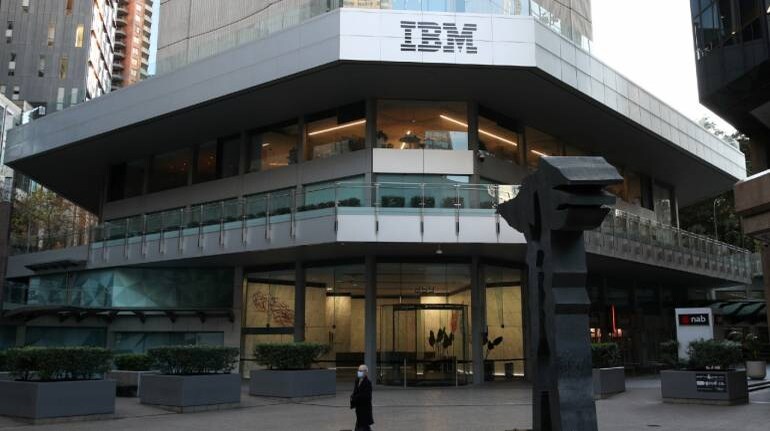
Last month, US-based tech major IBM announced that it is splitting into two to focus on hybrid cloud and Artificial Intelligence (AI), said CEO Arvind Krishna. The company's $19-billion infrastructure management services are being hived off into a separate entity. The process will take a year to complete.
The focus for the company clearly is re-skilling the workforce -- to align them with the company's core areas - hybrid cloud and AI. This will be important for the company's Indian counterparts, too. According to multiple media reports, India accounts for about a third of IBM's workforce. The company employs more than 3.8 lakh people globally.
In a recent interaction with Moneycontrol, Shailesh Agarwal, Vice President, Strategy & IBM Cloud Platform, IBM India/South Asia, shared more details on the timing of the split, and re-skilling workforce. Here are some excerpts from the interview.
While CEO Arvind Krishna has given some insight into why the company is splitting, could you tell us a little more on what brought about this change at this moment?Agarwal: This is in continuation of the overall strategy of focussing on hybrid cloud, data and AI. This has been our strategy and narrative for a couple of years now. (When) We were taking that value proposition to the market, and it was very clear that we do have to have different sales motion inside the organisation, which is managed services and the other parts, hybrid cloud, data and AI.
From the client perspective also, these two are different. Managed services are all about sales and efficiency. Hybrid cloud and data are about value and growth. The decision maker at the customer end is also different.
So we realised that to focus on that market, we may have to change organisationally and that is why we are splitting into two organisations. They have their own strengths and own offerings but different value proposition.
With the split, has there been any client concerns so far?Agarwal: We have announced it to the customers, nothing is hidden. Clients also understand that nothing is immediate. They know that there is a one-year time period before the split actually happens. Second thing is that it is not an acquisition by any other company. The company is only splitting.
Since it is not an acquisition, there is no new culture that will come into play. The rules, processes, people, and everything from the client perspective, will remain the same.
It is just that the name will change from A to B. Nothing else changes. The owner of the company also remains the same. It will be held by the same shareholders as IBM is held by.
But as things unfold and we get to the ‘D-date’, some of those things (concerns) will come into the picture. But at this time, we are working closely with clients and everyone has been informed anyway. There is enough time to iron out all complexities.
So what does this mean for the workforce?Agarwal: In that context, the profile of the salesforce has to change. They require much more technical depth upfront. The whole point of a generic sales person who can go in front of the client and have tea and coffee with him and tell him information is no more respected or there is no more value attached to that. To that extent, we need to change the technical profile in the organisation all across.
The one thing that keeps us awake is our ability to skill our workforce in line with the focus, and the narrative, so that you put the best version or technology innovation you have in the front line in a short time.
That is something we will have to work upon. Now that the focus is more sharply defined and not have a whole set of services as part of the same organisation, it will facilitate easier re-profiling of the salesforce.
When you say re-profiling, do you mean re-skilling? Do you have a re-skilling strategy in place?Agarwal: There is absolutely a strategy, when we are talking about a work-based profile to ensure that you upskill to address the new market. That will also require some skills to be brought in from the market.
There are some skills that we may not require anymore. So, all the aspects of re-skilling will go into the process.
Can we expect more India hiring?Agarwal: We still don’t know, since this is something we are working on. When I said re-profiling the workforce, it is about getting the skill level absolutely aligned to this focus. That will definitely require a change in the skill profile of the organisation. Capacity planning and all that is a business-as-usual process.
I don’t think we have a capacity issue right now. That, I guess, is a normal process inside the organisation and directly aligned to the growth and market opportunity. Hiring is based on opportunity and growth, right? It is a very flexible engine that way.
Can we expect more investments in India?Agarwal: We have already invested in the data centres in the country, in Chennai and Mumbai. Then there are several centres of excellence based in India. There will be more investments (but) based on specific geopolitical situation and data residency and other issues. We know that sometimes our ability to leverage the IBM infrastructure in the rest of the country may become a limitation.
Keeping that in mind, whatever investments that are required and aligned to hybrid cloud, we will make those investments.
Will these “limitations” impact investments?Agarwal: I would not say these are limitations since every government makes its own policies. You need to align with the law of the land. The only point we say on these policies and legislation is that, maybe the government should differentiate between B2B data and B2C data. These two are different data and while framing policies, if this is taken into account, it will make sure that the digital vision that India has is more enabled.
In our investment strategy, yes, these will have implications. But that is not a constraint. You will decide where to put and what to put taking those things into account.
Discover the latest Business News, Sensex, and Nifty updates. Obtain Personal Finance insights, tax queries, and expert opinions on Moneycontrol or download the Moneycontrol App to stay updated!
Find the best of Al News in one place, specially curated for you every weekend.
Stay on top of the latest tech trends and biggest startup news.