






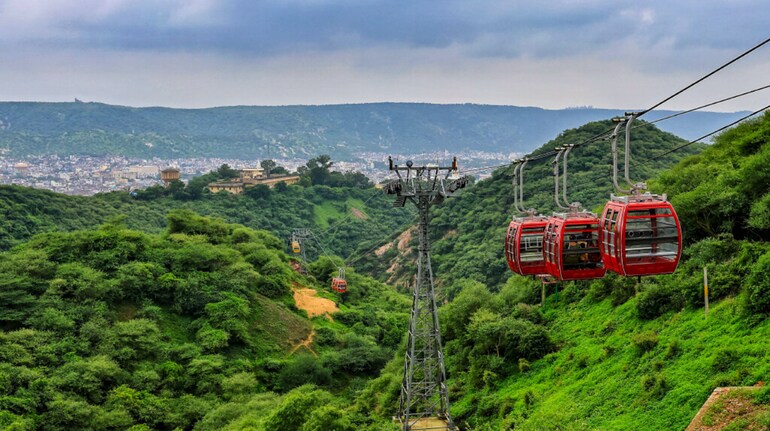

Older than the mighty Himalayas, the Aravallis, stretching from Delhi through Haryana and Rajasthan to Gujarat, are at the centre of a debate over their definition following a recent Supreme Court judgment.
The mountain range acts as a natural barrier against desertification in northern India and is a critical player in climate regulation, water security, and biodiversity. Yet, decades of mining, urbanisation, and regulatory dilution have pushed large parts of the range to the brink.
The judgment
In orders issued between November and December 2025, the Supreme Court considered the recommendations of a committee it had set up to define the Aravalli Hills and Ranges for the purpose of regulating mining.
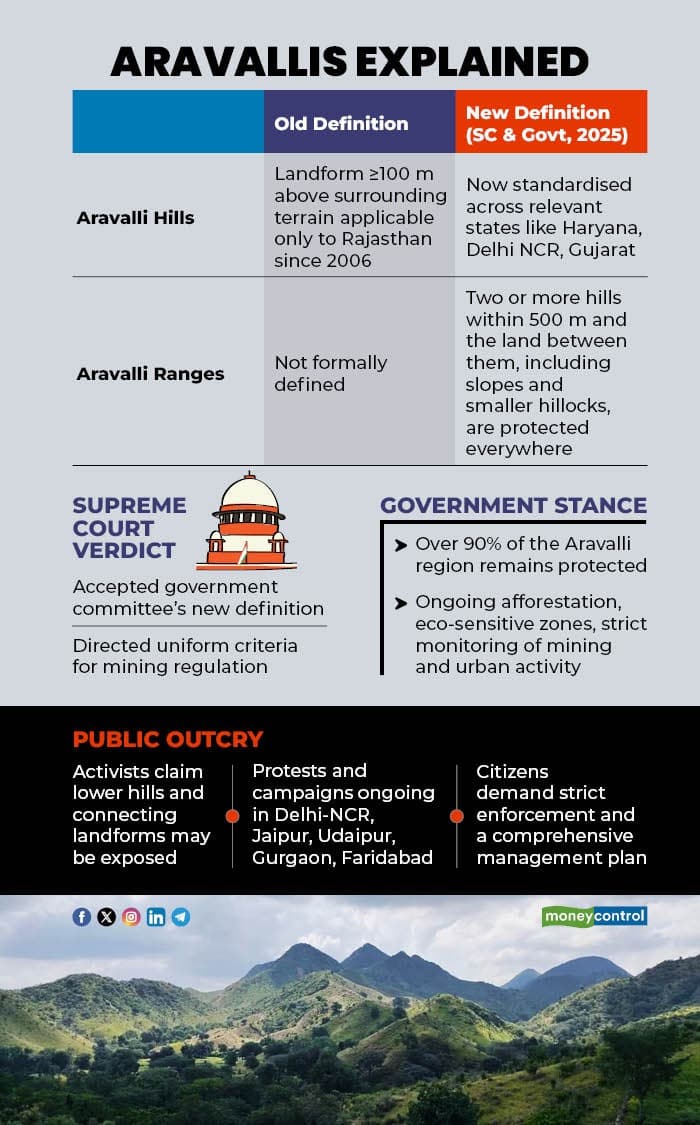
In accepting the recommendations, the Supreme Court affirmed that an Aravalli hill is any land rising 100 metres or more, and that two or more such hills within 500 metres form an Aravalli range.
The committee was led by the Ministry of Environment, Forest and Climate Change and included officials from Delhi, Haryana, Rajasthan and Gujarat, along with national forest and geological bodies.
The court reiterated that the Aravallis are ecologically vital, acting as a barrier against desertification, a groundwater recharge zone and a key biodiversity habitat.
The apex court emphasised that uncontrolled mining in Aravallis pose a “great threat to the ecology of the nation” and directed uniform criteria to safeguard them. Their conservation is thus vital for ecological stability, cultural heritage, and sustainable development.
What counts as the Aravallis?
While the basic definition remains largely the same, it was previously applied only in Rajasthan.
Any landform in the Aravalli districts that rises 100 metres or more above the surrounding terrain is classified as an Aravalli Hill. The protection does not apply only to the peak. All land within the lowest contour surrounding the hill, including its slopes and related landforms, also counts as part of the Aravalli Hills, regardless of height or gradient.
The Supreme Court and the government have now standardised this definition across all states, including Haryana, Delhi, and Gujarat. They also clarified that when two or more hills lie within 500 metres, the land between them, including slopes and smaller hillocks, even below 100 metres, is part of the Aravalli Range, ensuring connecting landforms are also protected.
According to the central government, these definitions go beyond technical mapping by ensuring that ecologically important areas remain protected and are not fragmented for mining or development to prevent long-term environmental damage.
The protests
Citizen groups such as Aravalli Bachao and People for Aravallis, along with activists across Delhi, Haryana and Rajasthan, have been protesting the new definition, claiming that it effectively removes protection for 90 percent of the Aravalli ranges.
Activist groups told the media that the new definition ignores hills below 100 metres, leaving large parts of the Aravallis open to mining and other non-forest activities.
Environmentalists warn that the new Aravalli definition could have serious consequences for the Delhi-NCR region.
By potentially excluding lower hills from protection, large areas may be opened up for mining, construction, and other non-forest activities leading to increased dust storms, worsening air pollution, and higher levels of particulate matter in already smog-prone cities like Delhi and Gurgaon.
Groundwater recharge, a critical function of the Aravallis, may also be reduced, worsening water shortages in parts of Haryana and Rajasthan while, urban heat could rise further, the loss of vegetation and ecological buffers may make surrounding cities more vulnerable to extreme weather events.
These environmental concerns have sparked public protests, especially in Gurgaon, Faridabad, and the Rajasthani cities of Jaipur and Udaipur.
Activists say that mining bans have often been poorly enforced, and vague land classifications have allowed mining and construction in sensitive areas. Without strong monitoring, they fear the new definition could be misused, harming conservation, biodiversity, water resources, and local communities across the Aravallis.
The government’s stance
The central government in a fact sheet, issued on December 21, clarified that the committee set up by the environment ministry, following Supreme Court directions, consulted all the concerned state governments and found that only Rajasthan had a formal definition for regulating mining in the Aravalli region.
This definition, in force since 2006, is based on a 2002 state committee report and treats any landform rising 100 metres above the surrounding terrain as a hill, banning mining on both the hill and its supporting slopes.
During deliberations, all states agreed to adopt this 100-metre criterion as a uniform standard for regulating mining in the Aravallis, while making it more objective and transparent.
The definition does not allow mining on all land below 100 metres. Under the agreed framework, all landforms within the lowest contour surrounding a 100-metre-high hill, as well as all land within 500 metres between two such adjoining hills, are also excluded from mining, regardless of their height.
The committee said it had, in fact, strengthened the existing Rajasthan model to make it clearer, more transparent and more conservation-oriented.
The fact sheet added that the Supreme Court praised the committee’s work in defining the Aravalli Hills and Range, strengthening protections, and preventing illegal mining, while allowing only sustainable mining. It accepted these recommendations and temporarily stopped new mining leases until a full management plan is prepared.
Union Environment Minister Bhupender Yadav on December 22 dismissed claims that mining in the Aravalli hills is being allowed without restrictions, saying the Centre is acting strictly within the framework laid down by the Supreme Court and that the mountain range remains safeguarded.
The minister pointed out that mining is allowed in only a tiny fraction of the region. Of the Aravalli range’s total area of 1.44 lakh square kilometres, just 0.19 percent is eligible for mining activity, he said.
What’s next?
The government has clarified that the ecology of the Aravallis is not under immediate threat, terming claims of widespread danger “alarmist.”
The Ministry of Environment, Forest and Climate Change, in coordination with state governments, reiterated its commitment to ecological preservation while supporting responsible development.
Ongoing afforestation, eco-sensitive zone notifications, and strict monitoring of mining and urban activities ensure that the Aravallis continue to serve as a natural heritage and ecological shield, the government said.
Despite these assurances, citizen groups, activists, and some political parties continue to mobilise.
Protests have already occurred in several northern cities, and campaigns like “Save Aravalli” marches and padyatras are being planned to raise awareness about ecological concerns.
The demonstrations aim to pressure authorities to ensure that the ancient hills of northwestern India stand tall.
Discover the latest Business News, Sensex, and Nifty updates. Obtain Personal Finance insights, tax queries, and expert opinions on Moneycontrol or download the Moneycontrol App to stay updated!
Find the best of Al News in one place, specially curated for you every weekend.
Stay on top of the latest tech trends and biggest startup news.





