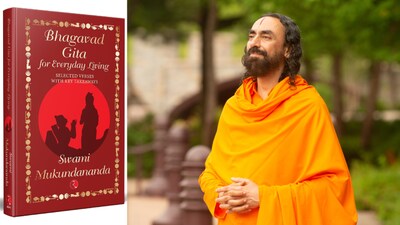
Bhagavad Gita for Everyday Living author Swami Mukundananda: 'AI handles information, and the Gita guides intention'
Swami Mukundananda on his new book 'Bhagavad Gita for Everyday Living: Selected Verses with Key Takeaways', what the Bhagavad Gita teaches us, and its relevance for modern living in the age of artificial intelligence and more scientific discoveries.

Book Extract: Fluke - Chance, Chaos, and Why Everything We Do Matters
Brian Klaas grew up in Minnesota, earned his DPhil at Oxford, and is now a professor of global politics at University College London. He is a contributing writer for The Atlantic, host of the award-winning Power Corrupts podcast, and frequent guest on national television.
Book Extract: Excerpted with permission from the publisher The New Age of Sexism, Laura Bates, published by Simon and Schuster India
Book Extract: Excerpted with permission from the publisher The New Age of Sexism, Laura Bates, published by Simon and Schuster India
Book Extract: Excerpted with permission from the publisher Proto: How One Ancient Language Went Global, Laura Spinney, published by William Collins
Book Extract: Excerpted with permission from the publisher Proto: How One Ancient Language Went Global, Laura Spinney, published by William Collins.
‘The work of history is the work of civilization’ — Prof Ruby Lal on writing feminist history, erasures from history
South Asian History Professor at Emory University, US, Ruby Lal explains her approach to Mughal history; reading signs of Nur Jahan’s co-sovereignty in memoir, court documents and art history; and why erasures from history textbooks are a problem.
How to end gold smuggling in India and negotiate better gold prices for Indian buyers, an IIM-A professor explains
IIM-A Professor and author of 'The Power of Gold' Sundaravalli Narayanaswami explains why curtailing gold imports to manage current account deficit does not work in India, and how - when it comes to buying gold in India - culture eats economists for breakfast.
Book Extract | Language of the Immortals: A Concise Study of Sanskrit by G. N. Devy
The fact that the canonical status of texts did not depend on the genre in which they were composed but rather on the function they were expected to perform in the sphere of their reception needs to be stressed when we consider the history of Sanskrit literature.
Book Extract | A Return to Self: Excursions in Exile by Aatish Taseer
In Mongolia, the texture of sin felt less like a crime against God than against oneself. Three symbols are often associated with Danzanravjaa’s life and thought: a female figure representing his love of pleasure; a swan symbolizing the arts; and, lastly, a scorpion signifying the human potential for self-destructiveness
What if the UK were ruled by India in the near future? Scottish MP Alan Gemmell's novel engages with gritty fictional and real-world problems
Different kind of Raj novel: UK Labour MP Alan Gemmell on imagining Britain as a colony of India in his political thriller '30th State', teaching the history of empire in British schools, and returning art to former colonies.
Book Extract | 1975: The Year That Transformed Bollywood by Pratik Majumdar
The Emergency period was akin to a dark age for the Hindi film industry. Film-makers were unfairly forced to navigate an environment of intense scrutiny with curtailed artistic expression, and any deviation from state-approved narratives could lead to severe consequence
Book Extract | The Lion of Naushera by Ziya Us Salam and Anand Mishra
Within weeks of India gaining independence, Kashmir resembled a battlefield because of Pakistan's repeated incursions to capture the Muslim-dominated princely state.
[In]Complete Justice: Reflecting on the Supreme Court at 75 -- triumphs and trials
The book ‘[In]Complete Justice: The Supreme Court at 75, Critical Reflections’ critically examines the Supreme Court's evolution, highlighting its successes, failures, judicial activism, and key reforms. It explores the Court’s role in shaping India’s democracy, law, and social justice
Bharatanatyam practitioners across US, UK... India are giving the dance form a contemporary urgency: Leela Samson
Indian Classical Dance today: Dancer-choreographer Leela Samson unpacks histories and movements that have brought us to the present moment in Bharatnatyam, in 'Dance of Freedom: A Short History of Bharata Natyam'.
Book Extract| The CIA Book Club by Charlie English
In the late 1960s, against the backdrop of the Vietnam war, CIA activities were increasingly scrutinized by the media and public officials.
Book Extract | This is for Everyone by Tim Berners-Lee
Today, experts in the AI field are rather crudely characterized as ‘AI boomers’ or ‘AI doomers’.
Book Extract | How to Sleep Like a Caveman by Dr Merijn van de Laar
Data is available on mouth-taping and sleep, though this is mainly focused on a small sample of obstructive sleep apnoea patients.
'There's nothing Urduish about Urdu. Urdu is about the world the writer is living in': Rakhshanda Jalil
An anthology of Urdu short stories attempts to bust stereotypes around who writes in Urdu, and for whom. Editor Rakhshanda Jalil explains why she chose to keep the subtitle - Stories by Non-Muslim Urdu Writers - even though it made her 'cringe'.
Book Extract: 'This is for Everyone' by Tim Berners-Lee
The groundbreaking memoir from the inventor of the World Wide Web, Sir Tim Berners-Lee, is the story of our modern age.
Book review: Source Code by Bill Gates is also the story of a computer revolution
Bill Gates, Paul Allen, Rick, and many others developed software that made computers intelligible to the common man. Bill Gates' Source Code is the story of that revolution, and that moment in tech history.
Book Extract | The Shortest History of Migration by Ian Goldin
The legal limbo in which asylum seekers find themselves typically hinders them from working or establishing themselves in their host communities.
Book Extract | Every Living Thing by Jason Roberts
In sum, life appears to exult in blurring the boundaries we place upon it. Buffon’s observation from two and a half centuries ago seems more relevant than ever.
Book review: Arundhati Roy's candid memoir, about her relationship with mother Mary Roy, is unputdownable
Arundhati Roy shot to international fame after becoming the first Indian citizen to win the Booker Prize for her novel, 'The God of Small Things'. Her memoir, 'Mother Mary Comes to Me', is a moving account of her relationship with her influential mother.
Book Extract | [In]Complete Justice? The Supreme Court at 75 by S Muralidhar (Editor)
Gopal Subramanium was designated Senior Advocate by the Supreme Court at the young age of 35, and served as the Additional Solicitor General of India from 2005 to 2009, and as Solicitor General of India from 2009 to 2011.
Book Extract | How We Grow Up: Understanding Adolescence by Matt Richtel
The transition from childhood to adulthood is a natural, evolution-honed cycle that now faces radical change and challenge.
Book Review | A framework to make sense of our bewildering era
There’s an unprecedented shift in geopolitics, technology and balance of power in the backdrop of a looming climate shock. All of them are happening at the same time. It’s a book that takes the reader through the forces of transition and provides the means to connect dots.







![[In]Complete Justice: Reflecting on the Supreme Court at 75 -- triumphs and trials](https://images.moneycontrol.com/static-mcnews/2025/09/20250912092814_Supreme-Court--770x433.png?impolicy=website&width=135&height=80 "[In]Complete Justice: Reflecting on the Supreme Court at 75 -- triumphs and trials")


![Book Extract | [In]Complete Justice? The Supreme Court at 75 by S Muralidhar (Editor)](https://images.moneycontrol.com/static-mcnews/2025/08/20250829154223_Supreme-Court-book-770x433.png?impolicy=website&width=135&height=80 "Book Extract | [In]Complete Justice? The Supreme Court at 75 by S Muralidhar (Editor)")




