Book Extract
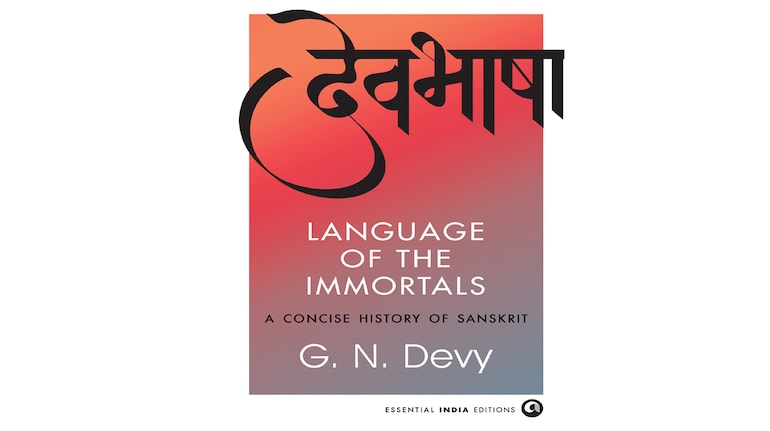
Excerpted with permission from the publisher Language of the Immortals: A Concise Study of Sanskrit, G. N. Devy, published by Aleph Book Company.
*******
THE LANGUAGE OF ESTEEM
The varna system was a peculiar, and despicable, creation of the world view originating in the Vedic ethos. The purohit, quite like the Egyptian pharaoh, came to be considered the necessary intermediary between the humans and the divine. The purohit had to know the Vedic chants. Thus, the small class of those who were trained to internalize the complicated mnemonics forming the architecture of the Veda corpus, gained esteem in the society far disproportionate to their material wealth or political clout. The esteem gained by their knowledge of the Sanskrit language turned them into a distinct class of the society, the ‘highest class’ at that. There does not appear to be any other material or historical reason for the purohits to emerge as the highest varna than the fact of their command over the Sanskrit language. Their patrons, the ones who could protect their ritual practices, got accepted by them as the next varna as the kshatriyas.
These had some access to Sanskrit, but no mastery over it. The others who worked in many professions were ranged as the next in the varna hierarchy, as vaishyas. All others, speakers of many local languages and involved in occupations that had nothing much to do with the ritual practices of the purohits, were relegated to the hugely amorphous varna category as the shudras. Since the magic of the original Vedic mnemonics continued its sway through the history of India, the varna-based social segmentation continued to exist and become increasingly coercive. Sanskrit was essentially spoken by a relatively small section of Indian society; but its hegemony pervaded every area of life, culture, and thought, at least until the Bhakti movement started challenging it in the second millennium.
All through the long history of the Sanskrit language, the poets and writers who used it continued to bask in the afterglow of the miraculous mnemonics of the Vedas. The hegemony of Sanskrit led society to turn most of the iconic writers in this long tradition ahistorical. Perhaps, it is therefore that determining the exact dates or historical periods of authors in Sanskrit poses a serious challenge:
Writing the history of Sanskrit kavya literature along modern historicist and chronological principles has been even more problematic than piecing together the succession of dynastic history in early India. Scholars have long complained of the sparse biographical and ‘historical’ information that the Sanskrit literary tradition has supplied for its own authors, making the establishment of both absolute and relative chronologies among works and authors an enduring problem for the field. In some literary works and inscriptions, we occasionally come across mention of a poet’s father and grandfather, and literary patrons are sometimes mentioned, but in most cases the information provided is all too brief. The number of texts whose authors can be placed in particular historical contexts remain, as numerous scholars have noted, strikingly limited.
The fact that the canonical status of texts did not depend on the genre in which they were composed but rather on the function they were expected to perform in the sphere of their reception needs to be stressed when we consider the history of Sanskrit literature. Both the shastras and the akshara texts were composed in verse, prose, or a combination of the two. Both were seen as products of known human authorship. And, as against the suta literature and the mantra literature which were turned timeless, the shastras and the akshara literature were freely subjected to the vagaries of literary tastes, shifts in critical views, and the climate of philosophical opinion. Philosophical debate and literary disagreement were the common features of the scholarly community that developed these two branches of Sanskrit literature. Linguistics and poetics were considered shastras.
**********
G.N. Devy, Language of the Immortals: A Concise Study of Sanskrit, Aleph Book Company, 2025. Hb. Pp. 96
Sanskrit has long been celebrated as one of the building blocks of Indian civilization, and is venerated in temples, scriptures, and classical literature. In Language of the Immortals, renowned scholar and critic G. N. Devy uncovers the astounding paradox of Sanskrit—an ancient language that shaped Indian thought, philosophy, and identity for millennia, yet was never truly a language of the people.
With rigorous scholarship, Devy dismantles enduring myths and offers a revealing commentary on Sanskrit’s historical and cultural trajectory. He shows how it achieved unsurpassed prestige not through conquest or commerce, but sheer intellectual brilliance. He explores the way in which Sanskrit shaped intellectual life across centuries, influenced cultures beyond India, and maintained its prestige through the oral tradition and spiritual symbolism rather than the patronage of the state.
This concise yet profound work reimagines what it means for a language to live on—long after it has ceased to be spoken.
G. N. Devy is currently the Senior Professor of Eminence and Director, School of Civilization, Somaiya Vidyavihar University and was previously the Obaid Siddiqi Chair Professor at the National Centre for Biological Sciences, and Director, Adivasi Academy, Tejgadh, and Professor of English at the Maharaja Sayajirao University of Baroda. He led the People’s Linguistic Survey of India (PLSI), a comprehensive documentation of all living Indian languages, forming a fifty-volume PLSI Series. He has received several awards for his writing as well as for his community work, including the Padma Shri, Prince Claus Award, and Linguapax Award. His English publications include After Amnesia, Of Many Heroes, Painted Words, Nomad Called Thief, The Question of Silence, Countering Violence, The Crisis Within: On Knowledge and Education in India, Mahabharata: The Epic and the Nation, and India: A Linguistic Civilization. He is the co-editor (with Ravi Korisettar and Tony Joseph) of The Indians: Histories of a Civilization.
Discover the latest Business News, Sensex, and Nifty updates. Obtain Personal Finance insights, tax queries, and expert opinions on Moneycontrol or download the Moneycontrol App to stay updated!
Find the best of Al News in one place, specially curated for you every weekend.
Stay on top of the latest tech trends and biggest startup news.