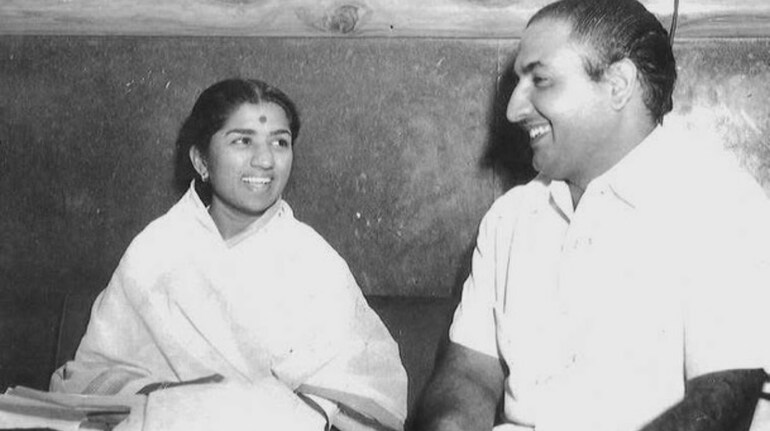

Hindi film music has always thrived on legendary collaborations, but few pairings were as iconic as Mohammed Rafi and Lata Mangeshkar. Between them, they recorded 448 songs, shaping the sound of Hindi cinema for decades. Yet, at the peak of their careers, the two maestros stopped singing together for nearly three years, a silence that stunned the industry.
Their collaboration began in 1947 with Chalo Ho Gayi Tayyar from Shaadi Se Pehle. Though the song itself faded with time, it marked the birth of what would become Hindi cinema’s most celebrated duet pairing.
Over the years, they lent their voices to classics from films like Baiju Bawra, Mother India, Kohinoor and Mere Mehboob. By the early 1960s, Mohammed Rafi and Lata Mangeshkar were the undisputed voices of Hindi film music.
What led to the rift ?
The rupture came in 1963, rooted not in music, but money. Lata Mangeshkar had begun campaigning for singers to receive royalties for repeated use of their recordings, a concept already standard in the West but unheard of in India then. She believed royalties could act as long-term financial security for artistes.
“I was taking royalty but I also wanted other artistes to get it,” Lata recalled in a 2009 interview. “Rafi saab was instigated into opposing my campaign.”
Mohammed Rafi, known for his simplicity and detachment from the business side of cinema, opposed the idea of demanding additional payments from producers.
The disagreement escalated during a musicians’ association meeting. Lata Mangeshkar remembered him saying, “We get money for what we sing from producers and that’s the end of what we get.” He then added, pointedly, “I guess this ‘maharani’ here will say whatever has to be said.”
Lata shot back immediately: “Of course I am a ‘maharani’. But why are you calling me that?”
Tempers flared. Mohammed Rafi announced he would no longer sing with her. “He said, ‘I won’t sing with Lata anymore’,” she later told Subhash K Jha. “I retorted, ‘Rafi saab, you won’t sing with me? I won’t sing with you.’”
For three years, the industry struggled without its most powerful duet. Music composers tried to bridge the gap until Shankar-Jaikishen’s Jaikishen intervened. Lata insisted on a written apology. “I got the letter and ended the cold war,” she said. “But whenever I’d see him, the hurt would return.”
Rafi’s son Shahid later disputed the existence of any apology letter, calling the claim hurtful. “My father was national property,” he said. “If she can prove it, I am ready to apologise.”
Despite lingering controversies, Lata always acknowledged Rafi’s greatness. “For Rafi Saab, singing was a form of worship,” she said in 2017. “He led an ascetic’s life.”
The two reunited professionally and continued recording memorable songs, their brief estrangement now remembered as a rare clash between legends whose voices defined an era.
Discover the latest Business News, Sensex, and Nifty updates. Obtain Personal Finance insights, tax queries, and expert opinions on Moneycontrol or download the Moneycontrol App to stay updated!
Find the best of Al News in one place, specially curated for you every weekend.
Stay on top of the latest tech trends and biggest startup news.