






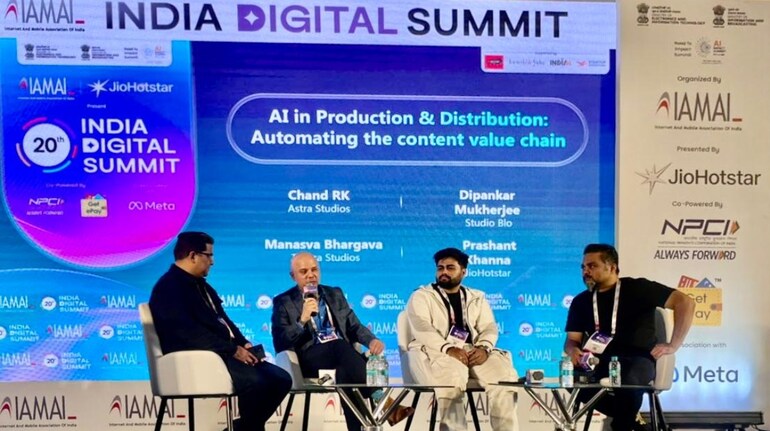

Artificial intelligence is rapidly becoming the central force driving the media industry’s transformation, extending far beyond a mere supportive tool to an operating layer that touches every stage of the content value chain, according to Prashant Khanna, Head of Sports & Live Experiences, Production Technology & Services at JioStar. He shared these insights at the India Digital Summit 2026 in Bengaluru, during a panel titled AI in Production & Distribution: Automating the Content Value Chain, organised by the Internet and Mobile Association of India (IAMAI).
Khanna highlighted that live sports broadcasts, in particular, demand extraordinary precision and real-time accuracy, with millions of concurrent viewers expecting flawless delivery. In such environments, AI and automation serve to augment creative talent rather than replace it, enabling production teams to prepare more effectively, anticipate outcomes, and execute complex workflows with confidence. By analysing multiple layers of data — including context and historical patterns — automated systems can now suggest the next visuals, graphics or narrative elements before they occur, allowing human creators to focus more on storytelling and less on manual execution.
He explained that this shift is not limited to production alone. In distribution, automation also plays a crucial role by adapting the same live content into multiple formats — horizontal broadcasts, vertical reels, short highlights or extended replays — depending on how different audiences prefer to consume it. This flexibility means viewers can choose to watch a quick three-minute summary, a 20-minute recap or a full live broadcast, all powered by the same underlying production pipeline.
According to Khanna, owning the fan relationship increasingly depends on how seamlessly this end-to-end value chain operates. “The ability to automate across production and distribution is what allows platforms to acquire new viewers, deepen engagement and offer differentiated experiences around the same core event,” he said.
On personalisation, he noted that technologies like real-time language adaptation, vertical live broadcasts and auto-framing of play make premium viewing experiences accessible to a wider audience without compromising quality. While AI has lowered barriers for creators, Khanna emphasised that quality storytelling remains the ultimate differentiator. Looking forward, he envisioned a future where live entertainment becomes more immersive, interactive and user-controlled — with virtual reality broadcasts, personalised data layers and second-screen experiences giving viewers greater choice and agency.

Discover the latest Business News, Sensex, and Nifty updates. Obtain Personal Finance insights, tax queries, and expert opinions on Moneycontrol or download the Moneycontrol App to stay updated!
Find the best of Al News in one place, specially curated for you every weekend.
Stay on top of the latest tech trends and biggest startup news.





