






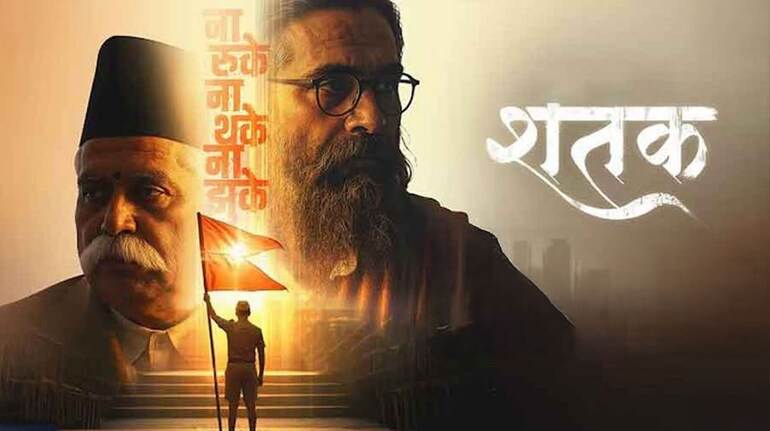

‘Shatak,’ directed by Aashish Mall, released in theatres on 20 February.
‘Shatak: Sangh Ke 100 Varsh’ traces the rise and evolution of the Rashtriya Swayamsevak Sangh (RSS) through its founders, Keshav Baliram Hedgewar and MS Golwalkar. It presents the organisation as one that stayed away from direct politics and instead focused on nation building.
The film highlights episodes such as the liberation of Dadra and Nagar Haveli from Portuguese rule (Lata Mangeshkar also chipped in in her own way) and the presence of RSS volunteers in Kashmir in 1948, where they are shown guarding the region before the Indian Army arrived. At the same time, the film is selective.
When it refers to Mahatma Gandhi’s assassination, it avoids mentioning Nathuram Godse. This omission makes the film feel less like a balanced historical account and more like a narrative designed to keep the focus firmly on the organisation’s achievements.
The story begins with Hedgewar’s childhood in Nagpur, showing him as intelligent, disciplined, and driven by nationalist ideas. The loss of his parents to the plague is presented as a turning point in shaping his resolve. His student years in Pune and Calcutta follow, where he studied medicine and came into contact with the Anushilan Samiti, a revolutionary group rooted in Hindu thought.
The film suggests this period strongly influenced his thinking and led to the formation of the RSS. It then shifts its gaze to MS Golwalkar, known as Guruji, who became the second Sarsanghchalak and is portrayed as a committed leader who carried forward Hedgewar’s vision with clarity and focus.
The film moves through the years before and after independence, showing the RSS as steady despite political pressure. Jawaharlal Nehru and Indira Gandhi are portrayed as strong opponents who tried to curb the organisation’s influence.
However, these portrayals are one-sided. The film does not examine why these leaders disagreed with the RSS or explore the deeper ideological differences. Instead, it frames the conflict mainly as an attempt to suppress the organisation. Complex political tensions are reduced to a simple battle of right versus wrong, leaving little room for nuance.
Visually, ‘Shatak’ relies heavily on CGI and artificial intelligence. While the recreated faces sometimes resemble the real figures closely, the overall look feels overly polished. The sets—whether jails, villages, or trains from the past—appear too clean and carefully arranged.
There is hardly any sense of dirt, chaos, or grounded reality. The heavy use of AI and CGI robs the film of texture and warmth. Instead of drawing the viewer in, it often creates distance, making many scenes feel staged and without real emotions.
Also read: Kennedy Movie Review: Anurag Kashyap delivers a moody, measured and morally unsettling drama
The storytelling style adds to this distance. The film moves quickly from one event to another, with long stretches of dialogue and explanation. There are few pauses for reflection, and the narrative often feels like a lecture rather than a drama.
In trying to cover decades within two hours, the film packs in too much and ends up skimming the surface. It becomes engaging when it touches on ideological clashes, but it never explores them in depth. In the end, ‘Shatak’ plays more like a tribute and a visual summary than a layered film that invites debate or emotional involvement.
Rating: 2.5/5
Discover the latest Business News, Sensex, and Nifty updates. Obtain Personal Finance insights, tax queries, and expert opinions on Moneycontrol or download the Moneycontrol App to stay updated!
Find the best of Al News in one place, specially curated for you every weekend.
Stay on top of the latest tech trends and biggest startup news.





