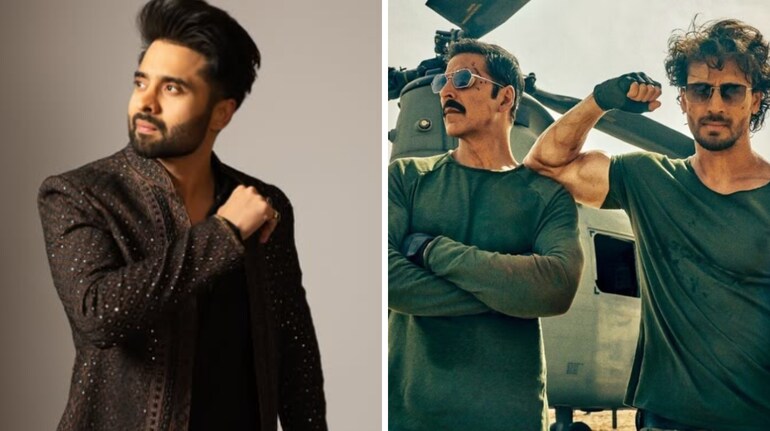
Former actor and producer Jackky Bhagnani has finally addressed the debacle of their multi-starrer, big-budget film Bade Miyan Chote Miyan. In an exclusive interview with Money Control, the actor-turned-producer said that the content had become tiresome and did not resonate with the audience.
During the exclusive interview, Jackky Bhagnani discussed his transition from actor to full-time producer, the difficulty of overseeing creative projects, and his desire to convey compelling tales through his production companies, Puja Films and Jjust Music.
With a cinematic history and a new perspective influenced by data, audience sensitivities, and his own creative instincts, Jackky Bhagnani talked about everything from filmmaking economics and the growth of OTT platforms to entourage expenses and the role of AI in the creative process.
Candid, grounded, and forward-thinking, he also discussed recent industry trends, such as Bade Miyan Chote Miyan's performance, writer undervaluation, and the genres he hopes to advocate.
Jackky Bhagnani confessed that there was tiredness in the genre and that Bade Miyan Chote Miyan's material fell short. Bade Miyan, starring Akshay Kumar, Tiger Shroff, and Prithviraj Sukumar, was released on Eid last year to a mediocre box office reaction.
He said: "First, I think there was a huge fatigue in that genre. I think when we started the film, as compared to when we released the film, I think overall there was some fatigue clearly. And I think we have to accept with a pinch of salt that the piece of content did not resonate with the audience."
Here is the exclusive conversation.
Excerpts from the Interview:
Ques: You are completely focused into producing films. You know, what made you take this decision? What inspired this transition?
Jackky: I think more than inspiration. I just love cinema, I love storytelling and I always wanted to be in the business of storytelling. And this was a natural progression for me. I thought that it's not like I'm not going to act anymore. But in the mean time, I just thought that there are so many stories I would want to tell. It started off actually with Sarbjit, where it's an amazing story. And I have to be a part of this film and no one better than Randeep Hooda to play that role. And I said that, if I am a true enthusiast of cinema, I should be a part of it. And of course, there is a legacy of producing in my family. And that's how it started. And then one thing led to another led to another. And here I am.
Ques: What do you think is the toughest part of being a producer?
Jackky: I think that a producer is like a parent, which is a thankless job. No matter what you do there will always be, some aspect to fit where the child would feel or one of the child would feel that, I didn't get my thing. So, I think if I have to correlate it, that's the closest I could co-relate it. And only once you become a parent, you realize, I never saw it from that point of view. So, now that I've become a producer, I have immense respect for my father and for every other producer, because, you're always providing, you're always thinking of the child. In this case, it there are very few where the child is thinking of the parent.
Ques: So were you that child when you were acting?
Jackky: Because I've been a producer son, I was not a spoiled child. But no matter what you say, there are some days where you can be unreasonable. But like I said, every child has some or the other unreasonable days where you don't see it from a holistic point of view. You could be the most obedient child, but only when you become a parent, you realize that, this is absolute unconditional love. So, I think I would relate that to a producer closest.
Ques: Jackky you were an actor yourself. Now there's a lot of discussion about the entourage cost. Now that you're a producer, does that bother you?
Jackky: There are too many layers to this conversation. And because I've been on both sides of the fence, generally these kinds of conversations start coming up when there is a question mark on the recovery. The Return on Investment (ROI) has significantly declined. As you can see, films today are either performing exceptionally well or not at all. There is no midpoint like it used to be there pre pandemic. So what happens is that when those kinds of things happen, every extra expense, which is not part of the front of the screen, starts becoming a pain point. When you are making a movie, if you're putting in Rs 100 and not even making 40 sometimes, then everything that is surplus has a question mark to it. So I think, like I said, it's too layered. Entourage, it's not the only thing, but there are many things.
Ques: There were reports that a makeup artist of an actor is making more money than a screenwriter. So don't you think that's not justified?
Jackky: Absolutely not correct. If you ask me, it's not correct. And I feel that a writer cannot be held in the same compartment as anyone else. It's going to be unfair to me to, put people into brackets. But yes, if you ask me, if on a film, a screenwriter is making less than a couple of other professional people, it's clearly wrong. It is very wrong. But it's been happening for so many years. So, for any kind of change, the first important thing for any change is realization. And that conversation and realization is happening. The fact that you and I are talking means there is a realization. I'm fully with you. I'm not even going to debate it or be politically correct about it.
Ques: On the debacle of Bade Miyan Chote Miyan, why do you think it didn't work?
Jackky: I think there are again too many reasons. First, I think there was a huge fatigue in that genre. I think when we started the film, as compared to when we released the film, I think overall there was some fatigue clearly. And I think we have to accept with a pinch of salt that the piece of content did not resonate with the audience. And if I have to be honest, and if I have to continue working here, I cannot be delusional. And I have to accept it with a pinch of salt, because I always feel that when you are in a content business, a restaurant business, or in politics, the public is always right. Janta hamesha sahi hai; agar janta nahi aa rahi hai, iska matlab kahi na kahi aapke ke content se janta nahi connect kar rahi hai.
Ques: With the rise of OTT platforms, do you feel it has impacted the film industry? Is the audience now divided between theatres and OTT?
Jackky: If I have to be selfish, then I think it has not helped the theatrical industry. But if I have to be practical, I have to move with time, because many boats are here. And is there an OTT platform? Yes. And is that taking content to people's houses? Yes. There will be some goods and bads with this. Like I said, the theatrical industry has surely been impacted because what happens is you know that if you missed it this weekend, 56 days later, it'll come to your house. So psychologically, it's not a good thing. How do I combat it? I make content that makes people feel the need to go and see it that weekend itself. And that content could be a mix of too many things. I have to feel FOMO enough. I always feel ticket prices have gotten expensive. OTT has come. But I feel the most that if people feel it's worth their time, they will manage money, time, and everything. If they feel that they can wait for 56 days, they can watch it at home. Then they will watch it at home.
Ques: What do you have to say about AI? Is AI going to be intruding or it will be an assistant in your creative work.
Jackky: I think AI will be a great assistant. AI should become your EA. In whatever field you're in. AI can be EA where you use that. But the start point and the end point will always be the human mind. The process in between can the AI can do for you and make life easy for you. And again, AI is happening. You and me can keep discussing about it. You have to be smart how to use it correctly. And you should use the AI but it should not consume you. If you can manage that thin line, you will be ahead of the curve.
Ques: Puja Films has been around for decades and you've recently launched Jjust music. So can you tell us about these ventures.
Jackky: I have such a long way to go. I still feel that every day I feel there's so much to learn, just music. There's a reason why I call it Jjust music. And there are two J's to just music. One is just no other bulls**t. And the other is justice for music. Just music. The idea is that, be it the independent space or the film music space we are doing anyways, how can we be disruptive? We are a tiny boutique music label at this point. I'm not here to, you know, compete with anyone or the big boys, you know, they are giants here. But slowly but surely, we keep putting out excellent content and interesting, unique content, and we keep increasing our market share. I want to use your platform today to reach out to as much new talent as possible and say that our doors are open. If you guys feel that you'll have some amazing music, you know, amazing voice or an amazing expression you want to express, then just music is your place to come. Yeah. You'd be very, very happy to provide the platform. Yeah.
Ques: What drives your creative decisions as a producer? How involved you are? And what kind of stories do you want to tell?
Jackky: See, I feel that, you know, of whatever my journey has been in the last 24, 36 months, Uja Films was always known for comedy, the huge films and romantic films. We want to get back to primarily doing that. Of course, there is space for, you know, some unique film to come in and of course, we will say If all Laapata Ladies comes to me, I would love to do that. I would love, I would be honored to be a part of that. I would be honored to do a Chaava. We are anyways working on Ashwatthama. But because we are known for this and I feel that it comes naturally to us where music plays a very, very integral role. And these three genres, we want to be known for that. And it reaches out to the wider audience. Now, how can we take these genres and tell stories of heartland, urban stories or, you know, regional stories? We'll keep playing with that. Yeah. And Ashwatthama is on, that means you've just said. Because they've always, always, Ashwatthama is very different. I will, I will speak when the time comes, but it's very different. Yeah, because, you know, we keep reporting. Every day we have these stories. And what do you see? You've grown up in this film industry.
Ques: So how do you see the polygon has changed over the years and what are the trends or, you know, shifts that you've been excited about? And how does it impact the future of Indian cinema?
Jackky: I think we have started giving a run for the money for international content. I think we are all getting very conscious. The audience is keeping us on our toes. There's enough data available now. And you asked me a question: how do I take my creative decision? I think there was a time when I was only taking my creative decisions on gut. If you ask me, going forward, it's going to be 50% gut always, but 50% data. It's going to be a combination of the two, because I think that's the Gen Z way of thinking, where, you know, what is the data telling you? What do Gen Z or the audiences want to see? And using that data, applying your gut that in this periphery, and then we will go out there. Because at the end of the day, it's constantly changing. So no one knows anything.
Jackky Bhagnani is also hoping to make a comeback in front of the camera, saying he is searching for a solid screenplay to return to the big screen

Discover the latest Business News, Sensex, and Nifty updates. Obtain Personal Finance insights, tax queries, and expert opinions on Moneycontrol or download the Moneycontrol App to stay updated!
Find the best of Al News in one place, specially curated for you every weekend.
Stay on top of the latest tech trends and biggest startup news.