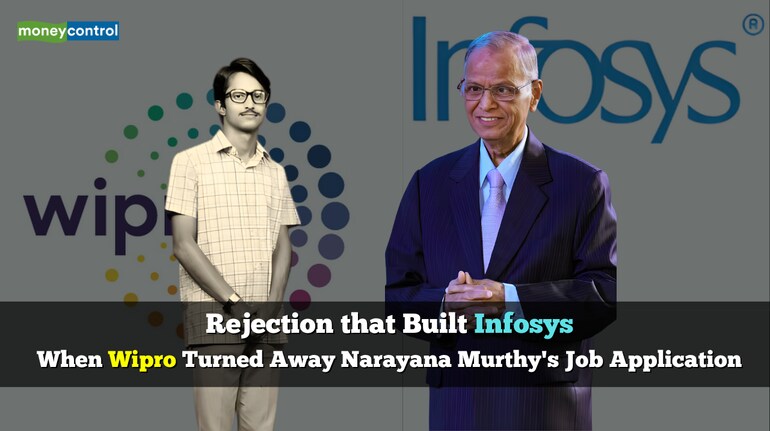

In the late 1970s, a young systems programmer walked into the offices of Wipro in Bangalore seeking employment. His name was Narayana Murthy. He had just returned from a stint working with an Indian computer manufacturer, where he had helped develop the country's first indigenous BASIC interpreter. He understood operating systems. He understood hardware. He understood, perhaps better than most men his age, the direction in which technology was headed.
Wipro said no.
It was not a dramatic rejection. There was no raised voice, no slammed door. Just a polite, quiet dismissal. Murthy collected himself and left. He did not know it then, but that walk out of Wipro's office would become the defining turn in a story neither company could have predicted.
At the time, Wipro was not the IT giant it would later become. Azim Premji, then in his late twenties, had inherited a vegetable oil business from his father. The company sold cooking fat and laundry soap. But Premji had travelled to the United States and seen something stirring. He wanted to pivot into computers. He just did not yet know which men to bet on.
One of those men had just left his building.
Murthy did not land on his feet immediately. He tried starting his own venture, Softronics. It failed. He tried again. That failed too. He was no longer a promising young engineer; he was a man in his thirties with a string of closed doors behind him. His wife Sudha, a brilliant engineer in her own right, was the one with the steady job and the steady salary. She had stood first in her class at a time when engineering colleges were not welcoming to women. She had walked into factories where men refused to shake her hand. She had fought every inch of the way, and she had won.
One evening, she handed Murthy an envelope. Inside was ten thousand rupees, her savings. "Start something," she said.
Murthy took the money. He did not ask her to join him. That decision, made quietly in that moment, would later become one of his deepest regrets. But that night, he simply took the envelope and began to plan.
In 1981, seven men gathered in a small apartment in Pune. They had no office furniture. They had no clients. They had ten thousand rupees and a name they had debated for hours: Infosys. They wrote code on paper before they could afford the machines to execute it. They slept on the floor. Their neighbours suspected they were running some kind of illicit operation. In truth, they were building something that did not yet have a name in India: a professional software services company that would one day compete with the best in the world.
It took years. There were cash crunches, near-collapses, and moments when the partners wondered if they had made a terrible mistake. But slowly, Infosys began to win contracts. Then reputation. Then credibility. By the early 1990s, it was no longer a scrappy startup; it was a company to be reckoned with.
And Wipro, which had once rejected its founder, was now watching it from across the market.
Decades later, at an industry event, Azim Premji approached Murthy. They were both grey-haired now. The sharp hunger of their youth had settled into something quieter. Premji extended his hand and said something that could not have been easy.
"One of the biggest mistakes I ever made," he said, "was not hiring you."
Murthy did not gloat. He did not remind Premji of the valuation gap that would later widen to nearly threefold in Infosys's favour. He simply nodded. Two men, standing in a room full of people, carrying between them the weight of a decision made forty years earlier. One who had closed the door. One who had built his own.
There is an irony here that neither man has failed to notice. If Wipro had hired Murthy in the 1970s, Infosys would not exist. Murthy would have been an employee, perhaps a respected one, perhaps even a leader within Premji's organisation. But he would not have built what he built. The rejection that stung in that moment became the engine that drove him for the next four decades.
It is not a story about revenge. It is not even a story about winners and losers. It is about the unknowability of outcomes. Every rejection is a door that closes, but also a path you are now forced to carve yourself. Murthy did not set out to prove Wipro wrong. He set out to build something he could believe in.
This story, which Murthy recounted in a recent interview with CNBC-TV18, is not unique to him. It plays out every day, in offices and factories and startups across the world. Someone is told they are not good enough. Someone is shown the door. Most of them walk through it and find another job. Some of them, a very few, walk through it and build a company that becomes the standard by which the first company is measured.
The difference is not talent alone. It is what you do with the rejection. Murthy did not carry bitterness; he carried the stone in his pocket and used it to lay a foundation. He did not spend his career trying to wound Wipro; he spent it trying to build Infosys. The victory, such as it is, is not that he proved Premji wrong. It is that he never needed to.

Discover the latest Business News, Sensex, and Nifty updates. Obtain Personal Finance insights, tax queries, and expert opinions on Moneycontrol or download the Moneycontrol App to stay updated!
Find the best of Al News in one place, specially curated for you every weekend.
Stay on top of the latest tech trends and biggest startup news.