






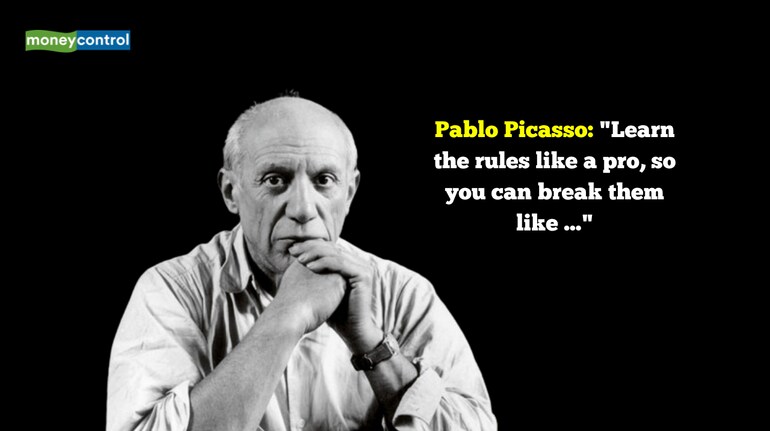

In any creative field, there is a powerful temptation to break convention from the start, to declare oneself an innovator by sheer force of rebellion. Yet, Pablo Picasso, one of history's most radical artistic revolutionaries, offered a counterintuitive blueprint for true originality. He advised:
"Learn the rules like a pro, so you can break them like an artist."
This statement is not a contradiction but a clear roadmap, revealing that meaningful innovation is not born from ignorance, but from deep, respectful mastery.
Foundation: Learning the Rules "Like a Pro"
The first half of the directive demands rigorous discipline. "Learning the rules" means immersing oneself in the fundamentals—the anatomy of form, the theory of color, the principles of perspective, or the structures of any craft. To do it "like a pro" implies more than casual familiarity; it requires dedicated study, practice, and understanding to the point where the rules become second nature. Picasso himself mastered classical draftsmanship as a young artist, producing lifelike portraits long before his Cubist period. This phase is not about blind obedience, but about building a rich vocabulary and a solid technical foundation from which to operate.
Liberation: Breaking Them "Like an Artist"
The second act is where genius speaks. Once the rules are fully internalized, the creator earns the right to break them. But this breaking is not random destruction. It is a deliberate, informed, and expressive choice. When Picasso shattered perspective, he did so with a profound understanding of the very tradition he was deconstructing. The "artist" breaks rules not to be a rebel, but to serve a new vision, to express something that the old forms could not contain. The break is purposeful, eloquent, and carries the weight of knowledge behind it. Without that foundation, breaking rules is merely error or gimmickry; with it, it becomes innovation.
The Deliberate Choice, Not the Blind Leap
This philosophy highlights the critical difference between a novice’s accident and a master’s intention. A beginner who cannot draw a proportional figure is simply unskilled. A master like Picasso, who chooses to distort and fragment the figure, is communicating complexity, emotion, and multiple viewpoints. The power of the work lies in the viewer’s subconscious understanding that this deviation is a choice, not a mistake. The broken rule carries meaning precisely because the artist has proven they know how to follow it.
While rooted in art, Picasso’s principle applies to any field of innovation—from writing and music to technology and entrepreneurship. Truly transformative work in coding, for example, often comes from those who first deeply understand the original language or system. Great jazz musicians know harmony inside out before they improvise. This process honors tradition not by copying it endlessly, but by using it as a launchpad for a personal and revolutionary leap.
Ultimately, Picasso’s quote dismantles the myth of the born rebel. It champions the student, the apprentice, the disciplined practitioner. It argues that the most profound freedom in creativity is not the freedom from rules, but the freedom earned through mastery, which allows an artist to rewrite the rules altogether.
Discover the latest Business News, Sensex, and Nifty updates. Obtain Personal Finance insights, tax queries, and expert opinions on Moneycontrol or download the Moneycontrol App to stay updated!
Find the best of Al News in one place, specially curated for you every weekend.
Stay on top of the latest tech trends and biggest startup news.





