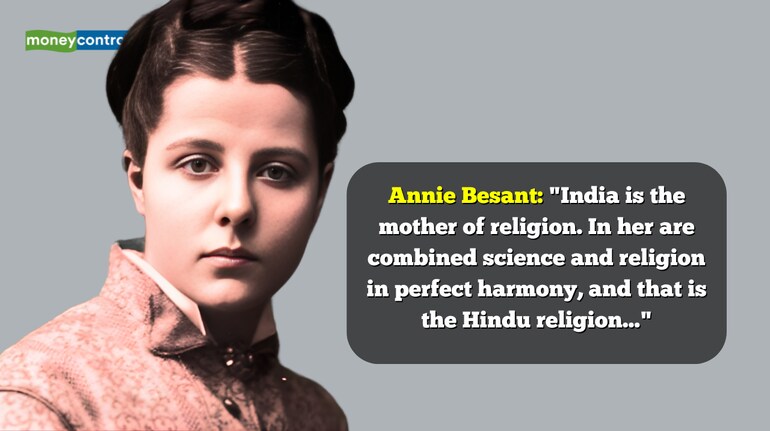

There are voices from the past that seem to speak directly to our present moment. Annie Besant, the British socialist, women's rights activist, and eventually a passionate advocate for Indian self-rule, was one such voice. Her connection with India transformed her life, and her words about the subcontinent carry a depth of reverence that transcends mere observation. She declared:
"India is the mother of religion. In her are combined science and religion in perfect harmony, and that is the Hindu religion, and it is India that shall be again the spiritual mother of the world."
This statement is not just praise; it is a profound assertion about India's unique place in human civilization and its potential role in humanity's future.
The Ancient Cradle of Faith
When Besant calls India "the mother of religion," she points to a historical truth that scholars across the world acknowledge. The Indian subcontinent gave birth to Hinduism, one of the world's oldest living religions, as well as Buddhism and Jainism, which spread across Asia and shaped countless cultures. The spiritual seeking that characterizes the Indian subcontinent is not a recent development but a continuous thread stretching back thousands of years. From the meditations of sages in Himalayan caves to the philosophical depth of the Upanishads, India has been a laboratory of the human spirit, exploring questions of existence, consciousness, and the divine with unparalleled intensity.
The Harmony of Science and Religion
Perhaps the most striking part of Besant's observation is her claim that in India, science and religion exist "in perfect harmony." This challenges a common Western narrative that frames science and religion as eternal adversaries. In the Hindu worldview, the search for external truth and internal truth are not separate endeavors. The ancient Indians who mapped the stars and developed sophisticated mathematics were often the same people who contemplated the nature of the soul. The concept of Rita or cosmic order in the Vedas contains both the physical laws of the universe and the moral laws of human conduct, unified in a single vision. This integrated approach, where the scientist and the sage walk the same path, is a gift India offers to a world often torn between these two ways of knowing.
The Distinctive Character of Hindu Religion
Besant specifically names "the Hindu religion" as the vessel of this harmony. Unlike traditions that demand faith in the absence of evidence, Hinduism has historically encouraged questioning, debate, and multiple paths to truth. It does not insist on a single book or a single prophet but offers a vast library of philosophies, practices, and deities, allowing each seeker to find their own way. This pluralism is not weakness but strength—an acknowledgment that the divine is too vast for any single description and that science and spirituality are simply different languages asking the same ultimate questions.
India as Future Spiritual Mother
The second half of Besant's quote looks forward, not backward. "It is India that shall be again the spiritual mother of the world" is both prophecy and call to action. Besant believed that the materialism of the modern world, for all its achievements, had left humanity spiritually hungry. The West had mastered the external world but lost touch with the internal one. India, with its ancient wisdom and its ability to hold science and spirit together, was positioned to offer the world something desperately needed—not conversion to a particular faith, but a reminder that the search for meaning is as important as the search for material progress.
A Message for Today
In our current moment, marked by climate crisis, technological disruption, and widespread spiritual restlessness, Besant's words resonate with fresh urgency. The world is searching for ways to integrate scientific advancement with ethical wisdom, technological power with human compassion. India's ancient insights—about interconnectedness, about the limits of material pursuit, about the reality of consciousness—offer resources for this search.
Besant's vision also carries responsibility. If India is to be the spiritual mother of the world, it must first honor its own inheritance. This means preserving and transmitting its philosophical traditions, supporting genuine spiritual exploration, and demonstrating in its own life the harmony of science and religion that Besant admired. It means being worthy of the role she envisioned, not through nostalgia for a glorious past, but through living those values in the present.
In the end, Annie Besant's words are both recognition and invitation. They recognize what India has been and carries within it. And they invite India—and the world—to imagine a future where the deepest wisdom of the ancient past helps illuminate the path forward for all humanity.
Discover the latest Business News, Sensex, and Nifty updates. Obtain Personal Finance insights, tax queries, and expert opinions on Moneycontrol or download the Moneycontrol App to stay updated!
Find the best of Al News in one place, specially curated for you every weekend.
Stay on top of the latest tech trends and biggest startup news.