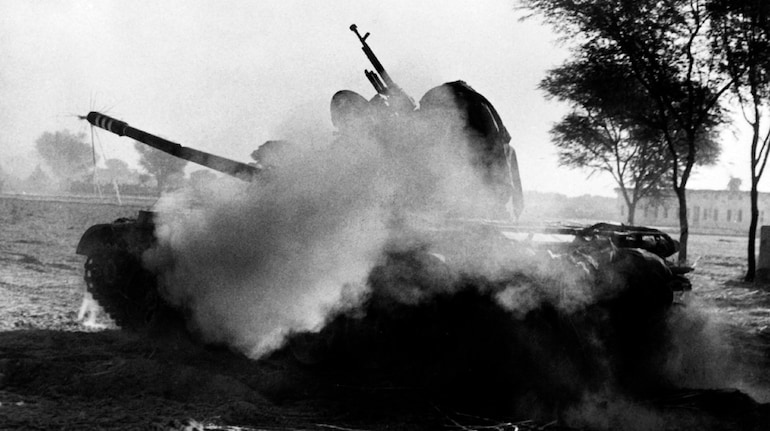

By late November 1971, the crisis in East Pakistan had already escalated beyond covert support and border skirmishes. Refugees were streaming into India. Mukti Bahini fighters were increasingly active. Indian forces were positioned along the frontier. What had not yet happened was a declared, full-scale war between India and Pakistan.
The Battle of Boyra changed that atmosphere overnight.
A tense border turns hot
The engagement took place near Boyra, close to the Jessore sector in what was then East Pakistan. Indian Army units had been operating along the border in support of Mukti Bahini actions. Pakistani forces were attempting to push back these advances and regain control of key approaches.
On November 22, Pakistani F-86 Sabre jets appeared over the battlefield, attacking Indian ground positions. The move represented a significant escalation. It was no longer limited to artillery duels or small-unit clashes. Air power had entered the picture.
Indian radar picked up the intrusion, and the Indian Air Force scrambled Gnats from a nearby base to intercept.
Gnats versus Sabres
The Gnat, often nicknamed the “Sabre Slayer,” was small, agile and well-suited for close-in dogfights. In previous skirmishes, it had proven capable of matching the Pakistani F-86 Sabre, which had been supplied by the United States and was considered one of the more capable fighter aircraft in the region.
On that November afternoon, three Indian Gnats engaged four Pakistani Sabres. What followed was a brief but intense dogfight.
According to accounts reported in The Times of India and The Hindu over the years, Indian pilots shot down three Pakistani Sabres during the engagement. One Sabre crashed inside Indian territory and two fell within East Pakistan. The Indian aircraft returned safely.
The visual evidence of wreckage and captured pilots reinforced the impact. The clash was no longer deniable or ambiguous. It was a clear air engagement between the two air forces.
A signal before December 3
The formal Indo-Pak war is often dated to December 3, 1971, when Pakistan launched pre-emptive air strikes on Indian airfields in the western sector. But the Battle of Boyra showed that in the east, hostilities had already crossed into direct state-on-state combat days earlier.
Indian political and military leadership took note. The engagement demonstrated both readiness and resolve. It also underlined that the eastern theatre was not insulated from escalation.
Military commentators writing in The Print and defence analyses have pointed out that Boyra had psychological significance beyond its scale. It signalled to Pakistani commanders that the Indian Air Force was alert and capable in the eastern sector, even before the war formally expanded across both fronts.
The pilots and the moment
The Indian pilots involved in the Boyra engagement were later recognised for their actions. Their success reinforced confidence within the Indian Air Force at a time when rapid operational decisions would soon be required on a much larger scale.
The dogfight also fed into a broader narrative of the Gnat’s performance. In both 1965 and 1971, the aircraft earned a reputation for holding its own against more heavily marketed adversaries.
But Boyra was not just about aircraft types. It was about timing. The clash occurred at a moment when India had not yet publicly committed to full-scale war, though preparations were well underway.
Strategic consequences
In purely tactical terms, the Battle of Boyra was a limited engagement. It did not alter the balance of forces overnight. Yet its strategic value lay in what it revealed.
First, it demonstrated that air engagements were now part of the eastern theatre. The conflict was no longer contained to ground manoeuvres and irregular warfare.
Second, it tested command-and-control responses under live conditions. Radar detection, scramble procedures and fighter coordination were exercised in real combat just days before a much broader air campaign began.
Third, it shaped perceptions. The loss of multiple Sabres in a single engagement was a blow to Pakistani confidence in the eastern sector. For Indian forces and Mukti Bahini fighters, it provided a morale boost.
Prelude to dominance in the east
When Pakistan launched its wider air offensive on December 3, the war expanded dramatically, particularly on the western front. But in the eastern theatre, the Indian Air Force quickly established air superiority.
The groundwork for that dominance had already been laid. Boyra was one of the first visible signs that control of the skies in the east would tilt toward India.
Within two weeks of the formal outbreak of war, Indian forces were closing in on Dhaka. Air power, mobility and coordinated ground advances compressed the timeline. The surrender on December 16 ended the campaign in the east with unusual speed.
Remembering Boyra
The Battle of Boyra is sometimes overshadowed by larger operations like the Tangail airdrop or the final surrender in Dhaka. Yet it holds a distinct place in the chronology of 1971.
It was the air duel that came before the declared war. It revealed that escalation had already begun. And it showed that in the skies over the eastern frontier, the balance was shifting.
In military history, not every decisive moment involves large formations or sweeping offensives. Sometimes it is a brief engagement — measured in minutes rather than days — that signals the direction a war is about to take. Boyra was one such moment.
Discover the latest Business News, Sensex, and Nifty updates. Obtain Personal Finance insights, tax queries, and expert opinions on Moneycontrol or download the Moneycontrol App to stay updated!
Find the best of Al News in one place, specially curated for you every weekend.
Stay on top of the latest tech trends and biggest startup news.