






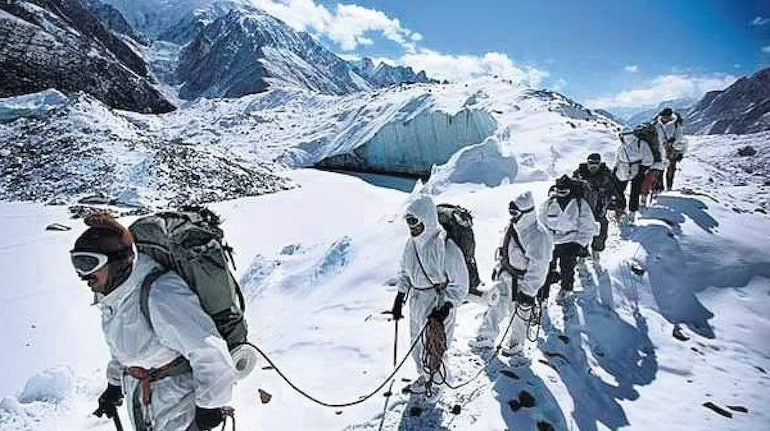

Siachen was never a war of dramatic breakthroughs. It was a war of holding on. By the early 2000s, both armies had spent nearly two decades maintaining posts at 18,000 to 20,000 feet, where weather, altitude and logistics punish you every single day. The Indian Army held the dominating heights along the Saltoro ridgeline, a posture formalised on the ground as the Actual Ground Position Line, while Pakistani positions sat lower on the western spurs.
That geometry mattered. When you control the ridge, you control observation and fire, but you also inherit the burden of sustaining men and materiel where nothing is easy. Every winter casualty and every helicopter sortie becomes part of the cost ledger. In that sense, “guns falling silent” on Siachen was not about romance or diplomacy. It was about stopping a steady leak of lives, limbs and money on a front where even routine movement can kill.
How the 2003 ceasefire reached the glacier
The Siachen quietening was tied to a broader India-Pakistan ceasefire that came into force in late 2003 and was understood to apply not only to the International Border and the Line of Control, but also to the glacier sector via the Actual Ground Position Line.
This mattered because Siachen sits beyond the last formally demarcated point on the LoC maps (NJ9842), and that cartographic ambiguity is exactly what produced the original dispute. So extending a ceasefire “up there” was also a practical workaround: it did not solve the map problem, but it reduced the incentive to keep testing it with artillery and small-arms fire.
Why both sides accepted the silence
Three forces pushed in the same direction. First, fatigue. Siachen is a posting where even a small exchange of fire can trigger disproportionate escalation and risk, not just from bullets but from panic movement on ice, helicopter emergencies and exposure.
Second, the politics of a thaw. In the early 2000s, India and Pakistan were also trying to steady a relationship that had been through Kargil and then the intense mobilisation cycle that followed the 2001 Parliament attack. A ceasefire was one of the few tools that could show intent quickly without requiring a grand settlement on Kashmir.
Third, command common sense. Generals do not love uncertainty, but they love avoidable attrition even less. A ceasefire gave local commanders a clearer rulebook and reduced the pressure to “respond” in ways that could spiral.
What changed on the ground after the guns fell silent
The biggest change was not a headline. It was predictability. A quieter Siachen meant fewer moments where a patrol had to sprint between sangars, fewer nights with artillery fear layered on top of altitude insomnia, and fewer supply runs timed around anticipated firing patterns. It also meant fewer “routine” incidents becoming tragedies because a firefight forced exposure. That does not mean Siachen became safe. It means one category of danger reduced, while the mountain kept all the others.
It also changed the tone of the argument back home. Once firing reduces, the question becomes sharper: if we can keep this ceasefire, why can we not move to disengagement?
Why the ceasefire did not become a settlement
This is where Siachen becomes brutally specific. India’s security establishment has long argued that any withdrawal must begin with recording and authenticating existing troop positions on a map, essentially acknowledging the Actual Ground Position Line on paper before anyone climbs down. The fear is straightforward: vacate first, regret later, and then face an even bloodier and more expensive operation to retake the heights. The VIF paper lays out how “authentication” of the AGPL became a central bargaining chip precisely because it is seen in India as an insurance policy against reoccupation.
Pakistan, for its part, has resisted steps that look like formal acceptance of India’s current posture. One way this shows up is in how disengagement drafts get structured: proposals that push withdrawal but avoid placing existing positions in the main agreement text, shifting details into annexures. Indian negotiators have repeatedly seen that as too flimsy for a place like Siachen, where “who was where” is the whole dispute.
So the ceasefire held, but the map never followed.
Why 2003 still matters in 2026
It proved that restraint is possible even in the most hostile terrain. Siachen is not a normal front. If guns can stay relatively quiet there, it undercuts the fatalism that “nothing ever changes” between India and Pakistan.
It also set the template for how progress actually happens on this rivalry: stepwise, reversible, and focused on reducing harm before resolving sovereignty. That is also why Siachen remains a classic example of the gap between tactical calm and strategic closure. The ceasefire reduced suffering. It did not remove suspicion.
In fact, the longer the ceasefire holds, the more the unresolved core question hardens: can you translate quiet into a written guarantee that neither side will exploit withdrawal? The Print has captured this stalemate in plain terms, noting that despite repeated rounds, the talks have remained stuck on demilitarisation terms rather than moving into execution.
The bottom line
The guns fell silent on Siachen in 2003 because both sides could see the math: the glacier was consuming men and resources without delivering decisive strategic gains. The ceasefire did something rare in India–Pakistan history. It made daily life less lethal without requiring either side to publicly surrender its claim.
But Siachen is also proof that silence is not the same as peace. Until the two militaries can agree on a verifiable, written mechanism that locks in today’s ground reality while allowing a climbdown, the ceasefire will remain what it has been since 2003: a lifesaving pause, not an ending.
Discover the latest Business News, Sensex, and Nifty updates. Obtain Personal Finance insights, tax queries, and expert opinions on Moneycontrol or download the Moneycontrol App to stay updated!
Find the best of Al News in one place, specially curated for you every weekend.
Stay on top of the latest tech trends and biggest startup news.





