






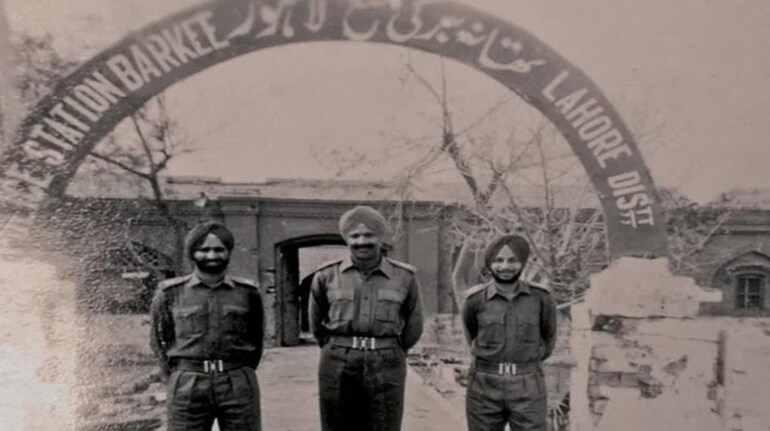

When India crossed the international border on September 6, 1965, it was a dramatic shift in the war’s geography. Until then, fighting had been concentrated in Jammu and Kashmir. The Indian decision to open a front towards Lahore was designed to relieve pressure in the north and force Pakistan to redeploy forces. Within days, the small town of Burki, just east of Lahore and near the Ichhogil Canal, became the focal point of intense combat.
Mainstream Indian reporting over the years, including anniversary coverage in The Hindu, The Indian Express and The Times of India, has consistently described the Lahore sector as one of the most politically and militarily sensitive fronts of the war. The push towards Burki was part of this wider offensive.
Why Burki mattered
Burki lay close to the Ichhogil Canal, a formidable anti-tank obstacle constructed by Pakistan as a defensive line to shield Lahore. According to analyses published in The Hindu’s retrospectives on the 1965 war, the canal was not merely a waterway but a deliberate military barrier, with steep embankments and fortified positions designed to blunt armoured thrusts.
Indian Express coverage of the war’s milestones has noted that once Indian forces moved towards Lahore, their immediate tactical aim was to seize key villages and road junctions, including Burki, that anchored Pakistan’s forward defences. Capturing Burki would place Indian troops within striking distance of the canal and bring psychological pressure on Lahore itself.
The advance to the canal
The Indian offensive in the Lahore sector involved infantry supported by armour and artillery. The Times of India, in its war anniversary reporting, has highlighted that the fighting in this sector was marked by intense artillery exchanges and close-quarter engagements as both sides attempted to control built-up areas and canal approaches.
Indian troops advancing towards Burki encountered stiff resistance. Pakistani forces had fortified the approaches and were determined to hold the canal line. The battle unfolded over several days, with heavy shelling and counter-attacks. The Hindu has described the canal battles of 1965 as among the most intense infantry engagements of the war, with units fighting house to house in some sectors.
Eventually, Indian forces succeeded in taking Burki after determined assaults. The capture brought them to the eastern bank of the Ichhogil Canal. Indian Express accounts of the campaign have pointed out that this advance represented one of the deepest Indian penetrations on the western front during the conflict.
A clash on the Lahore doorstep
For Pakistan, the defence of Burki and the canal was tied directly to the defence of Lahore. Pakistani forces launched counter-attacks in an attempt to push Indian troops back from the canal line. The fighting remained fluid, with artillery duels and attempts to secure or retake positions along the embankments.
The Times of India has noted that while India achieved tactical gains in the Lahore sector, the offensive was never aimed at occupying Lahore permanently. Instead, it was designed to create strategic leverage and compel Pakistan to divert forces from Kashmir.
Indian Army veterans quoted in mainstream publications over the years have described the canal as a formidable obstacle. The steep banks limited armoured manoeuvre, and any attempt to cross under fire would have required significant engineering support. In that sense, the battle of Burki became as much about holding ground as about pushing further.
The broader strategic picture
The Hindu’s long-form pieces on the 1965 war have emphasised that the Indian move across the international border surprised Pakistan’s high command. The opening of the Lahore front forced Islamabad to shift focus away from its initial offensive in Kashmir.
Burki, in this context, symbolised the turning of the tide. By mid-September, Indian troops were positioned along the canal in several places. The psychological impact of Indian forces being within artillery range of Lahore was widely reported at the time.
Indian Express retrospectives have argued that while the war ended in a stalemate diplomatically, the Lahore sector demonstrated India’s willingness to escalate horizontally and carry the fight into Pakistani territory if required.
Costs and consequences
Like many battles of 1965, Burki came at a cost. Casualties were suffered on both sides. Mainstream Indian coverage has highlighted acts of bravery by infantry and armoured units involved in canal-line operations, though Burki itself is often discussed as part of the larger Lahore offensive rather than as a standalone engagement.
The ceasefire that came into effect on September 23 froze positions largely where they stood. Indian forces held ground east of the canal in parts of the sector. The subsequent Tashkent Agreement saw both sides agree to withdraw to pre-war positions.
Legacy of the battle
In Indian war memory, battles such as Asal Uttar and Dograi often receive more public attention. Yet The Hindu and The Times of India have repeatedly underlined that the Lahore sector operations, including Burki, were central to India’s 1965 strategy.
The fighting at Burki illustrated several themes that would recur in later wars: the importance of prepared defensive lines, the role of artillery in shaping infantry battles, and the limits of armoured manoeuvre in canal and obstacle-heavy terrain.
It also reinforced a broader strategic lesson. By crossing the international border and advancing towards Lahore, India signalled that it would not confine future conflicts to Kashmir alone. The Battle of Burki, fought on the outskirts of one of Pakistan’s most important cities, became a vivid example of that doctrine in action.
In the end, Burki was not about capturing Lahore. It was about reshaping the battlefield. As Indian mainstream reporting over decades has suggested, the clash demonstrated how quickly a localised conflict could expand and how terrain, preparation and political objectives intersected in shaping military outcomes.
The canal still runs quietly today. But in September 1965, its banks witnessed some of the fiercest fighting of the war, as Indian troops pushed forward to a line that tested both resolve and restraint.
Discover the latest Business News, Sensex, and Nifty updates. Obtain Personal Finance insights, tax queries, and expert opinions on Moneycontrol or download the Moneycontrol App to stay updated!
Find the best of Al News in one place, specially curated for you every weekend.
Stay on top of the latest tech trends and biggest startup news.





