






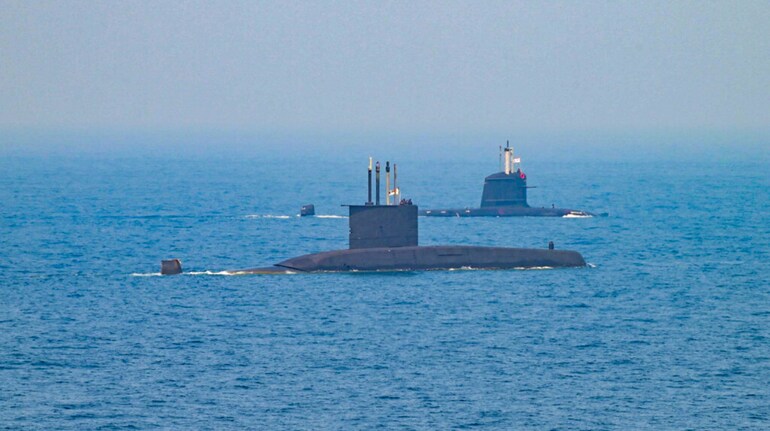

India has officially confirmed that negotiations with Germany for the acquisition of six conventional submarines for the Indian Navy are moving forward on a positive note, though the deal has not yet been sealed. Senior government officials said discussions covering technical, financial and commercial aspects are ongoing, with optimism around a constructive outcome. The confirmation came during German Chancellor Friedrich Merz's visit to India, where defence cooperation featured prominently in bilateral talks.
Addressing media following the joint statement by Prime Minister Narendra Modi and German Chancellor Friedrich Merz, Foreign Secretary Vikram Misri spoke about the long awaited submarine deal. Misri said, "There are technical, financial and commercial discussions in such deals. These discussions have maintained a positive momentum. The deal has not been concluded, but discussions are proceeding positively and we hope to see a positive outcome."
India-Germany defence talks gain momentum
Defence and security cooperation formed a key pillar of discussions between Prime Minister Narendra Modi and Chancellor Merz in Ahmedabad. The two sides signed a declaration of intent to strengthen bilateral defence industrial collaboration, signalling a shared commitment to deeper strategic engagement. Germany has indicated its willingness to expand cooperation between defence manufacturers to support joint development and production.
Easing of German export norms boosts collaboration
Indian officials highlighted that Germany has recalibrated its defence export policies in recent years, making it easier for Indian procurements to receive clearances. Long-pending applications have been fast-tracked, creating a more favourable environment for defence trade. New Delhi has reiterated that its military procurement decisions are driven strictly by national interest and operational requirements.
Project-75I and the Navy's undersea priorities
The submarine negotiations are linked to Project-75I, the Indian Navy's flagship programme to induct six next-generation diesel-electric submarines equipped with air-independent propulsion (AIP), advanced sensors and modern weapon systems. Issued under the Strategic Partnership Model, the project is a key component of the government's Make in India initiative, with domestic construction planned at Mazagaon Dock Ltd in Mumbai.
Why undersea capability matters now
Submarine capability has assumed heightened importance for India amid a more volatile regional security environment. Renewed friction with Pakistan and China's expanding submarine footprint in the Indian Ocean have sharpened the Navy's focus on undersea deterrence. Modern conventional submarines capable of prolonged underwater operations are seen as essential for maintaining maritime balance and strategic credibility.
Type-214 selection and operational advantage
According to defence sources cited by Times of India, the Indian Navy has selected Germany's Type-214 Next Generation submarine, primarily due to the proven reliability of its fuel-cell-based AIP system, superior acoustic stealth and lower lifecycle risk. AIP technology enables submarines to remain submerged for weeks without surfacing, significantly reducing detection risks. In high-threat maritime zones, endurance and stealth often outweigh experimental capabilities-a calculation that appears to have shaped the Navy's choice.
Discover the latest Business News, Sensex, and Nifty updates. Obtain Personal Finance insights, tax queries, and expert opinions on Moneycontrol or download the Moneycontrol App to stay updated!
Find the best of Al News in one place, specially curated for you every weekend.
Stay on top of the latest tech trends and biggest startup news.





