






Budget and not speeches and doctrine give the clearest statement of a country’s strategic priorities. By that measure, capex allocation for the Indian Navy continues to be telling on India’s maritime ambitions.
The 2026–27 budget allocates ₹2.19 lakh crore for defence capital expenditure. Of this, only ₹25,000 crore is earmarked for the naval fleet — 11 percent of total capital spending. By comparison, aircraft and aero-engine procurement alone accounts for more than ₹63,000 crore. And this has been the case over several years now.
These figures reveal a fundamental mismatch. While India’s strategic discourse emphasises maritime security and being a security provider, its financial commitments remain limited.
The disparity between aspiration and allocation defines the history of the Indian Navy’s modernisation — shifting force targets, limited expansion, and expanding capability gaps.
As India’s economy grows, so will its strategic interests and security responsibilities. A $10 trillion, $15 trillion, or $20 trillion economy will inevitably require the Indian Navy to operate beyond its traditional focus on the Indian Ocean Region. With India’s expanding trade, energy and critical resources flows, and overseas investments, it will be required to expand its arc of area of responsibilities to include eastern Atlantic with Africa’s resource-rich regions, and the western Pacific theatre of the Indo-Pacific.
Protecting these interests will demand sustained naval presence, greater logistical reach, and credible force projection. Jugaad or make do workarounds cannot substitute actual capabilities. Decades of planning and investment are needed to increase shipbuilding capacity, and building fleets to enhance operational reach. The size and potency of the Indian Navy in the future, especially during times when it could be most needed, will depend on the decisions made today.
Failure to make these decisions — and to commit the necessary resources — risks constraining the strategic choices available to future governments. Underinvestment today will not merely slow naval expansion, it will shape the limits of India’s global role for decades to come.
India's economic prospects are closely linked to the oceans. Its geographic location provides a natural strategic advantage in the Indian Ocean, and a great majority of its energy and trade flows via maritime routes.
Naval capability cannot be expanded quickly. Warships take years to design and build, submarines take much longer. Building effective maritime power requires consistent, predictable investment over decades. When funding is limited, fleet growth slows and operational readiness is impacted.
The tension between ambition and resources is evident in India's changing fleet targets. Earlier plans envisioned a 200-ship navy by 2027. This goal was later revised to 175 warships, with the timeline shifting into the mid-2030s. Even this decreased aim is doubtful, as older platforms retire faster than new ones being inducted.
The gap between planning and execution is particularly evident in submarine force structure. Under the Navy’s 30-year submarine building programme envisaged in 1999, India planned to induct 24 conventional submarines (SSK). The plan was later revised to include 18 SSK and six nuclear-powered attack submarines (SSN). So far, only six SSKs have been added. And even this modified plan has been scaled back, with procurement of SSNs reduced from six to two, and it will be more than a decade before its induction. Meanwhile, much of the existing conventional fleet — the Sindhughosh and Shishumar class submarines is approaching the end of its service life and is expected to be phased out by the end of this decade, leaving a glaring gap.
India’s frequent downward revisions in force structure are not because its strategic environment is turning favourable. Instead, it reflects underfunding and procurement delays. Without consistent capital support, long-term naval planning becomes an exercise in adjusting force structure to available funding.
More concerning than current limitations is the absence of a credible pipeline for future naval capacity. At present, not a single destroyer or conventional submarine is under construction. Surface combatants and submarines require long construction cycles, and pauses in production today translate directly into capability shortages a decade later.
Equally serious is the absence of mine countermeasure capability. India does not currently operate modern minesweepers, and no replacement vessels are expected to enter service in the near future. This creates vulnerabilities in harbour defence, sea-lane protection, and chokepoint security — fundamental tasks for any maritime power.
Amphibious capability reflects a similar pattern of delay. The proposal to acquire Landing Platform Docks has re-entered consideration after receiving Acceptance of Necessity from the Defence Acquisition Council. However, such approvals mark only the beginning of a lengthy procurement process, and past experience suggests that actual induction remains years away. Until then, India’s ability to conduct expeditionary operations or reinforce island territories remains limited.
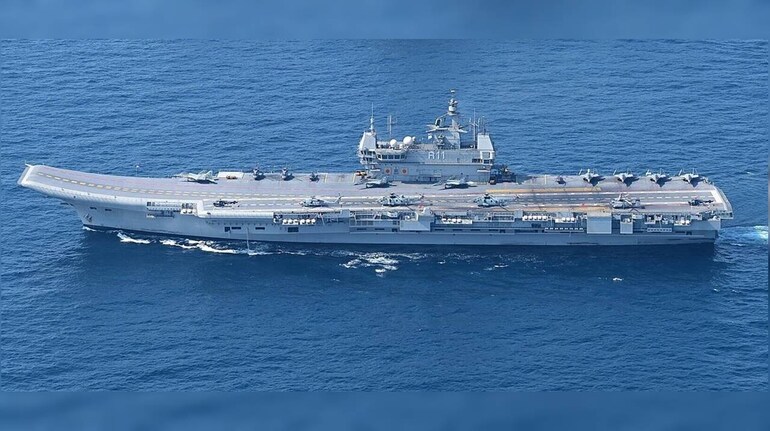
Even decisions regarding the Navy’s most visible platforms remain unresolved. The proposal for a third aircraft carrier is still pending. It’s likely that an order for another carrier will be to replace INS Vikramaditya rather than enable a three-carrier force capable of sustaining continuous multi-theatre operations.
This uncertainty reflects a broader strategic dilemma. Aircraft carriers along with their escort warships are potent for power projection and sea control, while submarines offer stealth and area denial. While the Indian Navy doctrinally leans on sea control, resource constraints and lack of decision-making leaves them to make difficult choices between competing priorities, leaving long-term force structure unclear.
First, India’s continental mindset. Guarding the land borders consumes over 50% of India’s defence capex.
Second, procurement processes remain slow and risk-averse, creating delays that disrupt long-term production cycles. Inevitably, delays lead to obsolescences of the original qualitative staff requirements (QSR) leading to updated QSR which spiral into further delays and cost escalation.
Third, shipbuilding capacity. Beyond funding levels lies a deeper structural challenge: shipbuilding capacity. India has made significant progress in building its own naval ships reducing its reliance on other countries. However, the pace of production is slow and follows a step-by-step process, mainly because of limited shipyard resources and complicated purchasing procedures.
India’s challenge is to translate technological capability into sustained industrial production. Changing this trajectory requires more than incremental increases in allocation. It requires prioritising maritime capability, ensuring predictable long-term funding, expanding shipbuilding infrastructure, and creating continuous production pipelines rather than episodic procurement.
Without such reforms, budget increases alone will not translate into capability.
India possesses enduring maritime advantages — favourable geography, strategic location, and expanding economic interests at sea. But geography alone does not produce maritime power. Sustained investment, long-term planning, and industrial capacity are its foundations.
The defence budget offers the clearest indicator of national priorities. If India seeks to emerge as a leading maritime power in the coming decades, its financial commitments must reflect that ambition. Without alignment between doctrine, resources, and force planning, capability gaps will persist, fleet targets will continue to shift, and maritime strategy will remain constrained.
Maritime power begins with the budget. The current numbers do not lie: to emerge as a genuine maritime power, India must bridge the gap between strategic rhetoric and financial commitment, or risk constraining its global role for decades to come.
(Yusuf T Unjhawala is an adjunct scholar at the Takshashila Institution. He tweets at @YusufDFI.)
Views are personal and do not represent the stand of this publication.
Discover the latest Business News, Sensex, and Nifty updates. Obtain Personal Finance insights, tax queries, and expert opinions on Moneycontrol or download the Moneycontrol App to stay updated!
Find the best of Al News in one place, specially curated for you every weekend.
Stay on top of the latest tech trends and biggest startup news.




