






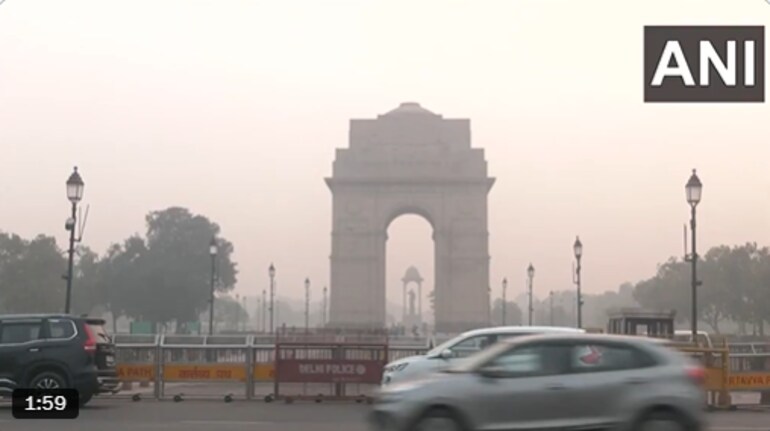
Delhi has started enforcing stricter measures to fight rising air pollution after the city’s air quality dropped to the “severe” category this week. The national capital recorded an Air Quality Index (AQI) in the severe range for three days in a row since Saturday, December 13.
The measures come in addition to the already active Stage 4 restrictions under the Graded Response Action Plan (GRAP), which were imposed by the Commission for Air Quality Management (CAQM).
The Supreme Court on Wednesday expressed dissatisfaction with the steps taken so far to control pollution and urged authorities to adopt a stronger and more complete plan to handle the crisis.
What are the restrictions?
50% WFH: One of the key measures is the introduction of a hybrid work model. Delhi Labour Minister Kapil Mishra said that all government and private offices must shift to a work-from-home and office rotation system.
Under this rule, only 50 percent of staff are allowed to work from the office at any given time, while the rest must work from home.
However, several services have been exempted. Emergency and frontline workers, including hospital staff, fire services, pollution control teams, sanitation workers, transport services, and other essential services, will continue working as usual. Daily-wage workers are also excluded from this rule.
Vehicle entry ban: The Delhi government has also tightened rules on vehicle entry. Environment Minister Manjinder Singh Sirsa announced that vehicles registered outside Delhi and not meeting Bharat Stage VI (BS-VI) emission standards will not be allowed to enter the city when GRAP Stage 4 is in force.
However, the Supreme Court on Wednesday lifted earlier protection for older vehicles, allowing authorities to take action against BS-III and older vehicles in the capital.
Traffic police and transport department teams have been deployed at city borders and petrol pumps to enforce the ban. Trucks carrying construction materials have also been barred from entering Delhi during this period.
PUC certificate mandatory: From Thursday, vehicles without a valid Pollution Under Control (PUC) certificate will not be given fuel at petrol pumps. A PUC certificate is issued after checking vehicle emissions at authorized centres.
The cost of a PUC certificate is Rs 60 for two- and three-wheelers, Rs 80 for four-wheelers, and Rs 100 for diesel vehicles. For BS-IV and BS-VI vehicles, the certificate is valid for 12 months.
Strict checks: To ensure proper implementation, more than 500 police personnel, 37 Prakhar vans, and 126 checkpoints have been deployed across the city. Violations will be punished under the Environment (Protection) Act.
Relief for construction workers: The government has also announced relief measures. Registered construction workers affected by the restrictions will receive compensation of Rs 10,000.
Carpooling app: To reduce the number of vehicles on roads, the Delhi government plans to launch a city-specific carpooling app which will allow users to offer rides or join others travelling in the same direction.
Identification of traffic congestion hotspots using Google Maps and rolling out an integrated traffic management system to better control traffic signals are also in the pipeline.
Discover the latest Business News, Sensex, and Nifty updates. Obtain Personal Finance insights, tax queries, and expert opinions on Moneycontrol or download the Moneycontrol App to stay updated!
Find the best of Al News in one place, specially curated for you every weekend.
Stay on top of the latest tech trends and biggest startup news.




