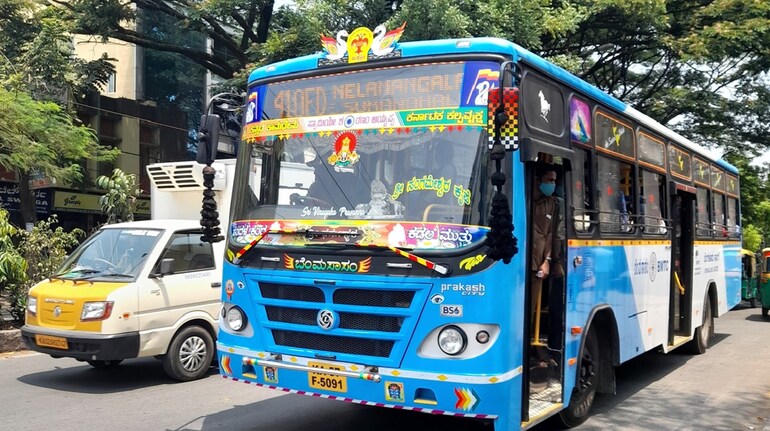

As complaints pour in over stage-based fare structure of Bangalore Metropolitan Transport Corporation (BMTC), questions are being raised on whether the city’s public transport lifeline can transition to a distance-based pricing model.
BMTC now follows a stage-based fare system, where the city is divided into fixed ‘stages’ of 2 km each. Passengers pay depending on the number of stages crossed. This means a commuter travelling 2.5 km may have to pay the equivalent of 4 km, as the journey spills into the next stage.
Under the present structure, stage 1 (2 km) of non-AC bus costs Rs 6, stage 2 (4 km) Rs 12, stage 3 (6 km) Rs 18 and stage 4 (8 km) Rs 23. The maximum fare falls under stage 25 (50 km), priced at Rs 32. The stage system often results in commuters paying for more distance than they actually travel.
Transport Minister Ramalinga Reddy told Moneycontrol that he would study the demand for revisiting the fare structure.
Also, read: Bengaluru: Nearly half of BMTC's ticket revenue now comes via UPI as passengers go digital
However, a senior BMTC official said there are practical difficulties in moving from a stage-based to a distance-based fare system. “Most of the stages were fixed around 25 years ago. Over time, additional bus stops have come up every 300-400 metres in some places. Each stage is about 2 km, which gives conductors some breathing time to issue tickets. We will also need to map all routes and bus stops before implementing distance-based fares. Also, if an ETM faces issues, it is easier to switch to manual ticketing, but that may not be possible under a distance-based fare structure,” the official said. He said that not every stop is individually mapped in the ticketing system and that clusters of stops form a stage, resulting in uniform pricing within that band.
However, mobility experts said that globally, cities transitioning to smart ticketing ecosystems have moved toward kilometre-based pricing.
Also, read: National Common Mobility Card fails to make a mark in Bengaluru as bus agency is not on board
How the stage system works - and where it falters
Under the stage system, two passengers travelling slightly different distances can end up paying the same fare - or sharply different fares - depending on where stage boundaries fall. On several routes, commuters travelling just beyond a stage limit are charged for an entire additional stage, even if the extra distance is marginal.
Urban mobility experts point to two structural concerns: arbitrary boundaries and inequity for short trips. Stage limits were fixed years ago and may not reflect current ground realities. Bus stops may have shifted, routes may have changed, but the stage boundaries largely remain static. In some stretches, consecutive stages are less than 2 km apart, defeating the very logic of the system. BMTC operates 6,301 schedules covering 66,302 trips daily, spanning 13.06 lakh km has a daily ridership of around 45 lakh.
Also, read: Bengaluru's BMTC to launch 'express bus service’ on long routes
Technology may no longer be a constraint
The demand for reform gains traction because BMTC now uses 100 percent electronic ticketing machines (ETMs), replacing the earlier pre-printed manual tickets where stage-based ticketing was operationally necessary. ETMs are Android-based devices with GPS capability, making digital distance calculation technically feasible.
A senior transport planner said all Indian cities, except Chandigarh, follow stage-based ticketing, but argued that Bengaluru could lead a shift. “All cities in India follow a stage-based fare system, except Chandigarh. Bengaluru, being the tech capital, can take a cue and opt for a distance-based fare system. If that isn’t immediately possible, they should rationalise fare stages. The current stages were fixed many years ago. Bus stops may have shifted, but stage boundaries remain the same. They will have to be revised at some point.”
He added: “Today, all ETMs are Android devices with location features. We can technically enable distance-based ticketing. Even if mapping exact stops is difficult, distance-based calculation is feasible.” According to him, the current system disproportionately affects short-distance commuters.
“Stage-based ticketing penalises short-distance travel. One option is to rationalise stages strictly based on actual 2 km distances. At present, many stages are not truly 2 km apart.”
Also, read: Eye on Bengaluru ahead of Karnataka polls: Bus service hits bump, BMTC struggles with dwindling fleet
Ground-level anomalies
Commuters have cited multiple examples of fare anomalies. Amogh A, a member of the Friends of BMTC group, pointed to inconsistencies on Hosur Road. “The stages are meant to be 2 km apart. But there are places where consecutive stops are stages, even when they are less than a kilometre apart,” he said.
He cited examples such as Krupanidhi College to Madiwala (around 900 metres), Konappana Agrahara to Electronics City (around 900 metres) and other places where commuters are forced to pay for an entire stage despite travelling short distances.
“These are just some examples. There are plenty of such stages where the distance is less than 2 km. BMTC’s fare stages need proper restructuring,” he said.
Another passenger said: “It is worse for people who live on the cusp of a stage and travel just one stop beyond it”.
Social media users have echoed similar concerns. One commuter said travelling 3.2 km from Jayanagar to JP Nagar costs Rs 18 because two stage changes occur within a short gap. Another pointed out that Malleswaram 8th Cross to 15th Cross attracts a Rs 12 ticket despite being a short, walkable stretch.

Discover the latest Business News, Sensex, and Nifty updates. Obtain Personal Finance insights, tax queries, and expert opinions on Moneycontrol or download the Moneycontrol App to stay updated!
Find the best of Al News in one place, specially curated for you every weekend.
Stay on top of the latest tech trends and biggest startup news.