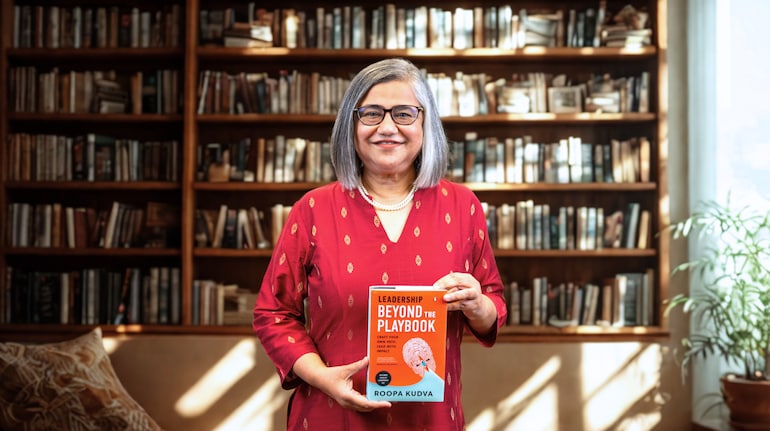
Roopa Kudva was CEO of credit-rating and analytics company Crisil between 2007 and 2015, and then managing director of Omidyar Network India till 2023 when the impact investor announced its exit from the country. Kudva, an Indian Institute of Management - Ahmedabad alumni, says she used all of that experience to write her first book ‘Leadership Beyond the Playbook: Craft Your Own Path’. In an email interaction with Moneycontrol, she also explains why the world needed yet another book on leadership and how “in periods of systemic change...what becomes obsolete first is not specific skills, but fixed ways of leading”. Edited excerpts:
Why did you think the world needed another book on leadership? People are still reading Dale Carnegie, Stephen R Covey, Daniel Kahneman, Richard Thaler, Cass Sunstein, among others, today...
Those authors endure for a reason. Dale Carnegie and Stephen Covey articulated timeless principles of human behaviour and character. Kahneman, Thaler, and Sunstein helped us understand how people actually think and decide, often in ways that are predictably flawed. I don’t see my book as competing with those ideas, or trying to replace them. My book is a practitioner’s perspective on how leadership actually plays out today in a world where complexity is the norm. Leaders deal with overlapping demands - technology shifts, new stakeholder expectations, mental health, regulatory scrutiny - often all at once. In that environment, leadership is less about applying a framework and more about exercising judgment.
The book does not offer new models or theories. Instead, it draws on four decades of building, leading, and governing across the corporate, startup, and social impact worlds to surface the questions that repeatedly trip leaders up. It focuses on how leaders make trade-offs, how they decide without perfect information, and how they shape a leadership style that fits their context rather than someone else’s success story. The book isn’t an alternative to the classics. It’s a companion for leaders trying to translate enduring ideas into real-time decisions.
Tell us about the book - you mentioned it’s not “an alternative to the classics”?
What’s different is how the book brings together what leaders are grappling with today with the timeless foundational leadership skills. The book addresses contemporary topics such as leading in the age of AI, supporting mental health, managing across generations, building resilience, and anchoring leadership in purpose. These are not treated as standalone or trend topics. They sit alongside classic capabilities like strategic orientation, execution, communication, and stakeholder management.
Few leadership books bring these together in a coherent arc, even though this is how leadership is actually experienced today - these issues show up together, not sequentially. The emphasis is on judgment: making trade-offs, deciding without perfect information, and acting decisively in complex situations. Reflection is used as a means to better action, not an end in itself. The book is firmly a modern leadership book, grounded in today’s realities, with a bias toward clarity, judgement, and decisive action rather than frameworks or formulas.
Early on in your book you ask: 'What would you do if your leadership style became irrelevant tomorrow?' This, of course, is a question most people today are grappling with at all levels of the organization. Do you have any tips on how best to lead teams through systemic changes of the kind that could be precipitated by newer technologies like AI and/or more calamities like pandemics and changing climate?
In periods of systemic change - whether driven by AI, a pandemic, or climate disruption - what becomes obsolete first is not specific skills, but fixed ways of leading. We often hear adaptability and continuous learning offered as solutions - but that advice is too generic. Three capabilities matter most as the ground shifts beneath our feet:
1. Judgement over expertise. In uncertain environments, leaders are rarely short of data or expert opinions. What they are short of is the ability to weigh trade-offs, decide with imperfect information, and course-correct without defensiveness. This is where leadership shifts from knowing to deciding.
2. Breadth of perspective. Systemic change rarely arrives neatly packaged. Technology, people, regulation, and societal expectations show up together. Leaders don’t need to be experts in everything, but they must connect the dots, ask the right questions and deliberately draw on the expertise of their teams.
3. Adaptability anchored in purpose. Change becomes destabilising when people don’t know what will endure. A clear sense of purpose - what you hold steady even as methods evolve - creates coherence and trust during upheaval.
What matters more in leadership than mastering the next disruption is reshaping how you think, decide, and engage with uncertainty.
You write that every leadership journey is different. In that sense, what can most of us learn from your journey growing up in the North-East, leading Crisil and then greenlighting for investment some Indian startups that wanted to make an impact?
I’m wary of suggesting that anyone should replicate another person’s leadership journey, because context matters enormously. A few lessons from my own path may still be useful.
First, my career was never a neatly planned arc. It evolved by staying open to opportunities as contexts changed….sometimes by embracing what came my way, such as moving into impact investing, and sometimes by asking for opportunities, as I did with the CRO role at Crisil. So, it was less about rigid career planning and more about being alert to shifts and having the confidence to act on them.
Second, my journey reinforces that you don’t have to be the best at everything to lead. I wasn’t the best analyst or the best investor. Leadership is about orchestrating outcomes through others - bringing together diverse strengths, creating alignment, and being honest about your own gaps. Acknowledging what you don’t know is often a source of strength, not weakness.
Finally, adapting with the times matters. Moving from a pre-liberalisation public-sector institution to a market-driven environment, and later into the entrepreneurial and impact ecosystem, required continual adaptation. What stayed constant was judgment; what changed was how it was applied.
Some of the boxed content towards the end of most chapters (for example, the “universal stakeholder management principles”; “step-by-step framework for leaders to create a communication strategy”; “what women can do: overcoming leadership barriers”) feels like checklist items. Would you say you are a believer in checklists? Can they help more of us follow the leadership principles most pay lip service to?
There is a deliberate tension in the book between “no playbook” and structured tools. The lists and boxed sections are not meant to be rigid step-by-step instructions or a recommended sequence to follow. They are prompts.
Leadership rarely fails because leaders don’t know the principles. It fails because, in the middle of complexity and pressure, they don’t pause long enough to apply them thoughtfully. The purpose of these tools is to slow leaders down and help them pay attention to what they might otherwise overlook.
The DIY leadership kit at the end of the book starts with guided reflection - how is this to be used? Do you find most people in leadership positions are good judges of their kind of leadership style and whether they are overusing it, for example?
Most leaders value agency, and the DIY Leadership Kit is designed with that in mind. While leaders may not always be the best judges of their own blind spots, they usually have a strong sense of what matters most in their specific context. The kit gives them the freedom to choose where to focus, rather than prescribing a fixed path.
That’s why the questions and action points are structured as a menu, not a sequence. Leaders are encouraged to pick what is most relevant for the moment they are in. The emphasis is not on doing everything, but on doing a few things thoughtfully.
Equally important, many of the reflection questions and action points explicitly push leaders to seek input from others, recognising that self-awareness is relational. For example, Action Point 1 asks leaders to seek 360-degree feedback from peers, subordinates, and supervisors, while Action Point 2 encourages them to ask their team directly how they experience their leadership, and what they should do more or less of. Used this way, the kit combines agency with humility. It helps leaders pause, listen, and then act deliberately, adjusting their leadership style rather than being trapped by it.

Discover the latest Business News, Sensex, and Nifty updates. Obtain Personal Finance insights, tax queries, and expert opinions on Moneycontrol or download the Moneycontrol App to stay updated!
Find the best of Al News in one place, specially curated for you every weekend.
Stay on top of the latest tech trends and biggest startup news.